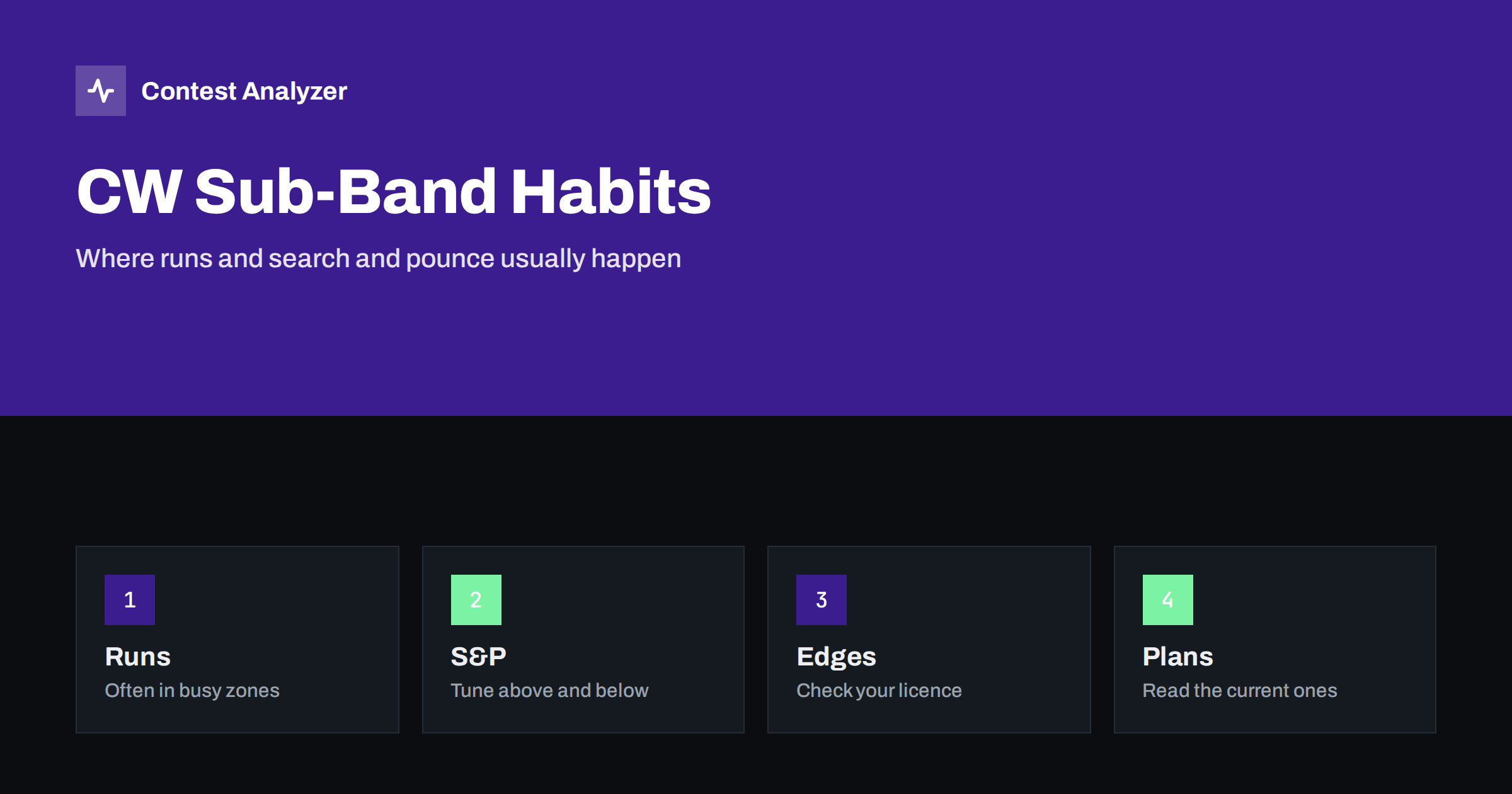
Short answer: In big CW contests the activity is not spread evenly over the CW part of each band. Habits, the band plan and the way the stations tune create busy zones where many runs sit, and quieter zones where operators search for new stations. These habits are not rules, they differ from band to band and from year to year, and the limits of your own licence and the current band plans always come first. Use the habits as a map and confirm them in your own statistics.
Habits are not rules
A band plan is a recommendation that is agreed by amateur radio societies. In some countries parts of it are also written into the licence conditions, and in others it is a gentlemen’s agreement. In a contest, the plan is strongly influenced by custom. Large contests such as CQ WW DX CW are so crowded that operators settle into zones that work for them, and these zones are repeated every year. A newcomer sees the same pattern in the first hour of the contest, even without knowing why.
It is important to separate three things: what the licence allows, what the band plan recommends and what the contest crowd does. Only the first one is a legal limit. The second is a good practice that you should follow. The third is a convenience that you can use or ignore. If you operate from a country with different limits, the pattern may be different. The article on band edges in the ITU Regions explains why the limits depend on the region.
Where runs usually settle
A run needs a clear frequency and a signal that is strong enough to attract callers. In practice, run frequencies in a big CW contest are spread over the main CW part of the band, with a higher density in the parts where most operators expect to find other stations. Some operators with a strong signal choose the busiest zones because the callers are there. Others choose a quieter zone because they can hold the frequency for longer. A quiet frequency may produce fewer QSOs per hour in the first minutes, but it may keep a steady rate for hours.
The best choice depends on the band, the time of day and your signal. For example, on a crowded band at the start of the contest, a clear frequency can be hard to find. On a band that is about to close, a frequency that has been used for a long time may lose its callers, and the operator needs to move. The article on the first hour of a contest explains how to find a frequency under pressure.
Where search and pounce happens
Search and pounce means tuning across the band and calling stations that are running. This activity is spread across the whole range where runs exist, because it follows them. Operators who search usually tune up or down the band in a steady direction and check each signal quickly. They often leave the busiest parts for the time when they need a multiplier, and they spend most of the time where the density of stations is high but the pileups are short.
It is useful to know the pattern when you plan how to spend an hour. If you are running, you may notice that stations that search for you come at certain times. If you are searching, you will see that the best new multipliers appear in the zones where stations with a strong signal choose to run. Read the article on run vs search and pounce to see how to measure the share of each in your statistics.
Quiet zones and the lower edge
Some parts of the band are quiet by custom, for example segments used for other modes, beacons or special activities, depending on the band plan of your region. Even if your licence allows you to transmit there, the other users expect you not to run in these segments. In a contest, this is also a matter of courtesy, and some contest rules describe where certain operations are not allowed. If in doubt, read the current rules of the contest and the band plan of your society.
Near the lower edge of the band, you must be careful that the signal does not extend beyond the limit. This depends on your equipment and on the filters that you use. The lowest frequencies of a band are also often used by stations who want to be the first in the pile, and the strongest signals sit there. If you operate close to an edge, check the frequency display of your radio and the band limits in your logger.
What changes with the band
The 160 m and 80 m bands are used in the evening and the night, and the available CW part is narrow compared with the number of stations. The 40 m band is crowded around the clock, and the neighbour from another service can add to the noise. On 20 m the activity is high during the day, and runs can stay in the same zone for a long time. On 15 m and 10 m the activity depends on the solar conditions, and a band that is open for a few hours is empty before and after. The article on solar flux and contest results describes how conditions change the picture.
A practical conclusion is that you should not copy a plan from a previous year without looking at the present conditions. Your own log from last year is a good guide, but the best guide is what you hear in the first minutes on each band.
What the habits mean for your log
For your log the main point is the frequency field. In a CW contest your frequency is recorded for every QSO, and the log checking looks at it in the context of the band limits. If you use a transverter, split operation or a second VFO, the value in the log may differ from the frequency that you meant. The article on split operation and logging and the one on frequency errors explain these cases. A wrong frequency can place a QSO outside the band, even if the operator was in the right place.
Contest Analyzer marks QSOs outside the contest period and outside the band limits for your ITU region, with split QSOs shown as a note, and it lets you edit time and frequency in the report. It also gives your QSOs by hour and band, which shows you where your effort went. It checks every callsign and every zone against official license databases and several independent reference sources. See the contests page for the list of supported contests.
Courtesy on a crowded band
When a band is full, small acts of courtesy keep the contest enjoyable for everyone. Listen before you start to call CQ, and ask if the frequency is in use when you are not sure. Do not move a run frequency by a small step into the signal of a neighbour, because this reduces the quality for both stations and may lead to key clicks and splatter being noticed. Keep the bandwidth of your signal reasonable, and use the filters of your transmitter and your receiver properly.
The same applies to search and pounce. Do not call on top of a station that is working somebody, and do not tune across a run with a loud signal of your own. A short wait costs less than a long argument about a frequency. Over a 48-hour contest, a quiet and orderly operator usually makes more QSOs than an aggressive one, because the callers remember who is easy to work.
These customs are not written in a table, but they are part of how contesting works. A newcomer learns them quickly by listening, and a regular contester teaches them to the next generation by example.
A simple way to learn the habits of your contest
- Listen for the first ten minutes on each band before you choose a frequency, and write the zones that are busy.
- After the contest, compare your rate on each band with the zone where you ran, using the notes that you made.
- Note the places where you lost a frequency, and the reason, such as a stronger neighbour or a change in propagation.
- Write the findings in your station notebook and use them the next year.
- Read the current band plan and the rules of the contest again before each event, because both can change.
Related reading
The bottom line
CW activity in a big contest follows habits that repeat from year to year, but they are habits and not rules. Know your licence limits, read the current band plan and learn the pattern of your own contest from your own statistics.
FAQ
Are run frequencies fixed by the contest rules?
No. They follow habit and conditions, within the limits of the licence and the current band plans.
Should I run in a busy zone or a quiet one?
It depends on your signal and the band. Try both and compare the rate in your statistics.
Can I transmit up to the band edge?
Only if your licence allows it and your signal stays inside the limit. Keep a margin and check your radio.
Where can I find the current band plan?
On the website of your national amateur radio society and of the contest sponsor.
Why does the frequency in my log matter?
It places each QSO on a band, and a wrong value can put a valid QSO outside the band limits.