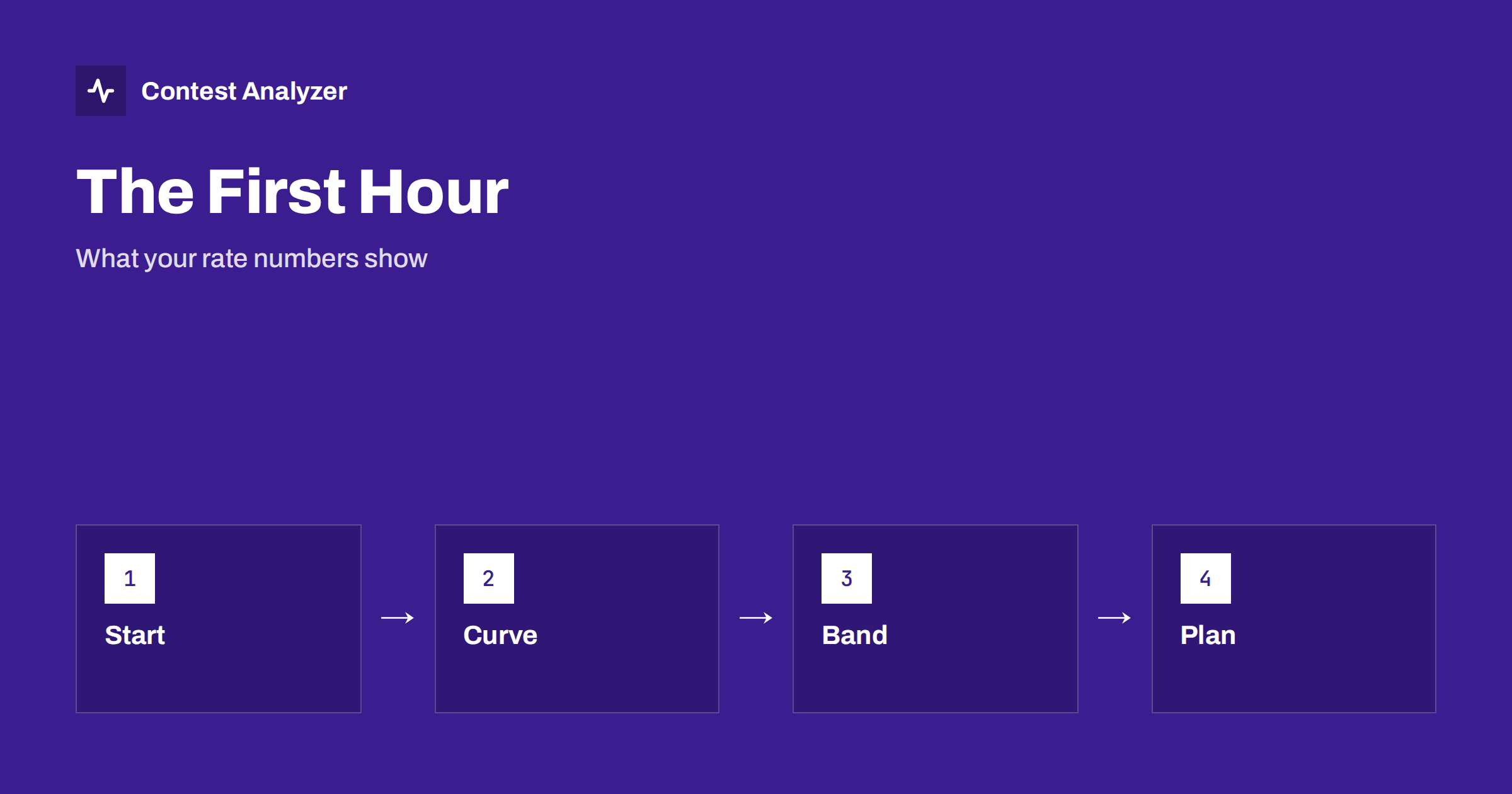
Short answer: The first hour of a contest sets the tone, and your statistics show it clearly: how quickly the first QSO came, how the rate climbed, which band you used and how much time went to searching instead of working. Compare that hour with your later hours and with last year’s first hour, and you will see whether your start was a plan or an accident.
Why the first hour is worth studying
Over a 24- or 48-hour contest, the first hour looks small. Yet it often contains the highest-rate period for the busiest band, because everyone is fresh and the stations that planned to be on are on. A slow or confused start can cost many QSOs, and it can also hurt in another way: a late start leaves less time for multipliers on bands that close early. The statistics reveal what happened.
For a view of the strategy itself, see our earlier article on starting strong in the first hour. This article is about the numbers you can pull from the log afterwards, and about what they say about your preparation.
Find the first QSO and the first ten
Start with two numbers. The first is the time of the first QSO after the start. Was it in the first minute, or the fifth? The difference may be a matter of the radio not being on the right frequency, the logger not being ready or the operator hesitating. The second is the time of the tenth QSO. If the first ten QSOs took fifteen minutes, you were searching rather than running, and that is worth knowing.
In a contest that has a clear start time in UTC, make sure that your first QSO does not appear before it. A QSO logged before the start is outside the period, and rules about that are strict. The article on QSOs before the start or after the end explains what to look for, and the clock article, wrong PC clock or UTC errors, explains a likely cause.
Read the rate curve of the hour
Next, look at how the rate behaved inside the hour. Listing QSOs in ten-minute blocks is enough. A healthy start is a rate that rises in the first quarter hour and then stays stable. A broken start looks like a long flat period followed by a jump, or a spike followed by a drop. Each pattern tells a story. A flat start suggests that you had difficulty finding a clear frequency or that you were not sure which band to start on. A spike followed by a drop suggests that you ran out of callers on that band, and you changed too late or too early.
Compare the hour with your best hour of the whole contest. If your best hour reached a rate twice as high as the first, the first hour had room for improvement. If the first hour was your best, it may mean that you did not keep the pace later, and the rate meter can help you hold it during the event. Use whichever comparison the numbers support.
The band you chose
The band split of the first hour tells you whether you started where the contest was happening. Many operators begin on the band that is usually the busiest at that time of day, and move at the first signs of decline. If your first hour was spent on a band that was quiet, you will see a low rate and long gaps. If you moved often, the log shows many band changes, which cost time. The article on band changes and rate describes the trade-off.
Your planning should rely on the previous year’s logs. Which band gave the best first hour last year, and was that a matter of luck or of propagation? Check the notes you made about conditions, and, if you can, the solar and geomagnetic data of the day. Then decide where to be at the start.
Running or searching
Look at the share of QSOs made while calling CQ and while searching for others. A good start usually has a long run on one frequency, if the band allows it. If the numbers show mostly search-and-pounce, you may have lacked a good frequency or a strong enough signal. If they show a short run, followed by a long search, it may mean that you gave up your frequency too early. The article on running and search-and-pounce shows how to measure each.
Think too about the type of contacts. The first hour often contains many nearby stations, because the band conditions favour them, and the callers from distant continents come later. A first hour dominated by very local QSOs is not wrong, but it may point to antennas, power or timing that could be changed.
Callsigns and accuracy in the first hour
The first hour is also a time of high energy and sometimes of careless typing. Look at the corrections you made later: how many came from the first hour? If a disproportionate share of the errors are in the first hour, you may want to slow down by a few percent in the opening minutes, or to check the logger settings before you start. The article on logger settings to check before a big contest lists the main ones.
Write down one change
The point of the review is a decision. Choose one thing to change for the next contest: an earlier start on the radio, a different first band, a better first frequency, a macro set that is ready or a checklist for the first ten minutes. Write it in your notebook with the date and the numbers that led to it. Next year, repeat the analysis and check whether the number improved, whether the first QSO came sooner and whether the early errors fell. A single, specific change is easier to test than a list.
Using a report
Contest Analyzer gives full statistics for your log: rates, QSOs by hour and band, countries, continents, zones and more, and it supports year-on-year comparison with your own logs. This makes it easy to put the first hours of several years side by side. It also checks every callsign and zone against official license databases and several independent reference sources and marks QSOs outside the contest period. Serial numbers are not checked. The contests page lists the supported events.
Compare with last year’s first hour
A single first hour tells you little unless you can put it next to another one. If you have uploaded the same contest in earlier years, compare four things: the time of the first QSO, the number of QSOs in the hour, the band mix and the number of countries or zones worked. Differences are meaningful only if the conditions were similar, so also look at your notes. A first hour that was weaker this year because of a geomagnetic storm is not a failure of planning, while a weaker one in a quiet year with the same station may be.
Keep the comparison fair. If the start time of the contest moved, if the category changed or if you changed antennas, say so in the notebook. The article on same contest, two years and the one on a station notebook show how to keep these records. After three or four seasons, you will have a real picture of what a normal first hour is for your station, and a good one stands out clearly.
Most of what the first hour shows was decided before the contest. A station that is tested the day before, with the logger configured, the keyer or voice messages loaded, the clock synchronised and the bands checked, produces a clean first hour. A station that is still being fixed in the last ten minutes produces a slow one. Make a list of what you will do in the final half hour: check the clock, check the exchange fields, test the microphone or keyer, select the first band and find a first frequency. The article on the final days before CQ WW CW contains a longer list that works for many contests.
Think, too, about your own condition, because the best preparation of the station cannot make up for an operator who is exhausted before the contest has begun. Starting a long contest tired is common, and a short rest before the start is part of the plan. Eat, drink and sit comfortably, because the habits of the first hour often continue for the whole event.
Related reading
- Reading Your Statistics After the First 24 Hours
- Your First Hour in a CW Contest: Plan and Expectations
- Hour-by-Hour Analysis of a Contest Log: Gaps and Peaks
The bottom line
Find the first QSO, the first ten and the rate in ten-minute blocks; check the band, the share of running and the errors; and write down one change. A short, honest look at the first hour is among the most productive pieces of analysis you can do.
FAQ
What is a good first-hour rate?
There is no universal number. Compare with your own previous first hours and with your best hour in the same contest.
Should I always start on the same band?
Not necessarily. Use last year’s logs and the current conditions to choose, and be ready to change quickly.
Can a slow start be recovered?
Often yes in a long contest, but a late start can cost multipliers on bands that close early.
How do I split the hour into blocks?
Count QSOs in ten-minute intervals by time. A spreadsheet or the hourly view of a report makes this easy.