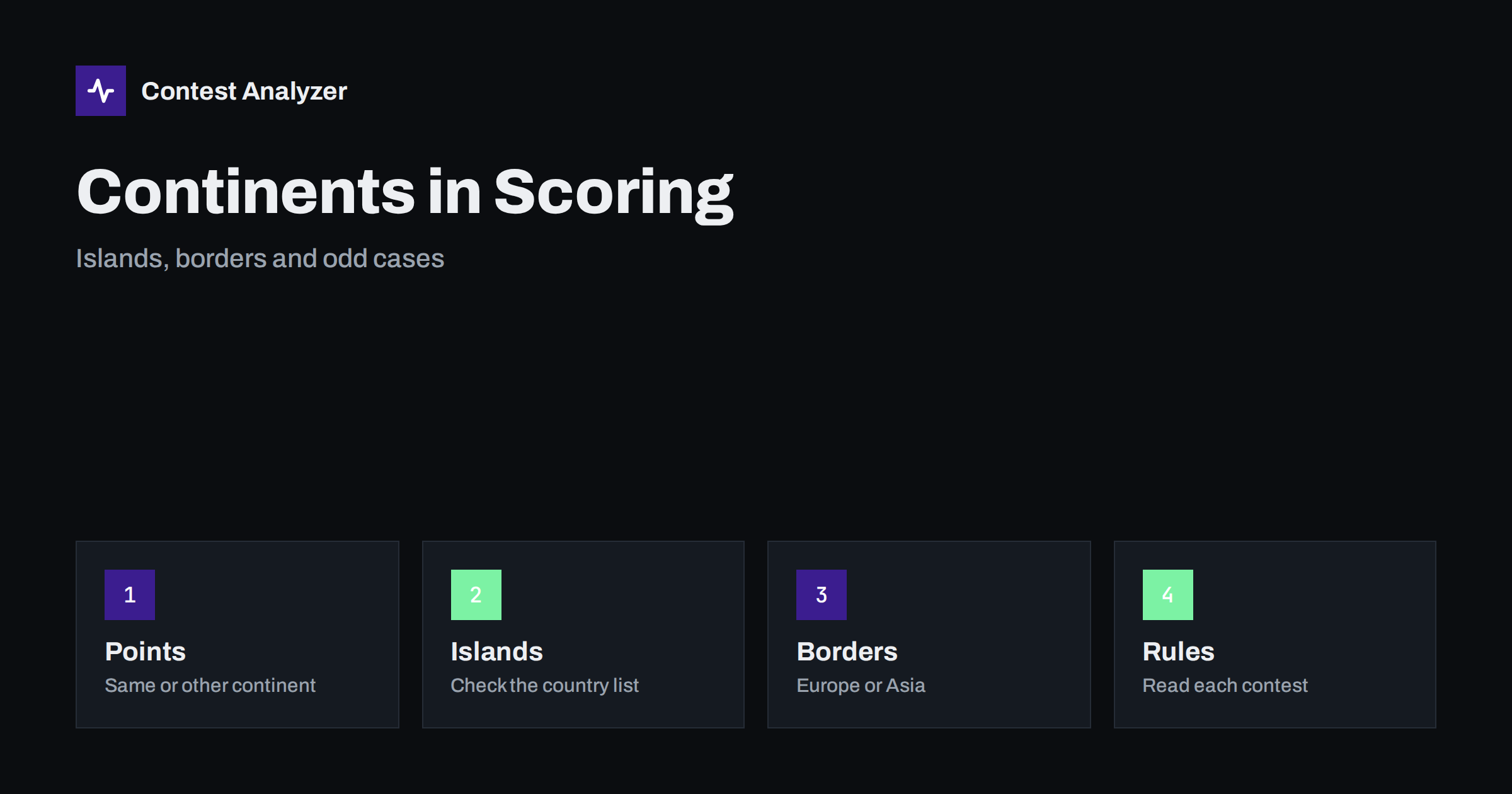
Short answer: Many contests use the continent of a station in the scoring: the QSO points may depend on whether the two stations are in the same continent, and in some contests continents are counted as multipliers or awards. The continent of a station follows from its country and, for a few countries, from its position. Islands and border countries sometimes belong to a surprising continent, so use a current country list and check the rules of the contest.
Where continents appear in contest scoring
The continent is used in several ways. The most common is the calculation of QSO points. In CQ WW DX, the points for a QSO depend on whether the two stations are in the same country, in the same continent or on different continents, so a station that works many stations on other continents gets more points per QSO than a station that works only its neighbours. Details are in QSO points in CQ WW, and the exact values must always be taken from the current official rules.
The second use is in awards and in statistics. Many operators track the number of continents they have worked, as an indicator of how well the bands were open. The third is as a multiplier or a bonus in some contests; this is not general, so check the rules of each contest. The article on continent breakdown of a contest log shows what the numbers can tell about your antennas and timing.
The six continents in the lists
Contest software commonly uses the following continent codes: Africa, Antarctica, Asia, Europe, North America, Oceania and South America. The lists are connected to the country list, such as the DXCC or the WAE lists. Each entity in the list has a continent assigned to it, together with its CQ and ITU zones. When you type a callsign, the logger looks up the prefix in the file and shows the entity, the zone and the continent.
It follows that the continent in your log is only as good as your country file. If the file is old, a new entity may be unknown, and a changed assignment may be wrong. The reasons to update it are in why you update the country file before a big contest, and the difference between the lists is in country multipliers: the DXCC list and the WAE list.
Countries on the border between continents
A few countries cover parts of two continents, and the lists deal with them in a way that depends on the rules of the list. Russia is the best known: the European part and the Asian part have different continents and different CQ zones, and the prefix and the call area help to tell them apart. Turkey has a small European part and a large Asian part, and in contest lists it is usually assigned to one continent for scoring. Do not rely on memory: look at the current country file and the rules of the contest.
For zones, the same border problem exists. The article on CQ zones explained shows how the zone and the continent are related for large countries. If the program shows a continent that surprises you, do not simply change it by hand. First check the callsign and the list.
Islands that count differently
Islands are a classic source of confusion. Their political ownership, their geographic position and their continent in the list are not always the same. An island that belongs to a European country may lie close to Africa or South America, and the contest list may assign it to the continent of its geographic position, to the continent of its owner or to a separate entity with its own prefix. Territories in the Pacific and the Atlantic are often counted as separate entities, with the continent of the nearest large landmass. Because the rules differ, the same island may count in a different way in two contests that use two different lists.
A practical example: some islands near the coast of Africa that belong to a European country are listed under Africa in the standard country lists, while some islands in the Atlantic that belong to the same country are listed under Europe. We do not give a table here, because it would become out of date, and the right source is the current list. The article on similar prefixes that are easy to confuse shows how a small change in the prefix can change the entity and with it the continent.
Portable, mobile and maritime stations
The continent of a portable station is, as a rule, that of the place from which it operates, and the callsign alone may not tell it. A station with the call of one country that operates from another may be on a different continent from the one that its prefix suggests. Maritime and aeronautical mobile stations are treated in special ways, and in many contests they do not count for points or multipliers, or count with special rules. The article on /P, /M, /MM and /AM in contests and the one on portable and maritime stations go through the main points.
When a station says that it is operating from a place other than its home, a short repeat of the location, or of the zone in contests where the zone is sent, helps you to log the right data. Use the exchange as the first guide, and the call lookup as the second.
Why a wrong continent matters
In a contest where the QSO points depend on the continent, a wrong continent changes your own score. If you log a station as being on the same continent when it is on another, you claim fewer points than you earned, and if you log it the other way you claim more than you earned. In the second case the check may reduce your score. In a contest where continents are multipliers or bonuses, a wrong continent can also give a false multiplier. It is therefore worth checking the continent for unusual QSOs.
You can see the continent in the statistics of your log. The continent breakdown shows the number of QSOs, the share of each continent and the points. A continent with an unexpectedly small or large share may reveal a problem in the country file. The article on DX versus same-continent QSOs shows how to read the shares.
Checking continents after the contest
Review the QSOs that have a continent different from the one that you expect. Most of them are normal, and a few may be errors in the call or in the list. Contest Analyzer shows countries, continents, CQ and ITU zones, WPX prefixes, distance and beam heading in full statistics. It checks every callsign and every zone against official license databases and several independent reference sources and shows only the few QSOs worth a second look. In the report you can edit calls, zones, time and frequency and download a corrected Cabrillo. It works with Cabrillo from N1MM Logger+, DXLog and Win-Test. See the contests page for the supported contests.
If you find that your logger gave the wrong continent for a prefix, report it to the author of the country file and update your file. Then check the points in your claimed score. The rules of each contest tell you whether the organisers will recalculate the points from the callsigns, which many do, or use the data from your log.
Antarctica, Oceania and the far corners of the list
Some continents rarely appear in a normal contest log, and they are the most likely to be misunderstood. Antarctic stations work with their own prefixes and calls that belong to the countries of their bases, and in the list they are counted as Antarctica irrespective of the country of the call. Oceania in the contest lists covers many small islands in the Pacific, together with Australia and New Zealand, and it is assigned to the entity through the prefix. A call from a distant Pacific island is very often a multiplier, and a wrong lookup in an old country file is a typical reason for a surprise in the result.
If you work such a station, look at the data that the logger shows. If the entity is not shown, or is shown as unknown, the country file is probably old. Do not guess; check the call against a current list after the contest, and correct the entity in the log if necessary. The article on planning for rare multipliers explains why these QSOs deserve a little extra care.
A short routine
- Update the country file before the contest, and check its date.
- Read the scoring section of the rules: how points and multipliers depend on continents.
- During the contest, look at the continent that the logger shows, especially for islands and border countries.
- After the contest, check unusual continents in your statistics.
- Note any differences in your station notebook for the next contest.
Related reading
- Multiplier strategy in CQ WW
- Openings to each continent hour by hour
- Zone errors with stations from multi-zone countries
The bottom line
Continents decide points or multipliers in many contests, and a few islands and border countries behave in surprising ways. Use a current country file, read the scoring rules and check the unusual continents in your own log.
FAQ
Do all contests use continents for scoring?
No. Many use them for QSO points, some for multipliers or awards, and some not at all. Read the current rules.
Why does an island have a surprising continent?
Lists assign continents by their own rules, and ownership and geography can differ. Check the current country list.
How can I find a wrong continent in my log?
Look at the continent breakdown and at the QSOs with unusual continents. Compare them with the call and the exchange.
Which source is the best for continents?
The country file used by your logger, kept up to date, and the list that the contest rules name.
Does a portable station change the continent?
It can. The continent follows the place of operation, not only the call.