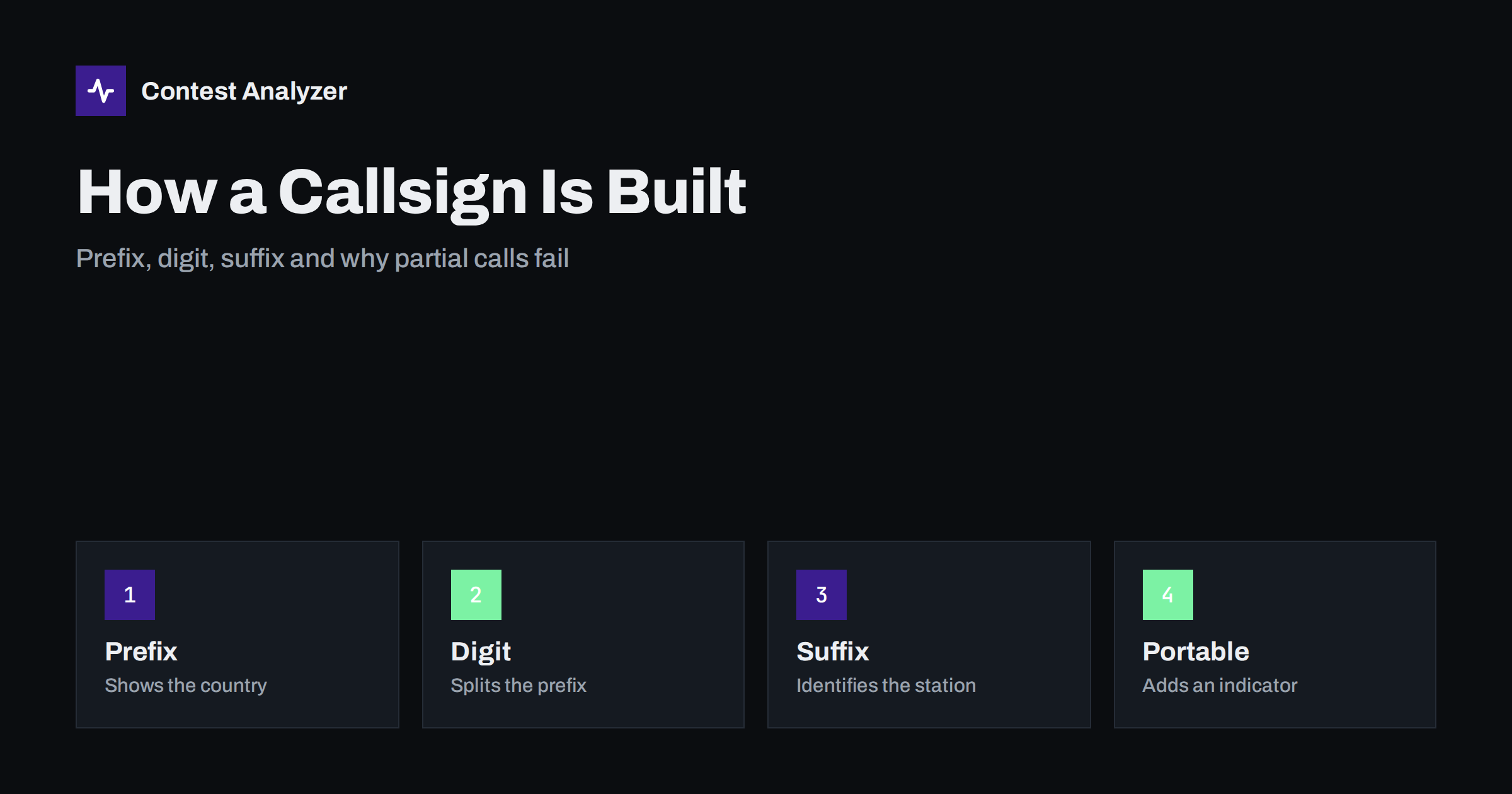
Short answer: A standard amateur callsign has three parts: a prefix of one or two characters that points to a country, a single digit, and a suffix of one to three letters that identifies the station. If any part is missing, the call cannot belong to a real licence, so a log checker has to treat it as an error. In a contest you should therefore log the whole call every time, and complete or remove half-copied calls before the log is submitted.
The three parts of a callsign
Take a call such as DL1ABC. DL is the prefix, 1 is the digit and ABC is the suffix. The prefix is allocated to a country by the international rules, and the country decides how the rest of the call is issued. The digit often indicates a region inside the country, or it is simply the last digit of the prefix block. The suffix is chosen or assigned by the national licensing authority and identifies the individual station.
The exact pattern differs between countries. Some calls have a one-letter prefix, such as W1AW or G3ABC. Some start with a digit, such as 4X4AA or 9A1A. Some have a prefix with two letters and a digit, followed by a long suffix. What stays the same is the logic: the call must contain at least one digit, and the digit separates the prefix from the suffix.
Why the digit matters so much
When you copy a call under noise, the digit is often the part you are most sure of, because it is short and distinct. Yet it is also the part that makes a call plausible or impossible. A call with no digit is not a call. A call with two digits in the wrong place is usually a copying error. In some countries the digit also tells you something about the zone or the region, and that is why a wrong digit can lead to a wrong zone in the log.
For the CQ WPX contest the digit is even more important, because the prefix is defined as the letters and the number up to the last digit. DL1ABC and DL2ABC have different prefixes, DL1 and DL2. A busted digit can therefore turn a new multiplier into a worthless one, or the other way round. The article on WPX prefixes explains how this works in detail.
Why the suffix is the weakest part when copying
The suffix is where most busted calls happen. It is made of one to three letters, and on SSB many letters sound alike. On CW, some letters are only one dot or dash different from each other. The prefix and the digit are usually familiar because you hear them every day, but the suffix is a random combination. This is why a station that sends the call once and quickly is more likely to be logged wrongly than a station that repeats it.
If you want to see what the typical confusions look like, read the articles on letters that sound alike on SSB and characters that are confused on CW. In both cases the error is in the suffix more often than in the prefix.
Portable indicators and extra parts
A call can be extended by an indicator after a slash, such as /P for portable, /M for mobile, /MM for maritime mobile or /QRP for low power. A call can also have a prefix before the slash, such as EA8/DL1ABC, which means that the operator with the home call DL1ABC is operating from the Canary Islands. The part that is used to decide the country and the zone is not always the part at the beginning. The rules of the contest and the official prefix lists decide how a call with an indicator is handled.
For logging, the safest way is to log exactly what the other operator sends and to keep the slash and the indicator. Do not drop the /P because you think it is not important. A different string is a different call in the log, and it may belong to a different country or zone. The article on portable and maritime stations gives more detail.
Special event and unusual calls
Not every call looks like the examples above. Special event stations often use calls with longer suffixes or with a different structure, for example calls with a number in the suffix or with a prefix that is used only for a limited time. Some countries issue calls with a long suffix in the contest period. Club stations may have a suffix that is a word or an abbreviation. These calls are real, and a good logger should accept them, but they are the ones most likely to be copied wrongly, because they do not look like the calls you know.
If you hear a call that you have never seen, ask for a repeat. A rare call is often a rare multiplier, and it is worth the extra seconds.
Why an incomplete call is removed from the log
Imagine that you log “DL1” or “K2” because the rest of the call was lost in the pileup, and you intend to correct it later. If you forget, the log contains a string that cannot belong to any station. The checking of a contest log in general terms is always based on the idea that a QSO needs two correct calls, one from each side. An incomplete call cannot match a real station, so it is removed, and in many contests there is an additional penalty. The article on busted callsigns describes what a busted call costs.
The right habit is simple. If you could not copy the whole call, either complete it before the end of the contest from your notes or the recording, or delete the QSO. A QSO that you cannot complete is not worth the risk of a penalty. The article on partial copies describes the practice in detail.
Habits that keep calls complete
A few small habits make a large difference. First, type the call as soon as you hear the first part, and then correct it while the other station is still sending, instead of waiting for the end. Most loggers show the partial entry, and the visual check often reveals a missing letter before the QSO is saved. Second, do not press the key that sends your exchange before the call field looks right. A wrong call sent back to the other station is also a signal to that station that something was not copied, and it may lead to a repeat that you could have avoided.
Third, use the help that the logger offers in the right way. A list of known calls shown while you type can confirm that the suffix you copied exists, but it can also lead you to accept a similar call that is not the one you heard. The article on Super Check Partial describes both sides. Fourth, if the other station is weak, do not guess. A short question such as the call with a question mark costs two seconds. A busted call costs the QSO and, in many contests, a second QSO as well.
Finally, write down in your notes the calls that you did not trust at the moment of logging. During the review after the contest you can come back to them and listen to your recording. The article on recording audio during a contest explains how to use the recording for this purpose.
How to read a callsign quickly
- Find the digit. Everything before it is the prefix, everything after it is the suffix.
- Check that the prefix belongs to a country that is active in the contest. A prefix that you never see is suspicious.
- Check that the suffix has one to three letters in the usual case, and that it does not contain characters that do not exist in the alphabet of calls.
- Look for a slash. If there is one, find out which part decides the country.
- If the call is rare, listen for the repeat before you log it.
This takes a second after some practice, and it avoids a large share of the typing errors that appear when the operator is tired.
What a checking report shows about callsigns
When you look at a finished log, a few simple questions help to find the problem calls. Are there calls without a digit? Are there calls with unusual lengths? Are there calls that appear only once and whose prefix you do not recognise? Contest Analyzer checks every callsign and every zone against official license databases and several independent reference sources and shows only the few QSOs worth a second look. You can edit the call in the report, mark the QSO as checked in your own audio recording and download a corrected Cabrillo. It works with Cabrillo from N1MM Logger+, DXLog and Win-Test, and the contests page lists the 22 contests that are supported.
Related reading
The bottom line
A callsign is a prefix, a digit and a suffix, with optional indicators, and all parts must be in the log. Learn to see the structure at a glance, ask for a repeat when a part is missing and never leave a half-copied call for the checker to find.
FAQ
Does every callsign contain a digit?
Yes, a standard amateur callsign contains at least one digit, which separates the prefix from the suffix.
Which part of a call is copied wrongly most often?
The suffix, because it is a short random combination of letters that often sound alike.
Should I log the /P after a callsign?
Yes, log exactly what the other station sends, including the indicator.
What happens to a call without a suffix in the log?
It cannot match any station, so it is removed, and some contests apply a penalty.
Can I complete a partial call after the contest?
Only if you can prove the full call, for example from your own audio recording. Otherwise remove the QSO.