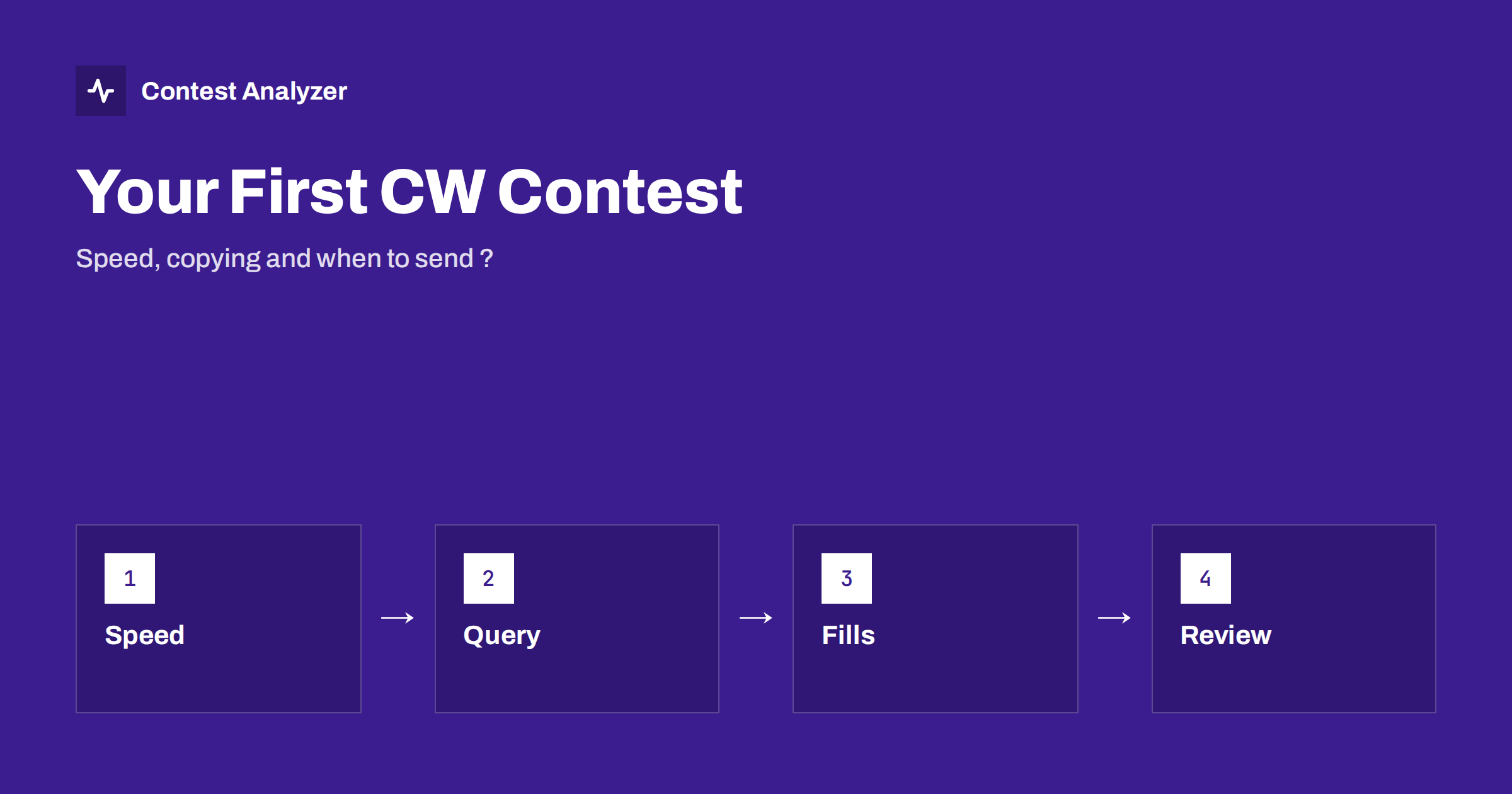
Short answer: In your first CW contest, accuracy is worth more than speed. Choose a speed at which you can copy a whole callsign and exchange without panic, send a question mark or ask for a repeat whenever you are unsure, and do not log what you did not hear. Many beginners lose more QSOs to busted calls than to slow operating, so a clean log of fewer QSOs is a good first result.
Start with the right goal
The goal of a first CW contest is not a high score. It is to complete a clean log, to get used to the pace and to learn what goes wrong. If you make fifty or a hundred QSOs and most of them are correct, you have done well, since you will have practised the exchange and the logger and seen the whole cycle from the first QSO to the submission. The score grows with experience, and the accuracy that you build in the first contest remains. The article on your first HF contest explains the general choice of contest, category and logger, and this article is about the CW side.
Choose a speed you can copy
In a contest, many stations send faster than in a normal QSO, and some send at a speed that is a challenge for an experienced operator. You do not have to follow them. Call stations that send at a speed you can copy, and reply at that speed or a little slower. Many operators answer at the speed of the station they call, and in a busy contest this is natural, but a beginner can send slowly and many stations will slow down, since a slow reply is a signal that the operator needs time.
When you call CQ, send at a speed that you can copy, because those who answer will usually send at your speed or a little faster. If you send a fast CQ and a station replies at the same speed, you must copy it. A slower CQ attracts stations that you can copy. If you find that the callers are faster than you can copy, slow your speed. It costs little rate and saves many errors. The article on CW copying accuracy in contests discusses speed, fills and repeats in more detail.
Copy the callsign first
The callsign is the most important part of the exchange for the log, since a wrong callsign makes the whole QSO invalid. In CW, callsigns are made of letters and numbers that are sent quickly and can be confused. Listen to the whole callsign before you start to write it, and do not commit to the first letters that you heard. If you hear only a part, do not log a guess. The usual confusions in CW are described in the article on CW characters that get confused, and it is worth reading before your first contest.
Use the logger. Most programs show a partial callsign list as you type, and you can use this to confirm a callsign that you almost heard; the article on Super Check Partial while operating explains the help and the traps. The list tells you which callsigns are possible, but it does not tell you what the other station sent, so listen to the end of the callsign.
When to send a question mark
A question mark, or the call with a question mark added, is the simplest way to say that you did not hear well. Send it early and without embarrassment. If you heard part of a callsign, send that part with a question mark, and the station will repeat the callsign. If you did not hear the exchange, send a question mark after the callsign or ask for the item that you missed. In a contest, experienced stations repeat quickly, so a question mark usually costs a few seconds. It costs less than a busted call, which costs a QSO and may cost more than a QSO in the final score.
- Send the call with a question mark if you heard only part of it. The station will send the callsign again.
- Send a question mark alone if you heard nothing useful. The station will usually send everything again.
- Ask for the item, such as the zone or the number, if only that was lost.
- Do not send a question mark after a callsign that you copied fully. This slows the QSO and may make the other station think that you have a problem.
The article on partial callsign copies gives more advice on when to ask and how.
Learn the exchange before the start
Before the contest, read the rules and write down the exchange for the contest. For CQ WW DX, the exchange is the signal report and the CQ zone; for CQ WPX, it is a report and a serial number. Prepare the messages in the logger and learn the usual forms of the numbers, since in CW the digits are often shortened. The article on cut numbers in CW contests explains this, and you should know it before you hear it on the air. Practise sending and receiving the exchange with a friend or with a practice program, so that the main part is automatic.
Log carefully and look at the screen
When the QSO is finished, look at the callsign and the exchange on the screen before you send the final message. If you see a letter that you are not sure about, it is better to ask than to log. Many beginners type fast and look at the screen only at the end of the contest. A quick look at the end of each QSO catches errors while the other station is still on the frequency. If your logger has a function to repeat the call or to ask for a fill, learn it before the start.
Try to keep a steady rhythm. A beginner often feels that every QSO must be fast, but a steady and clear exchange creates a better rate than a rushed one with many repeats. Take short breaks, drink water and, if you feel the attention falling, slow down for a few minutes. The article on operator fatigue in 48-hour contests is written for longer contests, but its ideas apply to every length.
After the contest: read the log
When the contest is over, do not submit at once. Open the log and read it. Find the callsigns that appear only once and look unusual, the QSOs where you remember an uncertain copy and the places where you made an unusual number of corrections. Compare what you find with your memory of the contest. This is the best lesson of a first contest, since each error shows what to improve. The article on the post-contest review routine gives a method.
Contest Analyzer helps you in this review. It checks every callsign and every zone against official license databases and several independent reference sources and shows only the few QSOs worth a second look, so a beginner does not have to read the whole log. You can edit calls or zones in the report and download a corrected Cabrillo. The report also gives full statistics, with rates, QSOs by hour and band, countries, continents, CQ and ITU zones, WPX prefixes, distance, beam heading, breaks and off time, and callsign length and structure, and later you can compare with your own logs from earlier years, which is a good way to see your progress. It works with Cabrillo from N1MM Logger+, DXLog and Win-Test and supports 22 contests, as listed on the contests page. Dupes are not errors, and serial numbers are not checked.
What to expect on the band
Expect the first hour to feel too fast. Many stations call at once, signals overlap, and the same callsigns come back several times. This is normal, and it becomes easier within a few hours as your ear adjusts. If a pile of callers is too hard, move to a quieter frequency and call CQ there, or tune across the band and answer stations that call CQ at a comfortable speed. You do not need to work everyone. Each clean QSO counts, and the confidence that you gain in the first hours will carry you through the rest of the weekend.
A starting plan for the first weekend
- Read the rules and write the exchange on a card near the radio.
- Prepare the messages in the logger and test them with a few trial QSOs.
- Start with calling stations that send at a speed you can copy.
- Use a question mark and ask for fills without hesitation.
- Look at the screen after each QSO and clear the fields before the next.
- Stop when you are tired, and do not try to make up for it at the end.
- Read the log after the contest and write down three lessons.
Related reading
The bottom line
Your first CW contest is a lesson in accuracy. Choose a speed you can copy, send a question mark when you are unsure, learn the exchange before the start and read your log after the contest. A clean log of fewer QSOs is a better start than a long log full of busted calls.
FAQ
What speed should I use in my first CW contest?
A speed at which you can copy a whole callsign and exchange without panic. Slow down if callers are faster than you can copy.
Is it rude to ask for a repeat?
No. In contests, experienced stations repeat quickly, and a repeat costs less than a busted call.
Should I log a callsign I only partly heard?
No. Ask for the callsign again. A guess may produce a busted call, which can cost the QSO.
How many QSOs are a good first result?
A clean log of fifty or a hundred QSOs is a good start. Accuracy is worth more than the number.
What should I do after the contest?
Read the log, look at the doubtful QSOs, correct what you are sure of and submit before the deadline.