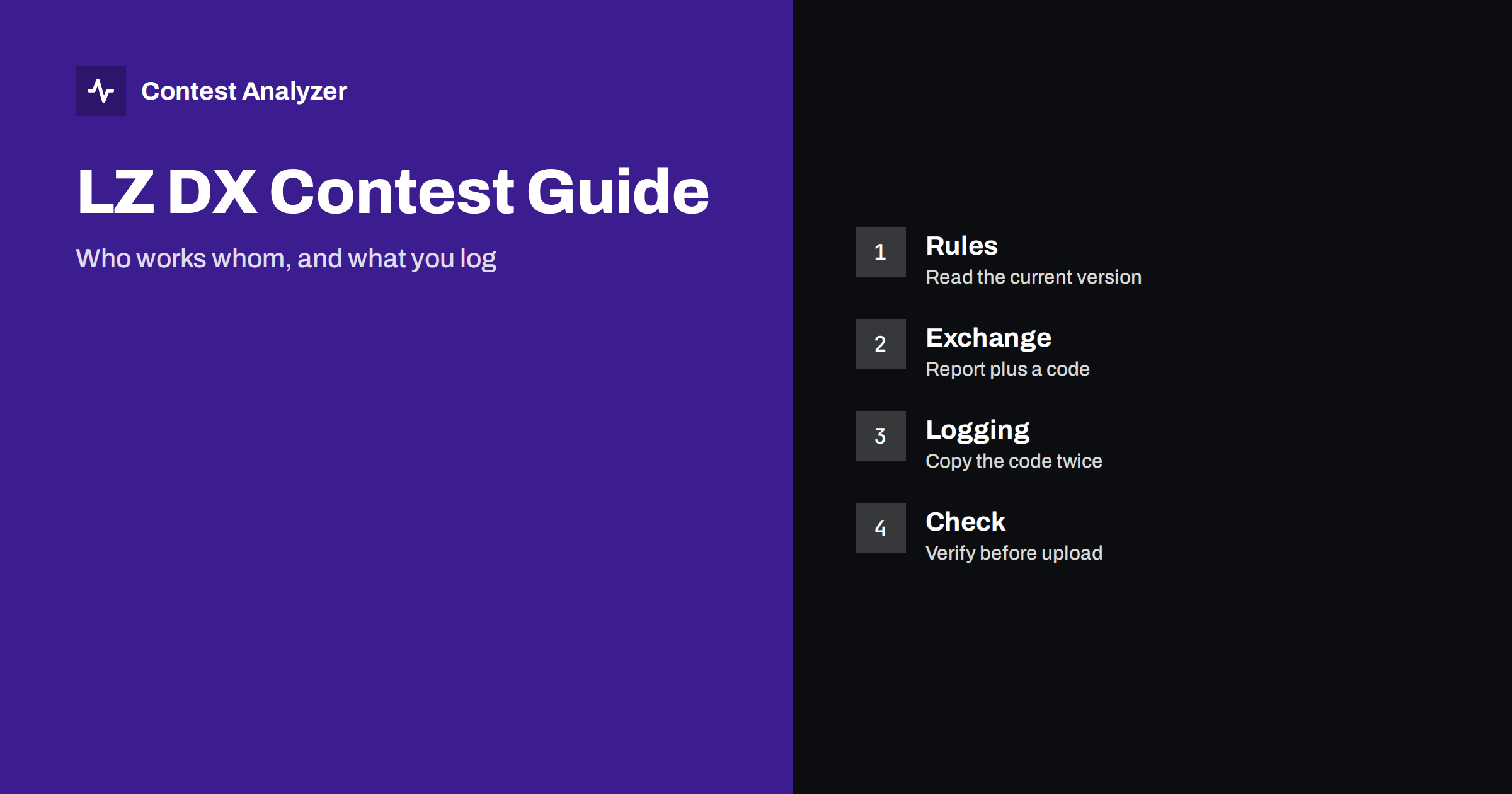
Short answer: The LZ DX Contest is an HF contest organised by Bulgarian amateurs, in which stations around the world work stations in Bulgaria and, in general terms, Bulgarian stations work everyone. The exchange is a signal report plus a code, and the code depends on where the station is located. Because rules, categories, bands and times can change between editions, read the current official rules before you plan your operation.
What kind of contest is it
The LZ DX Contest belongs to the group of national DX contests, like those of many other countries, that invite the world to make contacts with stations in one country. For stations outside Bulgaria the contest is a chance to collect Bulgarian callsigns, and for Bulgarian stations it is a chance to work the whole world over a weekend. It is not as big as the large worldwide contests, so it is a good one for operators who want a quieter event with a clear goal.
As with every national contest, the mood is different from the giants. There are fewer participants, the rates are lower for most stations, and the stations that are workable from your location depend on propagation. A station in a distant part of the world will see few Bulgarian signals at some hours and many at others, so time on each band matters. The article on band strategy hour by hour shows how to read your own numbers for this kind of planning.
Who works whom
In general terms, the contest asks Bulgarian stations to work stations anywhere in the world and the stations outside Bulgaria to work Bulgarian stations. Whether contacts between two stations outside Bulgaria count, and whether contacts between two Bulgarian stations count, is something that the rules decide. Read this part first, because it determines how you plan the weekend. An operator who thinks that every QSO counts and later learns that only part of them do can lose a lot of effort.
The same warning applies to bands, modes and operating periods. Many contests of this type have separate sections for different modes, and some have separate periods. Always read the current rules for the allowed bands, the modes, the duration and the categories. Do not rely on memory from a previous year.
The exchange in general terms
The exchange is usually a signal report plus a code. Stations in Bulgaria send a code that depends on their location, and stations elsewhere send a code that follows the rules of the contest, such as a serial number or a zone. Check the current rules for the exact definition. The point for your log is the same in both cases: the code must be copied and entered correctly, because a QSO with a wrong code can be reduced or removed when the logs are checked.
For a code that is made of letters, copy exactly what you hear, and ask for a repeat of the letters when you are not sure. Do not complete a partly heard code from memory of earlier QSOs. For codes that are numbers, see the general guidance on cut numbers in CW exchanges, which matters when you work CW. The checking logic is that a code is either right or wrong, and an almost right code is as bad as a wrong one.
Logging the code correctly
Most loggers have a template for this contest or let you define an exchange with a custom field. Before the start, test that the logger accepts the code format in the right order and that it writes the field to the Cabrillo file in the way that the contest requires. A wrong column order is a common cause of a rejected QSO, and the article on the Cabrillo QSO line format shows what each column holds.
It helps to keep a list of valid codes in front of you. The organisers usually publish the list, and some loggers can load it so that a typed code is checked against it. Use the list as a help, not a replacement for listening. A typed code that exists on the list but was not sent by the other station is still an error.
Planning your weekend
A plan for a national DX contest has three parts. The first is the time: decide how many hours you want to operate, and when. The second is the band: the best bands for Bulgarian signals depend on your location and the season, and a good approach is to look at last year’s log if you have one. The third is the mode: if the contest has separate parts for CW and SSB, decide which part gives you the most contacts for the effort.
Use the previous year’s statistics when you can. If you worked this contest before, look at your QSOs by hour and band and at the countries and continents that were easy. The article on year-on-year comparison of the same contest explains how to read that data without fooling yourself. If this is your first time, be modest: aim for a clean log and a result that you can improve next year.
Typical mistakes in this kind of contest
- Wrong code: a letter code copied from a weak signal and not confirmed.
- Wrong report: a stock report that is never changed, even when it should reflect the exchange in the rules.
- Wrong band in the log: a band change that the logger did not see.
- Mixed up callsigns: a similar call from another country copied as a Bulgarian one, or the other way round.
- Ignoring the rules for duplicate contacts: working the same station several times when the rules allow it only once per band or mode.
Most of these are problems of habit, not of knowledge. A short list on a card next to the radio helps, as does a sharp look at your first twenty QSOs to see whether the logger records everything as you expect.
Checking the log before you send it
After the contest, check the log before you submit. Look at the header, the category, the contest period, the bands, the exchange columns and the callsigns. Use the practical list in checking your contest log before you submit and in the article on log checking reports for what a committee looks at.
Contest Analyzer checks every callsign and every zone against official license databases and several independent reference sources and shows only the few QSOs worth a second look. It also marks QSOs outside the contest period and outside the band limits for your ITU region, with split QSOs shown as a note. You get full statistics, you can edit calls, zones, time and frequency in the report, mark QSOs checked in your own audio recording, duplicate a QSO line and download a corrected Cabrillo. It works with Cabrillo from N1MM Logger+, DXLog and Win-Test. Serial numbers are not checked, and the code in this contest should be checked by you. The supported contests are listed on the contests page.
Learning from the result
When the results appear, compare your claimed score with the published one, and look at the differences. Which QSOs were removed, and why? Was it a wrong code, a busted call or a missing log on the other side? The article on claimed versus final contest score describes how to read the gap. Use what you learn when you plan the next year.
Keep a short note for yourself: what worked, which band was best, how long you operated, and which mistakes repeated. A page of notes is a simple way to make progress from year to year, even when the contest itself is small.
A few practical details are worth settling before the weekend. Decide in advance how you will handle the contacts that you are not sure about: a partial call, a code that you could not confirm, or a station that faded in the middle of the exchange. The safest policy is to ask once more, and if the answer does not come, to leave the QSO out of the log rather than to guess. A QSO that you skip costs one point, while a guessed one can cost the point and later raise doubts about the rest of the log.
Think also about your own signal. A station outside Europe with a modest antenna will do better by calling at the right moments than by calling all the time. Listen for the pauses between Bulgarian stations, and call when the pile-up is small. If you run a high rate in other contests, be ready to slow down a little in this one, because the callers are fewer and the exchange needs attention. A relaxed rate with few errors gives a better final score than a fast one with many corrections.
Finally, keep notes during the contest. Write down which bands were open at which hours, which Bulgarian stations were loud and which codes caused trouble. These notes are small, but they are the best input for the next edition, and they cost only a few seconds each. A short page of notes at the end of the weekend is worth more than a long memory of how the contest felt.
Related reading
The bottom line
Treat the LZ DX Contest as a focused event: learn the exchange, check who works whom, copy the code carefully and check your log before submitting. Read the current official rules for every detail.
FAQ
Do all stations send the same exchange?
No. In general the exchange depends on where the station is located. Check the current rules for the exact definition.
Can I work Bulgarian stations on every band?
That depends on the bands the contest allows. Read the current rules for the bands and modes.
What is the biggest risk for my score?
A wrong code or a busted callsign. Both are avoided by listening carefully and asking for a repeat.
Is there a Cabrillo log requirement?
Most contests require a Cabrillo file. Check the current rules for the format and the deadline.
Does Contest Analyzer check the code?
It checks callsigns and zones. The rest of the exchange remains your responsibility.