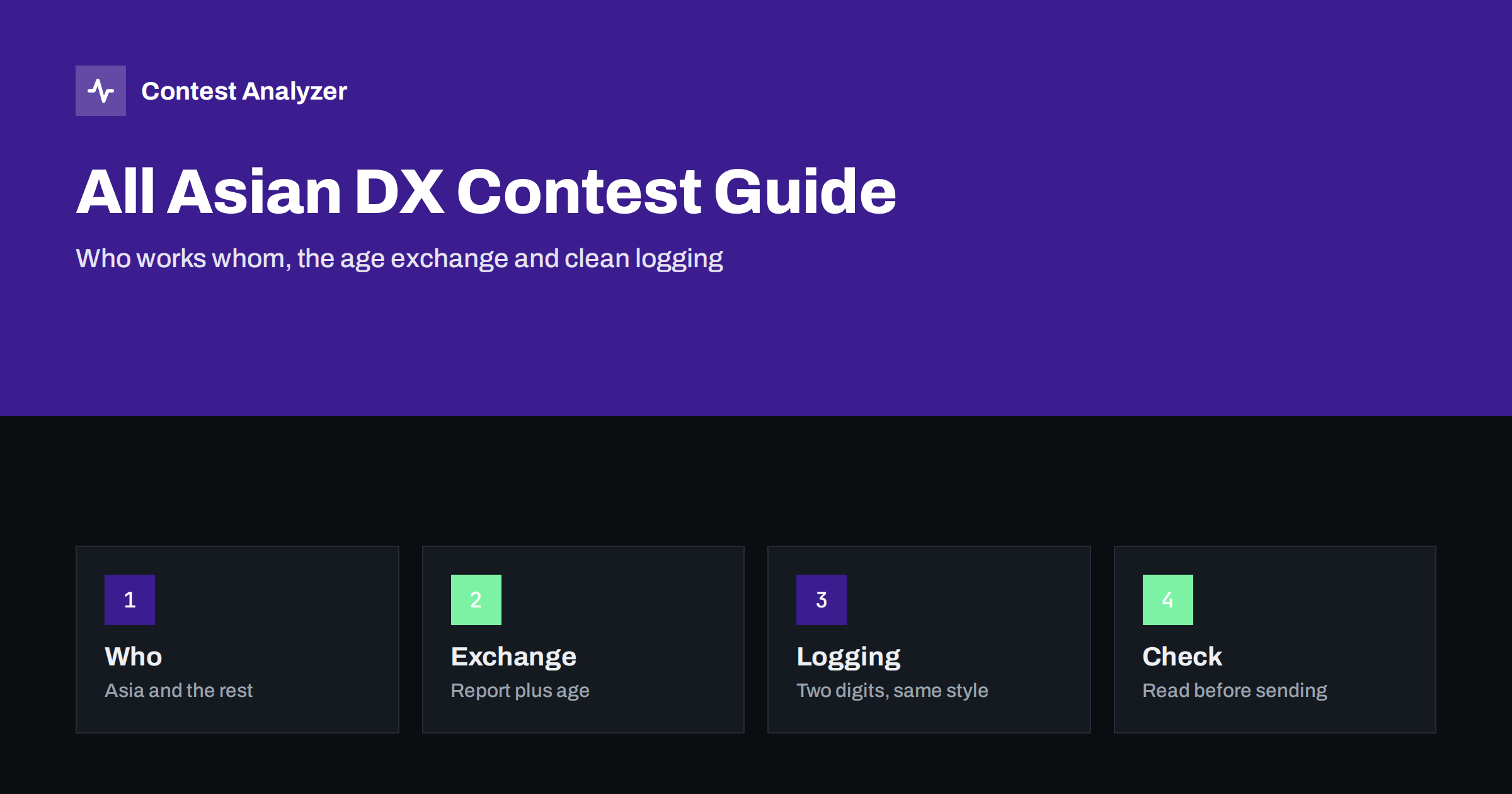
Short answer: The All Asian DX Contest is organized by the Japan Amateur Radio League (JARL), and its structure centers on contacts between Asia and the rest of the world. The exchange is a signal report plus a two-digit number that is, in general terms, the operator’s age. Details such as which contacts count, how multi-operator stations choose the number and how the multipliers are defined are set in the official rules and can change, so read them for the current year. This article gives the general picture and the logging habits that keep the log clean.
What the contest is
The All Asian DX Contest is a long-running international HF contest run by the JARL. It is held in separate parts for different modes, and each part has its own dates and its own log. As with other contests, the sponsor publishes the rules each year, including the bands, the periods, the categories and the log deadline. Always take those details from the official source and not from an older article, from a forum or from memory.
What makes the contest recognizable is its geographic idea. The contest is organized around Asia: stations in Asia and stations elsewhere in the world have different roles, and the contest is a chance for operators from all continents to contact Asian stations, some of which are rarely heard in other contests. For a DX operator it is a good opportunity for new countries; for an Asian operator, it is a chance to work stations from many continents.
Who works whom
In general terms, the contest is built around contacts between Asia and the rest of the world. Whether a contact between two stations on the same continent counts, and how it is scored, is defined in the rules and has differed between versions of the contest, so it is something you should read rather than assume. If you operate outside Asia, the practical consequence is that you will mostly call CQ for Asian stations to answer, or tune for Asian stations that are calling CQ. If you operate from Asia, you will be the one in demand.
It is worth thinking about this before the contest. If your station is outside Asia, the direction of your antennas, and the time of day when the path to Asia is open, will decide your results. Our article on beam heading and distance statistics shows how to see where your QSOs come from, and the same method works well for planning a contest around a single target region.
The exchange: report plus age
The exchange has two parts. The first is the signal report, normally 59 in phone and 599 in CW. The second is a two-digit number that, in general terms, is the age of the operator. This is unusual among large contests, where the second element is a zone, a state or a serial number, and it gives the contest a personal character: you are sending a fact about yourself.
The following points matter in practice:
- Know your number. If you operate alone, you know your age. If several operators use the same callsign, check the rules for what a multi-operator station is supposed to send, and agree on it in advance.
- Two digits, always. A single-digit age is normally sent with a leading zero. Check how the logger stores it.
- Copy the number you hear. The age you receive is not predictable from the callsign, so the logger cannot suggest it. Treat it like a serial number: listen and log what was sent.
- Use the same style every time. The same wording of the exchange in every QSO, so that other operators can learn it quickly.
Because the exact wording of the exchange rules is the sponsor’s, read them at the start of each season.
Setting up the logger
Most popular contest loggers can handle this contest, but you should check that your version has it, and that its definition matches the current rules. If it does not, you may have to use a generic setup or update the program. This is the same kind of preparation that we describe for CQ WW in our N1MM Logger+ setup article.
- Select the contest and the mode (phone or CW, depending on the part you operate).
- Set your callsign, category and the exchange you will send, including your own two-digit number.
- Update the country data file, so that the logger knows the current prefixes and countries. This helps with your own planning and with identifying Asian stations.
- Check the clock. The contest period is defined in UTC; if your PC clock is wrong, QSOs may fall outside it. See our article on UTC clock errors.
- Make a test QSO and export a Cabrillo file, to see the exchange columns before the contest begins.
Typical logging mistakes
The contest has a short exchange, and the typical mistakes follow from that:
- Wrong digits in the age. A pair of digits misheard or mistyped. Because the age is not a number the logger can verify, the log will show whatever you entered.
- Callsigns copied with a wrong suffix. Under pileup conditions, callsigns from rarely heard countries are copied by guessing. Confirm them. See our article on busted callsigns.
- Mixed-up fields. Report and age in the wrong columns when the exchange is typed by hand.
- The wrong part of the contest. Logging a CW part into a phone contest setup, or the reverse, which produces a wrong mode in the file.
Preparing the operation
The approach depends on where you are. A station in Europe or North America usually has a limited window with a good path to Asia, and it should be planned in advance. Look at past results and past logs: at what time, on which band, did you work the most Asian stations? Our article on band strategy by hour shows how to read your own QSOs by hour and band. Use the same data, if you have it, to choose the hours where you will spend your effort, and plan your rest for the hours when the path is closed.
Plan your breaks according to the rules for your category. Rest at the wrong hour costs more than rest at the right hour, and a short, well-chosen pause is better than falling asleep at the key during the best opening.
Phone and CW: practical differences
The contest has separate parts for different modes, and the way you handle the exchange changes with the mode. In phone, the age is spoken as two digits, and the risk is that two similar-sounding numbers are confused when the signal is weak. In CW, the number is short and fast, and the risk is a wrongly decoded digit. In both cases the best technique is the same: copy the whole exchange before you answer, ask for a repeat when you are unsure and say your own exchange clearly and at a steady pace.
Callsigns from Asia can be unfamiliar to operators in other continents. Prefixes and suffix styles differ from country to country, and a callsign that you hear only once can easily be written down wrongly. It helps to know the typical formats of the countries you expect to work, and to use the logger’s country data to see whether the prefix you copied is possible. If the entity does not match what you expected, ask for the call again.
Using your statistics to improve next year
A contest with a clear target region lends itself to analysis. After the weekend, look at the QSOs by hour and band, the countries and continents you worked, and the distances. The questions to ask are practical ones. When did the path to Asia open and close? Which band gave the most contacts at which hour? How long were the gaps between QSOs, and were they planned breaks or lost time? Our guide to comparing contest results from year to year shows how to put this on a common footing, so that you see real change and not just the effect of conditions.
After the contest: check and send
Export the Cabrillo file, check the header and the category, and read through the QSO lines. Look at the callsigns, especially the unusual ones, and at the exchange columns, because each one holds the age you logged. Then upload the file according to the instructions in the rules, before the deadline.
Contest Analyzer checks every callsign and every zone against official license databases and several independent reference sources and shows only the few QSOs worth a second look. It gives you full statistics and a year-on-year comparison with your own logs, and you can edit calls in the report and download a corrected Cabrillo. Serial numbers are not checked and dupes are not errors. Before relying on it for a particular contest, check the list of supported contests.
Related reading
- ARRL International DX Contest exchange guide
- Beam heading and distance statistics
- Band strategy hour by hour
- How to check a contest log before you submit it
The bottom line
The All Asian DX Contest is a friendly contest with an unusual exchange and a clear geographic idea. Learn who works whom from the current rules, agree on the number your station sends, listen carefully for the number you receive and read your log before you submit it. The sponsor’s rules decide the details; this guide helps you to be ready for them.
FAQ
Who organizes the All Asian DX Contest?
The Japan Amateur Radio League (JARL). Dates, categories and the log deadline are published in its official rules each year.
What is the exchange?
A signal report and a two-digit number that is, in general terms, the operator’s age. Check the rules for details, for example what a multi-operator station sends.
Do I need a zone or a state in the exchange?
No. This contest uses the age number in place of a zone, a state or a serial number.
Are all contacts valid for points?
That depends on the rules for the year, which define who works whom and how contacts are scored. Read them before the start.