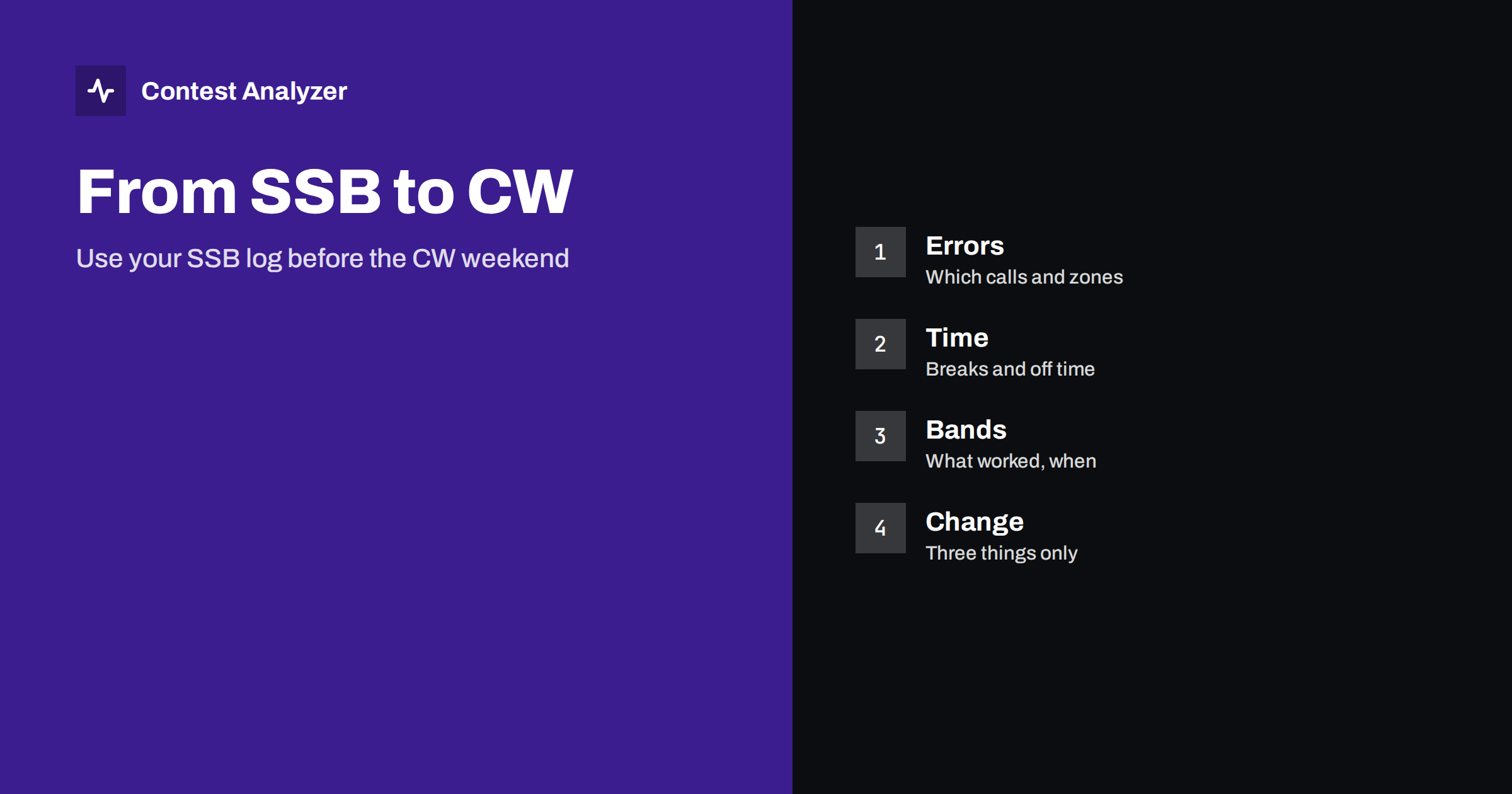
Short answer: CQ WW DX is held twice, with an SSB weekend and a CW weekend about a month apart, and the SSB log is the best preparation you have for the CW one. The modes are different, and so are many of the errors, but the structure of your weekend, the bands, the hours, the breaks and the zones you got wrong is similar. Review the SSB log, write down no more than three things to change, and test them in CW. Check the current rules of both weekends, because details can change.
Why the SSB weekend helps the CW one
The two CQ WW weekends are the same contest in two modes. The exchange, the zones and the multipliers are the same, and so is the logic of the score. The logger is the same, the antennas are the same, and in most cases the operator is the same. The main difference is the mode, and with it the type of the errors and the pace of the work.
The time between the two weekends is short, but it is long enough for a review and a few small changes. Many operators spend this time resting, which is reasonable, but a few evenings of analysis can lead to real improvements. The SSB log shows what happened in your own station and your own contest, and it is a better guide than any general advice.
Step 1: review the log of the SSB weekend
Begin with the same review that you would do for any contest. Export the Cabrillo file, keep a copy and look at the doubtful QSOs. Contest Analyzer checks every callsign and every zone against official license databases and several independent reference sources and shows only the few QSOs worth a second look. Correct what you are sure about, and note what the corrections have in common. Did most of them come from certain hours? From a particular band? From stations of a particular region? Did the zone errors come from the same countries? These patterns do not depend on the mode, and you can use them in the CW weekend.
The report also gives full statistics, with rates, QSOs by hour and band, countries, continents, CQ and ITU zones, WPX prefixes, distance, beam heading, breaks and off time and callsign length and structure. You can edit calls or zones in the report, download a corrected Cabrillo and compare with your own logs from earlier years. It works with Cabrillo from N1MM Logger+, DXLog and Win-Test and supports 22 contests, which the contests page lists. Serial numbers are not checked and dupes are not errors.
If you have the time, the routine in the post-contest review gives a good order of work.
Step 2: separate mode errors from habit errors
Not all the errors you find are about SSB. Some are mode-specific, and some are habits that will appear in CW as well. A useful way to sort them is to ask what caused each one.
- Mode-specific errors. Letters that sound alike on SSB, such as those in the article on SSB phonetics, will not appear in the same form in CW. In CW, other pairs of characters will cause trouble; see CW copying accuracy.
- Habit errors. Typing the call before it is complete, accepting the logger’s suggestion, filling in the zone from memory or skipping a repeat when tired will come with you into CW.
- Station errors. A wrong zone in your own exchange, a clock problem or a misconfigured logger will repeat unless you change them.
The habit errors and the station errors are the most valuable lessons, because they are under your control and are the same in both modes.
Step 3: look at the hours and the breaks
Your statistics show when you worked and when you rested. Look at the QSOs by hour and at the breaks and off time. Did you rest at the right time? Were there hours in which the rate was low and a break would have cost nothing? Did the errors increase after a long period of work? The article on night-hour logging errors describes the pattern in which errors cluster in the hours when you are tired.
The rules about off time matter as well. For example, in CQ WW the current rule for single-operator categories counts off time only for breaks of at least 60 minutes, so the way you take your rest affects the operating time. The article on off time and breaks explains the principle. Plan the CW weekend with the rest at the hours when your SSB statistics showed the lowest rate. Check the current rules for both weekends.
Step 4: look at the bands
The band choices in the SSB weekend are a good guide for CW, with some adjustment. The openings are the same, as they depend on propagation and not on the mode, but the number of stations active in CW may be different from SSB on each band. Look at your QSOs by hour and by band, and note when each band was productive. A table of these figures is one of the best planning tools; see band strategy by hour.
Look at the continents as well. Did you miss a continent on some band because of the time at which you were there? In CW, a weaker signal can be enough to work a continent that was difficult on SSB, so a band that was marginal for SSB may be worth a try in the CW weekend. Only your own log can tell you what happened, so use it.
Step 5: choose three changes
The danger in a review is to make a long list. Fifteen changes will not be made, and the CW weekend arrives. Choose no more than three changes. They should be specific, easy to do and likely to matter. Some examples:
- “Do not type the call before the other station has finished sending it.”
- “Take the long rest between the hours that were the weakest on SSB.”
- “Start on the band that gave the best first hour last time.”
Write them on a piece of paper near the station. After the CW weekend, check how many you managed to keep, and what effect they had on the log.
Step 6: prepare the CW-specific parts
The lessons from SSB do not cover the parts that are special to CW. Check the keyer, the macros and the speed. Think about the pairs of characters that cause trouble, and review the checklist in the article on the CQ WW DX CW checklist. If you use cut numbers in the exchange, read cut numbers in CW exchanges. And remember the deadline: for CQ WW the current rule is 48 hours after the end of the contest, so keep time for the review and the upload after the CW weekend as well.
What a committee report can add
If the committee of CQ WW sends or publishes any report on your log, read it together with your own review. A report from the organisers can show you errors that your own checking did not find, for example a QSO that was not confirmed by the other station’s log, and that is information that no review of your own log alone can give. Not every operator receives a detailed report, and the format and availability depend on the contest, so check what the current rules and the organisers’ pages say. The article on the UBN report explains how to read the three classes of problems in such a report, and log checking reports describes the general idea.
Timing is important here. The results and reports of the SSB weekend may arrive after the CW weekend, in which case your own review is the only source of lessons for the CW contest. Do not wait for the reports. Use what you have, and add the committee’s findings afterwards for the next year.
The three changes you choose for the CW weekend are the beginning of a record. After the CW weekend, add the results: which changes you made, what the numbers showed and what you will keep. In time, the notes become a short history of your contesting, with the date, the lessons and the effect. They are useful when you plan the next season, and they are an honest reminder of what has helped and what has not. A page or two per year is enough. If you keep your logs and your notes in the same folder, the record is easy to find and to use.
Compare the two weekends afterwards
After the CW weekend, put the two logs side by side. Compare the QSOs by hour, the rates, the continents, the errors that you found in the review and the breaks. The comparison is not a competition between modes. It is a way to see which parts of your operation are stable and which depend on the mode. Over the years, the same comparison, repeated, shows trends in your own accuracy and organisation. The article on comparing contest results between years describes the approach for the same contest in different years, and the method works for two modes as well, if you keep in mind the differences.
Related reading
- The post-contest review routine
- CQ WW DX CW checklist
- Off time and breaks: how operating time is counted
The bottom line
The time between the two CQ WW weekends is a gift. Use it to review the SSB log, to separate the errors that belong to the mode from those that belong to you, to look at the hours, the breaks and the bands and to choose three changes for the CW weekend. Then compare the two logs and keep the notes for next year.
FAQ
Are SSB errors useful for CW?
The habit errors and the station errors are. The mode-specific ones are different, but the hours and the conditions in which they appear are often the same.
How many changes should I make?
No more than three. A short list is more likely to be followed.
Do the same bands work in CW?
The openings are the same, but the activity may be different. Use your SSB data as a guide and adjust.
What about the log deadline?
For CQ WW the current rule is 48 hours after the end of the contest. Check the current rules for both weekends.
Can I use the same logger settings?
Mostly, but check the keyer, the macros and the exchange for CW before the weekend.