Short answer: A dupe is a repeat contact with a station you have already worked on the same band and mode in the same contest. If you are not sure whether you have worked someone, it is usually better to work them again than to spend time arguing, because a repeat QSO normally costs you nothing but a few seconds, while a missing QSO on the other station’s side can cost them a point. In most contests the duplicate simply does not score, and it is not a log error. Check the current rules for your contest to see exactly how repeats are treated.
What is a dupe
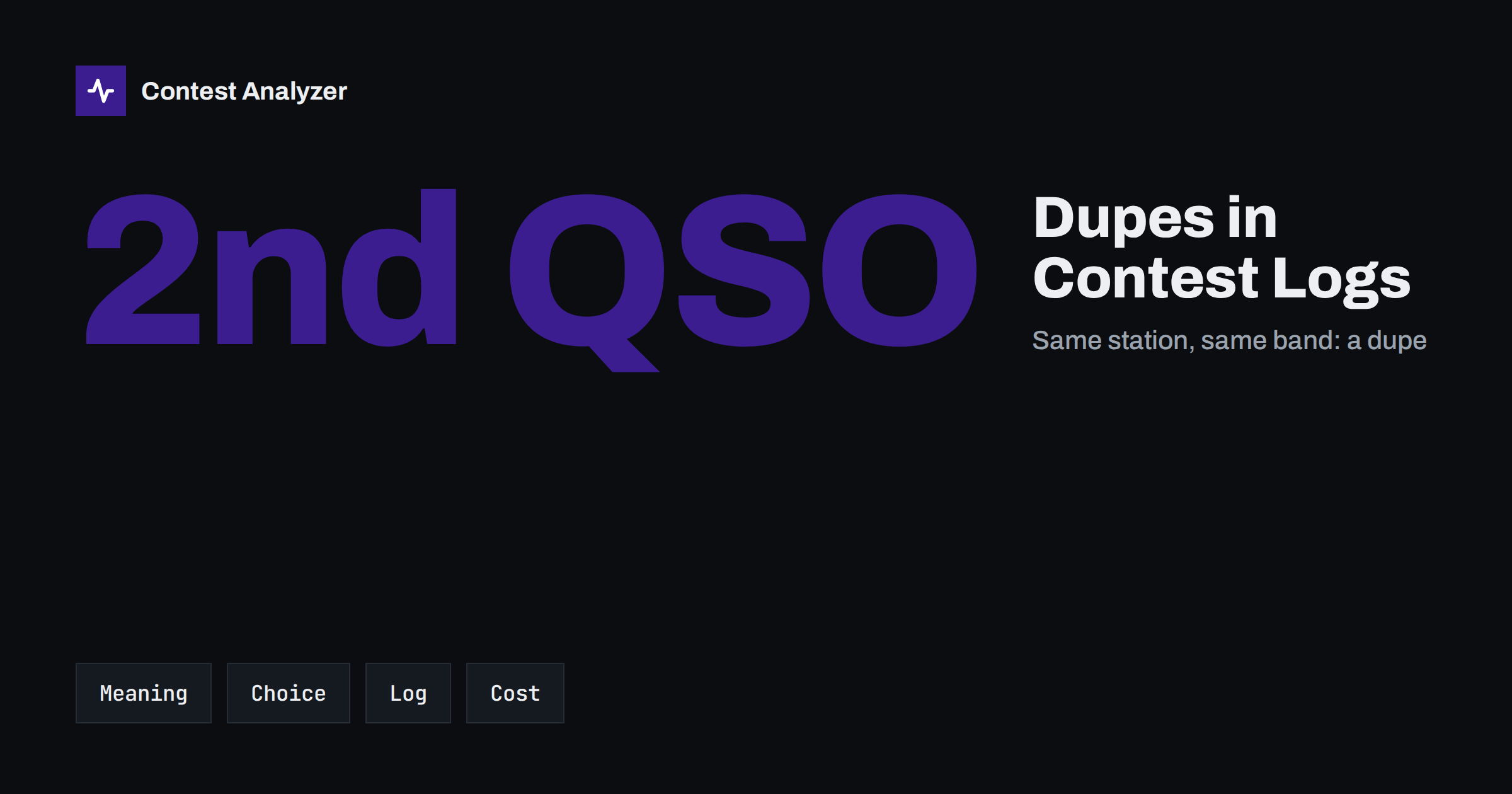
A dupe, short for duplicate, is a second contact with a station you have already worked in the same contest, on the same band and in the same mode. The definition is not the same in every contest: some count each band separately, some count each mode separately, and some have special rules. A contact with the same station on another band is normally not a dupe, because most contests allow you to work each station once per band.
Logging software marks dupes for you. When you enter a callsign that is already in the log for that band and mode, the program shows a warning in the entry window, and in most programs it will also give the contact no points. This is a help to the operator and a protection for the score.
Dupe versus error
It is useful to separate two ideas that people often mix up. A dupe is a real contact that happened twice, and it is not a mistake in the log. The log is correct: the QSO took place and you recorded it. Whether it earns points is a question of the scoring rules, and in most contests a dupe earns none.
An error, in the sense of log checking, is a line that does not match reality: a busted callsign, a wrong exchange, a QSO with the wrong time or a contact that cannot be confirmed. These are what contest committees penalize. When you review your log before you submit it, a dupe is not something you need to fix. Contest Analyzer follows the same logic and does not treat dupes as errors. For the errors that matter, see our articles on busted callsigns and not-in-log QSOs.
Why working a dupe is often better than refusing
When a station calls you and you think you have worked it already, you have a choice: send “dupe” and move on, or work the QSO again. The most common advice from experienced contesters is to work it, unless you are completely sure, and there are good reasons:
- You may be wrong. Perhaps you worked the station on another band, or the earlier QSO was with a different call that sounded the same. Refusing a valid contact costs you a point.
- The other station may not have you in the log. If your earlier QSO was imperfect, for example a copy error on their side, the new contact may repair it. A repeat QSO is a safety net.
- It takes less time. Saying “dupe” and waiting for an answer, in a pileup, can take as long as a short exchange. A refusal can also start a discussion that costs more time than the QSO.
- It is polite. The other operator probably wants the contact, and has done nothing wrong by calling you.
The exception is when a repeat would cost you in a different way: a busy run where every second matters, or a rule that penalizes extra QSOs. Read the rules of your contest, and use your judgment.
How dupes are generally handled by committees
The treatment of duplicate contacts is set in the rules of each contest. In many contests, dupes are removed during checking without a penalty, so a repeat QSO neither helps nor hurts the score. In others the rules are different, for example because they allow a contact to be repeated after some time, or because they apply a penalty. Do not assume that the practice you know from one contest applies to another. The rules page for the contest is the only source to rely on.
There is also a related point. Even when a dupe is not penalized, the exchange you log in a repeat QSO still has to be right. A repeat contact with a wrong callsign or a wrong exchange is not a harmless dupe: it is an error like any other. That is a reason to keep the same care in repeat contacts as in new ones.
Keeping dupes from costing you rate
Even if a repeat QSO has no scoring cost, it takes time. The aim is to avoid them where it is easy and to handle them quickly where it is not.
- Use the dupe check. Type the callsign as it is sent, before you answer, and look at the warning. Most logging programs show a dupe as soon as the call is complete.
- Answer anyway when unsure. If the call is not clear, a quick exchange is better than a guess.
- Do not call stations you have already worked. In search and pounce, check the entry before you call. Our article on run and search-and-pounce shows how to separate the two in your statistics.
- Keep your logger up to date. A dupe check works only on what is in the log. If a QSO was not saved, or the network between two computers failed, the check will not warn you.
The dupe from the other operator’s point of view
It helps to think about what the caller experiences. A station that calls you and is answered with “dupe” has just spent its own seconds, and it may be a weak station that waited a long time to get through. Some operators dislike being told they are a dupe, particularly when they are not sure of it themselves. A calm, short reply is better than a lecture, and if you have a spare second, simply completing the QSO is the friendliest answer.
On the other side, if you are the one who is told “dupe”, accept it and move on. Do not insist on a second contact if you are sure that you worked the station already, since you will lose the time you would have used for a new one. If you are not sure, a short question such as “which band?” is enough to settle it, and a good operator will answer it quickly.
Preparing your logger before the contest
The dupe check depends on the program’s settings, and the settings differ between contests. Before the first QSO, confirm that the logger counts bands and modes the way your contest does. In a mixed-mode contest, for example, the rule may be that each mode is counted separately, and the program must be set accordingly. Check how the program shows dupes in the entry window, and learn what key lets you log a repeat QSO when you decide to work it.
It is also worth knowing what the program does with a dupe after you log it. Many programs mark the QSO in the log with a flag so that it is not counted, but keep the line in the Cabrillo file; others write it with a special mark. Read the exported file to see what your program does, since the effect on the score depends on how the contest software reads it. If you are not sure, the export guide for N1MM Logger+, DXLog and Win-Test describes what to check in the file.
Dupes in multi-operator and multi-radio setups
The more computers or radios you have, the harder it is to keep the dupe information current. In a networked multi-operator station, the loggers share their QSOs, so that a contact made at one position is a dupe at the other positions as well. When the network is down, each position works from its own list, and dupes are more likely. Our article on multi-operator categories describes the structure of these stations, and you should test the dupe sharing before the contest begins.
With two radios, as in SO2R, the same applies: both radios must write to the same log, otherwise a station on one radio can be called again on the other. See the SO2R basics for the setup.
What dupes show in your statistics
Dupes also appear in the numbers. Your raw QSO count includes them, while the score does not, so the count and the score can differ. When you compare rates between years, look at both the total and the net number, because a year with many repeats may look better in the raw count than it was. The article on contest rates explains how to read these figures.
Contest Analyzer checks every callsign and every zone against official license databases and several independent reference sources and shows only the few QSOs worth a second look. It gives you full statistics for your contest, including rates, QSOs by hour and band, countries and continents, and a year-on-year comparison with your own logs. You can edit calls and zones in the report and download a corrected Cabrillo. Serial numbers are not checked, and dupes are not treated as errors. The FAQ has answers to other common questions.
Related reading
- Busted callsigns in contest logs
- Not-in-log QSOs: typical causes
- Run vs search and pounce
- Contest rates and QSOs per hour
The bottom line
A dupe is a repeated contact, not a log error. When in doubt, work the station: it costs seconds, and it may save a QSO for both of you. Use the dupe check in your logger, keep every computer and radio writing to the same log, and read the rules of your contest to see exactly how repeats are treated.
FAQ
Is a dupe an error in my log?
No. A dupe is a real repeat contact. Whether it scores is decided by the rules, and in most contests it does not.
Should I always work a station that calls me twice?
If you are not sure that you have worked it, yes. If you are sure, you may politely tell it that it is a dupe, but a repeat QSO usually costs only seconds.
Are contacts on different bands dupes?
Usually not, since most contests allow one contact per station per band. Check how your contest counts bands and modes.
Does Contest Analyzer treat dupes as errors?
No. Dupes are not treated as errors in the report.
Why is my QSO count higher than my score suggests?
The count includes repeats, which normally do not score. Compare the raw count with the net number of valid QSOs.