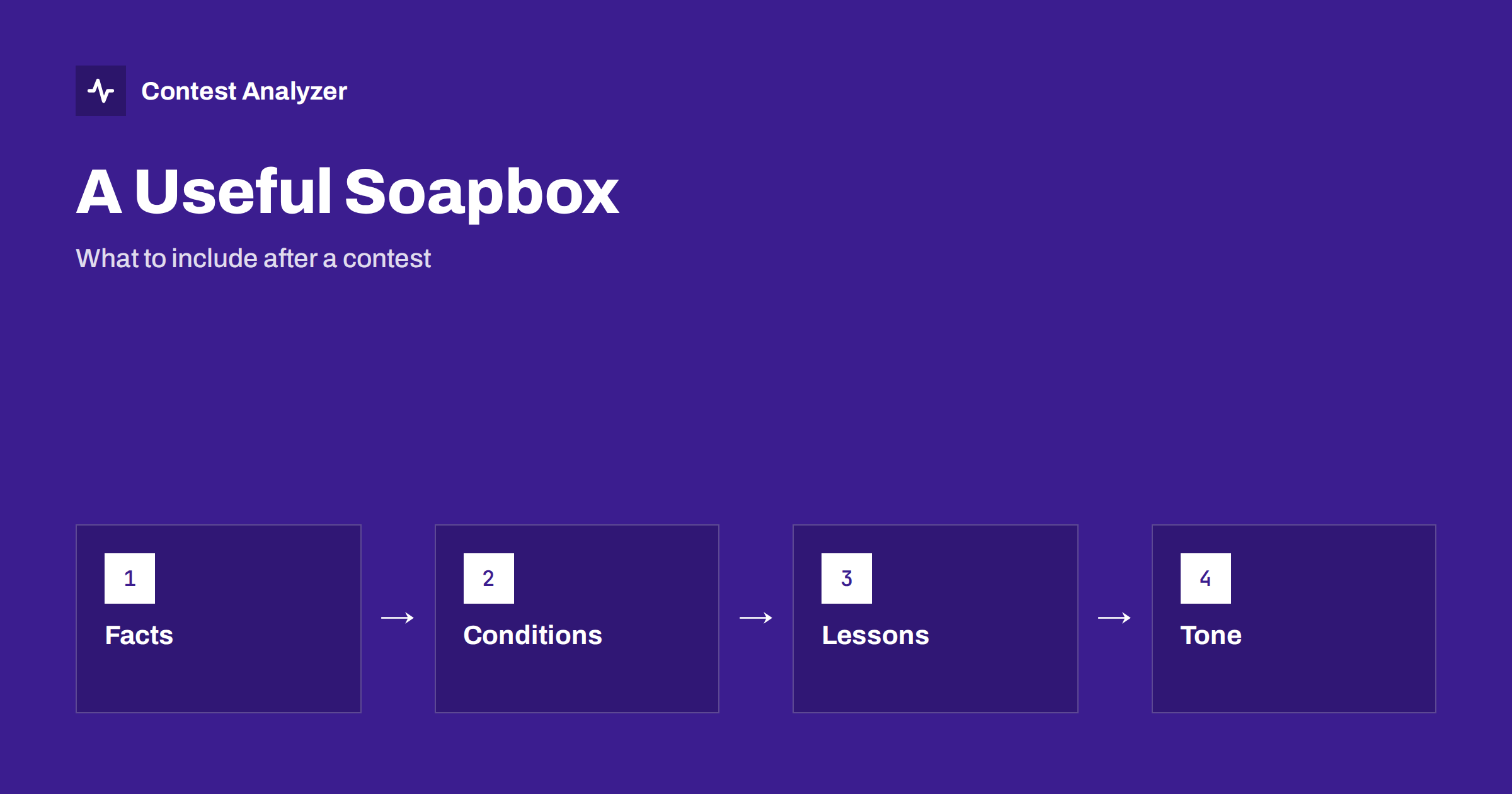
Short answer: A good soapbox is short, factual and useful to a reader who did not operate with you. Name your category and station, describe the conditions on the bands you used, mention one or two memorable moments and say what you learned. Keep the tone honest and friendly, avoid complaints about individuals and send it in the form the organiser asks for.
What a soapbox is for
After a contest, many organisers invite operators to write a few words about their experience. These notes are published on a website or in a journal, and they have several readers. Other participants want to compare conditions. Organisers want to hear what worked and what did not. Future you wants a record of what the weekend was like. A soapbox that serves all three is short and specific.
Some organisers collect comments in a form, others read the comment lines in the log file. Our articles on posting your claimed score and soapbox, on soapbox comments in a Cabrillo file and on a useful post-contest report with photos deal with those channels. This article is about the content.
Start with the facts
Begin with a line that tells the reader who you are and how you operated: your callsign, the category, the power and the number of operators, then the main antennas. Give the claimed score and the number of QSOs if you wish, but be careful: a claimed score is not a final one. The article on claimed vs final score explains why the two differ.
These facts make everything else easier to interpret. A comment that the low bands were noisy means something different from a station with a large antenna farm than from a station with a wire. If you changed the station since last year, say so in a few words: new antenna, new amplifier, different location. It is useful context for the reader and for you when you look back.
Describe the conditions
Next, write what the bands were like. Which were open when? Which were noisy? Were there unusual openings or a band that stayed closed? You do not need a long report. A few sentences with the band, the approximate time and the direction are enough. If the geomagnetic activity was high, say so. If a storm affected the lower bands, say so.
These details have long-term value. When you read your soapbox next year, you will not remember whether the second morning was good on 15 metres. The note will tell you. Also, if you have taken statistics from the contest, a line or two about what they showed gives your comment weight. For instance, you can mention your best hour or the share of QSOs on each band. The articles on solar flux and K index and on a station notebook show how to connect conditions with results.
Add one or two moments
A soapbox with only numbers is dull to read. Add something human: a rare station you worked after a long wait, a pileup that made you smile, an equipment failure that you fixed in the middle of the night, a new operator who made his first contest. Keep it to one or two lines. These moments are what makes other people read the comment to the end, and they are what you remember best later.
Take care with stories about problems. If a failure cost you QSOs, describe it without blame and say what you will do to prevent it. A short note like that is useful to others who may have the same problem. If the problem was another operator’s behaviour, remember that a soapbox is not the place for a quarrel. Report real rule violations to the organiser through the proper channel.
Say what you learned
The most valuable part of a soapbox is the lesson. One sentence is enough: started too late on the high bands, rested at the wrong time, found a problem with the callsign macro, under-used the second receiver. Writing it down makes you commit to it. If you also write one change for next time, the soapbox becomes part of your plan. The article on turning this year’s log into goals shows how to do that.
If you have time, check the log before you write. A quick review shows what really happened, not what you remember. Contest Analyzer produces full statistics, including rates, QSOs by hour and band, countries, continents, zones and breaks, and compares your result with your own earlier logs. It checks every callsign and zone against official license databases and several independent reference sources. A soapbox that says a few specific things about those numbers is more useful than a general one.
What to leave out
Leave out anything that identifies a private person without reason, accusations about unfair conduct, complaints about the rules aimed at nobody in particular and long technical descriptions that belong on your own website. Do not copy the whole log into the box. Do not promise results that you do not have. Do not write about how others cheated. If you disagree with the rules, there are better places to say it, such as a message to the contest committee.
Also avoid claims you cannot support. Statements such as I had the best signal on the band are not easy to prove. State what you did and what you observed, and let the reader judge. Check the spelling of callsigns, since a busted call in a soapbox is as embarrassing as in a log.
Format and length
Many sites limit the length of a comment. A good size is a short paragraph of four to eight sentences. Use plain text unless the form allows more, because formatting often breaks. If the comment goes into a Cabrillo file, remember that each line has its own limits and that special characters can cause trouble, as described in the article on characters that do not belong in a Cabrillo log. Keep a copy of the text in your notebook, with the date.
An outline you can reuse
If you write a soapbox after every contest, a fixed outline saves time and makes the notes comparable over the years. A simple outline has six lines. The first gives the category, power and operators. The second names the antennas and any change since last year. The third gives the claimed score and the number of QSOs, labelled as claimed. The fourth describes the bands and conditions, with a few times. The fifth tells one memorable moment. The sixth states one lesson and one plan for next time.
Write the outline in your notebook or in a text file, and fill it in within a day of the end of the contest, while your memory is fresh. Edit it down to the length that the organiser allows. Because the structure stays the same, you can place two years side by side and see at once what changed in the station, in the conditions and in your own thinking. It is also easy to share with a friend or a club newsletter, which may ask for a few lines.
Thank the people who helped
A soapbox is also a place for thanks. If a friend helped to put up an antenna, if a family member put up with a weekend of noise, if another station helped you with a difficult exchange, mention it in a word. Thanks cost nothing and are remembered. If your club took part as a team, name the club and its members in the form that the organiser asks for, and write the club name as the rules require it. The article on writing the club name right in Cabrillo shows how a small difference in spelling can split a club score.
Lastly, remember that the audience of a soapbox includes beginners. A short, friendly note about what you found difficult, and what helped, can encourage someone who is thinking about their first contest. Many experienced operators first entered after reading a modest comment from someone who sounded like themselves.
Keep a habit of reading other people’s soapboxes, too. They show what conditions were like at other locations, what equipment others use and what problems appear again and again. After a few contests you will notice that some operators write notes you always want to read. Look at what they do: they are specific, they are brief and they say something that you can use. That is the standard to aim for.
If you are unsure whether a detail belongs in the soapbox, ask whether a reader could use it. A note that the second receiver made a clear difference on the low bands is useful. A long list of every antenna dimension is better kept on your own page. When in doubt, write less, and keep the extra detail in your notebook, where it can grow with the years without burdening the readers.
Related reading
- Your Post-Contest Review Routine: What to Check
- Writing Notes During a Contest to Fix QSOs Later
- How to Submit a Contest Log: Upload or E-mail
The bottom line
Write a soapbox that gives your category, the conditions, one or two moments and a lesson, in a friendly tone and a few sentences. It helps readers, organisers and your future self, and it takes ten minutes if you have your notes ready.
FAQ
How long should a soapbox be?
A short paragraph is enough, unless the organiser sets another limit. Check how the comment will be used.
Should I include my score?
You may, but call it a claimed score, as it can change after checking.
Can I criticise other stations?
Avoid it. Report real violations to the organiser through the proper channel.
Is a soapbox required?
Usually not. Check the current rules of the contest for any requirement on comments.