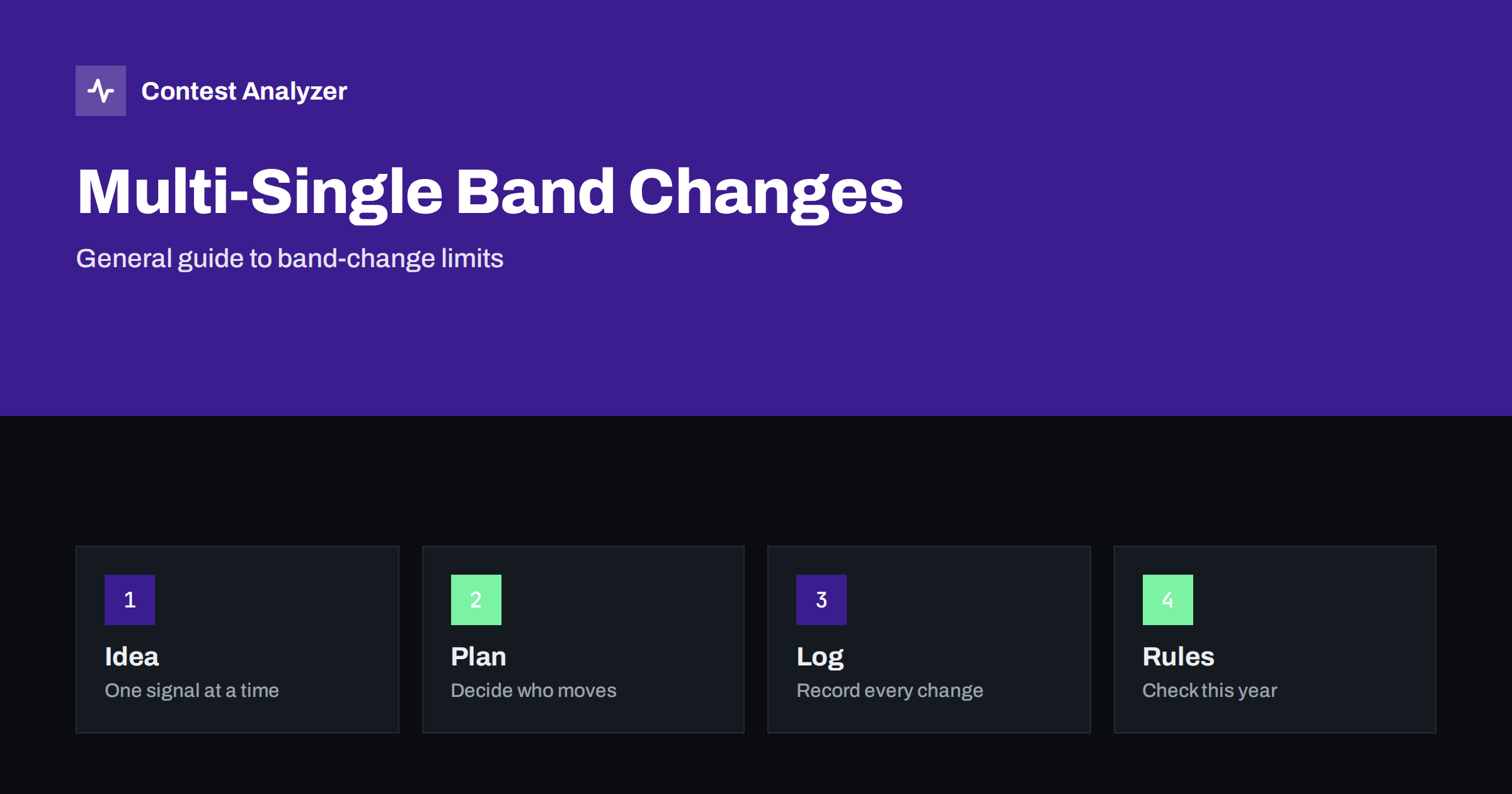
Short answer: In a multi-operator category with one transmitter, often called multi-single, the rules usually limit how often the station may change bands, so that one signal is on the air at a time and the team cannot simulate several stations. The limit differs between contests and can change between years, so read the current rules. Plan band changes in advance, record every change accurately, and review the log for violations before you submit.
What multi-single means
Multi-operator categories allow several people to operate from one station. They differ in how many transmitters may be on the air at once. In a multi-single category, in general terms, only one transmitter is allowed at a time, and the team shares it. The operators may sit at different positions and may use a second receiver to find multipliers, but only one signal is transmitted. Other categories allow two or more transmitters, and some give them limits of their own.
The definitions of these categories, and the names used for them, are not the same in every contest. For this reason a general article can only describe the idea. The details of the number of transmitters, the operators and the limits are in the rules of the specific contest. Our earlier article on multi-operator categories and band-change rules gives a general overview; this one concentrates on the single-transmitter case and on what it means for planning and logging.
Why band-change limits exist
The reason for the limit is fairness. A station that can change bands without restriction can answer a call on one band, then jump to another to work a multiplier, then return, and so use the whole spectrum with a single transmitter. A limit makes the team commit to a band for a minimum time, or to a maximum number of changes in an hour, which forces them to make decisions in the same way as a single operator would with one radio.
The form of the limit varies. Some contests count the number of band changes in a given period, such as an hour. Others require a minimum time on a band before leaving it. Some have special rules for a short visit to another band to work a multiplier. Because these details differ, and may be updated, do not rely on memory or on a summary. Read the current rules and, if something is unclear, ask the organiser.
Plan band changes before the contest
With a limit in force, every band change becomes a resource. A team does well when it decides in advance how to use it. Start from the propagation expectations: which bands will be open in which hours, and which are worth the effort. Draw a simple plan with the main bands for each period, and set aside a few changes for opportunities, such as an opening or a rare multiplier. A plan on a single page, visible to all operators, avoids arguments in the middle of the night.
Past logs help. If you have a log from earlier years, the band-by-hour view shows when each band gave the best rate. The article on band strategy by hour describes how to read it. Compare the number of band changes you made with the limit that applies this year. If the limit is stricter than before, you may need to reduce the number of short visits.
Who decides to change
In a team, one of the common sources of mistakes is unclear authority. Decide who has the right to call a band change. It is often the operator on the main frequency, with agreement from the person who watches the second receiver. A short phrase that signals the intention, and a short answer, is enough. The point is to avoid a change that a teammate did not expect, which may leave the log with a wrong band or a gap.
The person who handles the second receiver should know the rule well. Their job is to find multipliers without causing a violation. If the rules count a change when the transmitter moves, a receiver that only listens on another band does not trigger it, but you must check what the current rules say about the use of a second receiver and about assistance.
Logging band changes
The log must reflect what happened. Each QSO has a frequency, and the band is derived from it, so a band change shows up as a change in the frequency field. If the logger is connected to the radio, the frequency is taken automatically. If it is not, make sure the operator enters the band or frequency correctly. A wrong band is one of the most common logging errors in stations with several operators; see wrong band in the log after antenna or band switching.
With several computers, the problem is greater. If each computer logs QSOs for its own position, the merged log must show a sensible sequence of bands. A strange pattern, such as a quick alternation between two bands, may be a sign of a time offset between computers or of a wrong frequency. The article on errors that appear when you merge multi-op logs lists typical problems.
Reviewing the log for violations
After the contest, examine the sequence of bands in your final log. Sort the QSOs by time and list every change of band, with its time. Compare the changes with the limit in the rules. If you find a violation, do not hide it. Consider how the rules treat it; some contests allow a team to reclassify, and others apply penalties. Honesty about the category is part of the sport, and an organiser is far more likely to accept a corrected entry than a hidden problem.
A report with hour and band statistics makes this easier. Contest Analyzer shows QSOs by hour and band, and also shows breaks and off time, which helps you see the pattern of band use. It also marks QSOs outside the band limits for your ITU region, with split QSOs shown as a note. It does not check the rules on band changes themselves, so that part of the review is yours.
Common mistakes
- Using last year’s limits without reading this year’s rules.
- Counting a short visit to another band as free when it is not.
- Letting each operator decide changes without a shared plan.
- Leaving the band field to chance when the radio is not connected to the logger.
- Merging logs without checking the time and band sequence.
An example plan for a weekend
To see how a limit shapes a plan, imagine a team with a single transmitter and a rule that allows a limited number of changes per hour. The team looks at past logs and sees that the highest band is strong in the middle of the day, the middle bands carry the evening, and the lowest bands are productive from midnight until sunrise. A natural plan is to hold the highest band for several hours at midday, move down in the evening in two steps, and spend the night mostly on the low bands with one or two planned visits to a middle band for multipliers.
The plan leaves a small reserve of band changes for events no one can predict: a sudden opening, a rare station announced on the second receiver, or a band that dies earlier than expected. The team writes the plan on a sheet, with times in UTC, and the operator at the main position keeps count of changes in the current hour. Each change is announced aloud and noted on paper. That small discipline costs a few seconds and saves the team from an accidental violation.
When the weekend is over, the sheet becomes a record: planned changes versus actual changes. The comparison shows where the plan was too optimistic and where it was too cautious. It is also a good source for the team debrief, because it shows decisions rather than impressions. Over several years, such records build a team strategy that no single person has to remember.
Teamwork and tiredness
Fatigue makes band-change rules harder to follow. An operator who is tired at four in the morning may change band out of habit, forgetting that the count for the hour is already used. Rotating the operators, keeping the plan visible and giving the person at the second receiver the right to say “stay” help to prevent this. A team that rests well makes better decisions, and its log is cleaner. See operator fatigue in 48-hour contests for ideas about rest.
It is also worth deciding in advance what to do when the limit makes you miss something. Missing one multiplier is not a disaster. A violation can cost much more than the multiplier is worth, so it is wise to take the cautious option when in doubt. If you are unsure whether a move would count as a change under the rules, do not make it, and ask the organiser after the contest so that you know for next time.
Related reading
- Multi-Operator Categories and Band-Change Rules Explained
- Rate per Operator in a Multi-Op: What the Numbers Show
- Band Changes and Rate: How Often Should You Move?
The bottom line
Band-change limits in multi-single categories exist to keep the single transmitter honest. Read this year’s rules, plan the changes, assign who decides, record the bands carefully and review the sequence before you submit. A tidy log and an honest category are worth more than a few extra QSOs.
FAQ
Is the band-change limit the same in every contest?
No. The form and size of the limit differ between contests and may change, so read the current rules each year.
Can a second receiver search for multipliers?
That depends on the rules and the category. Check the current definitions of assistance and of the multi-operator categories.
How do I see my band changes?
Sort the log by time and list every point where the band differs from the previous QSO.
Does Contest Analyzer check band-change limits?
No. It marks QSOs outside the band limits for your ITU region and the contest period, but the band-change rule must be checked by you.