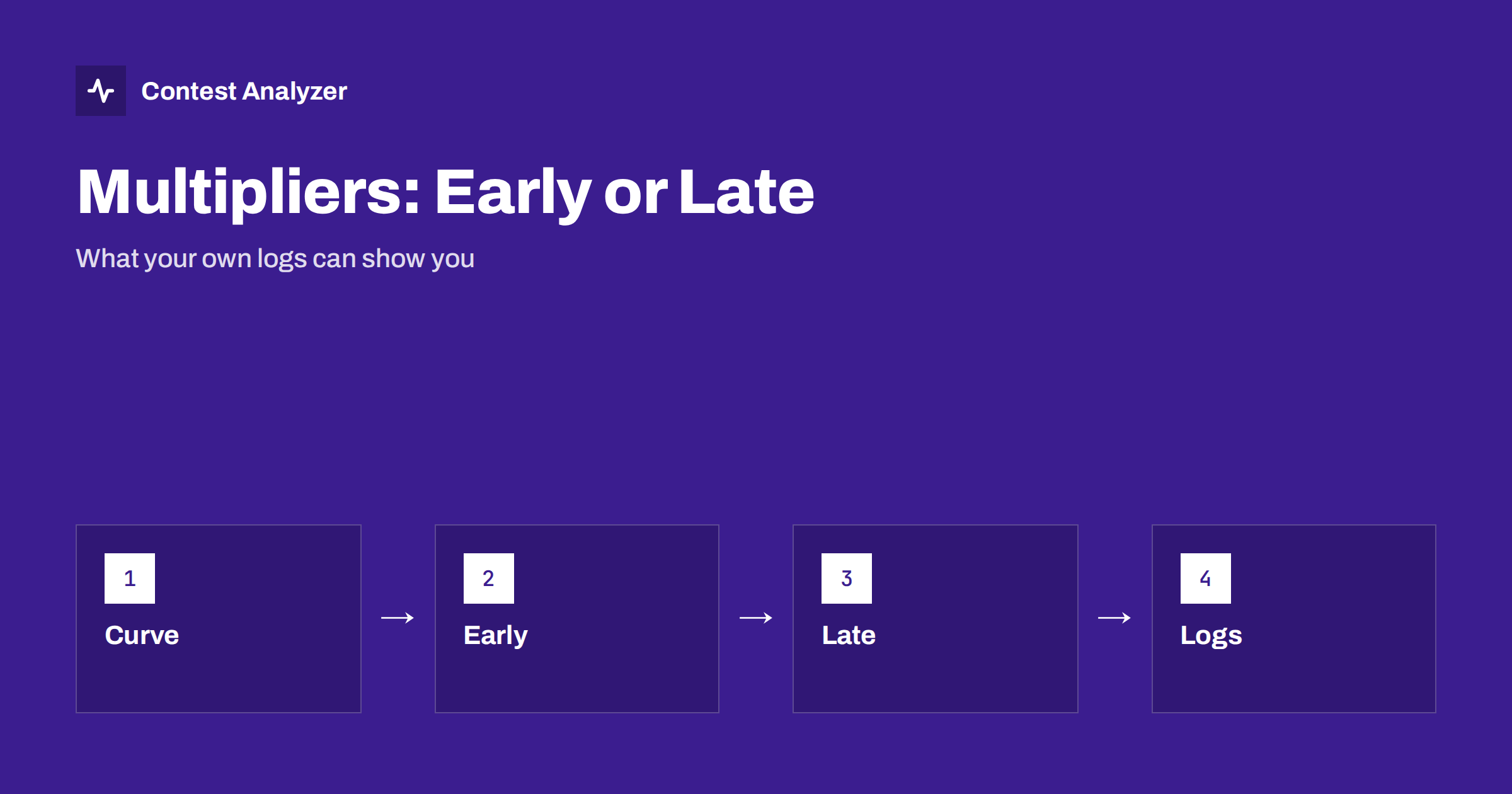
Short answer: There is no single correct time to chase multipliers. Early in a contest almost every contact is a new multiplier, so the gain per QSO is high; later, new multipliers become rare and each one costs more time. Your own logs can show where the curve flattens in your case and what the trade-off was in the hours when you went hunting. This article explains how to read those numbers and how to use them for your next plan.
Why the question matters
Most of the large contests score the product of QSO points and a count of multipliers, such as countries, zones or prefixes. The exact formula depends on the contest, so check the current rules. The relevant point is that a multiplier is worth more than a single QSO, because it raises the value of all your QSOs, but it is also harder to find. You must decide how much time to spend on finding multipliers rather than on making QSOs at the best possible rate.
Early, the choice is easy. Almost every station you work is a new multiplier on that band, so running at a good rate and taking whatever calls gives you a rich harvest. Later, the pool of unworked multipliers shrinks. You still collect them, but every new one takes more tuning, more waiting or a change of band. The practical question is when the effort of hunting is worth more than the effort of simply working the next caller.
The multiplier curve
If you plot the cumulative number of multipliers against time, you get a rising curve that is steep at the start and flatter later. The hourly statistics show the same thing as a list of new multipliers per hour: many in the first hours, fewer in the middle, a handful at the end. The article on new multipliers per hour shows how to read that list. The point where the curve flattens is the point at which hunting starts to cost more.
The shape differs by contest and by band. In a contest with zones and countries counted per band, each new band restarts the supply of easy multipliers. A change of band can therefore give a new burst of multipliers even in the middle of the weekend. In a contest with prefixes counted only once, the curve declines and does not restart. Use the rules of your contest to decide which situation you are in.
What “early” gives you
Hunting early has two advantages. First, the multipliers you collect are available for the whole contest, so they raise the value of all the QSOs that follow, at least in contests where the multiplier count is applied to the final total. Second, openings at the beginning of the contest are often good, and the stations you need are active. A multiplier that is missed in the first hours can be hard to find again, particularly if it comes from a band that closes.
The cost of an early hunt is the rate. Tuning for a single station while a run frequency is productive can reduce the number of QSOs in that hour. On a good run, the loss may be larger than the gain from one multiplier. Your logs show this directly: compare the rate in hours when you were mostly running with the rate in hours when you were mostly searching. The article on run versus search and pounce describes how to make that comparison.
What “late” gives you
Later in the contest, the number of stations that still need to be worked is smaller, and some of them are rare. Your rate on a run usually falls because the callers have already worked you or because the band has changed. In these hours, searching for a multiplier is often the more productive use of time. The same effort that yielded one QSO in the run yields a multiplier in the search, and a multiplier is worth more.
The risk of waiting is that the opportunity may have closed. A band that was open to a region during the first night may not be open on the second. If you postpone the hunt, make sure that you have a reason to expect the same opening again, and check the information from earlier years and your own logs. The article on planning for rare multipliers discusses patience and when to leave.
Use your own logs
The best evidence is your own history. Open the statistics for the same contest in earlier years and answer four questions. In which hours did you gain the most multipliers? On which band did the gains come? How much did your rate drop in those hours? And how many multipliers did you miss because you were not on the right band at the right time? A year-on-year comparison with your own logs shows whether your timing improved.
Contest Analyzer’s statistics cover countries, continents, CQ and ITU zones and WPX prefixes, plus rates and QSOs by hour and band, and allow year-on-year comparison with your own logs. These are the numbers you need for the analysis above. You do not need a special tool, however: a spreadsheet with the first appearance of each multiplier and its time gives the same answer.
A simple method for the next contest
- For each past contest, list the time of each new multiplier.
- Mark the hour at which the number of new multipliers per hour falls below a level you choose, for example two or three.
- Look at the rate before and after that hour.
- Decide on a plan: a hunt in the first hours of each band, a quiet run in between, a second hunt when the hourly gain falls.
- After the contest, compare the result with the plan and adjust.
This is a loop, not a formula. Conditions change and an experience from one year does not apply perfectly to the next. But a recorded plan lets you learn from each weekend, and that is how experienced operators build their strategy.
Beware of false conclusions
Statistics can mislead if you ignore the context. A year with poor propagation will show fewer multipliers, whatever your strategy. A change in antennas or in the category can change the picture. The article on solar flux and K index describes why you should compare years fairly. Also remember that the multiplier you did not find is invisible in the log: your numbers show only what you worked, and the stations you could not hear leave no trace.
Finally, do not forget accuracy. A multiplier that is based on a wrongly copied callsign or a wrong zone may not count. Hunting is only useful when the log entry is right, so a short check before you submit is part of the strategy.
An example from a made-up log
Imagine an operator who sees, in last year’s statistics, 40 new multipliers in the first six hours, 20 in the next twelve, and 10 in the remaining thirty. The hourly gain falls from about seven to under two and then to a third of a multiplier per hour. At the same time, the rate on a run at the best hours is high. The numbers suggest an early hunt on each new band, a long period of running while the rate is strong, and a second, planned hunt in the hours when the rate on the run falls below a level the operator chooses.
Now imagine that the same operator checks the hours of the second hunt and finds that the multipliers were mostly found on one band, in a window of two hours. Next year the plan can concentrate on that window, with preparation: the right antenna, a quick way to change band, and a list of the stations that were found in that window before. That is the kind of specific, testable improvement that statistics make possible.
The example is made up, and your own numbers will be different. What matters is the method: look at the curve, relate it to the rate, form a plan, and test it. A plan that fits the data of three previous years is usually better than a plan taken from an article, including this one.
When the rules change the answer
Do not forget that rules can change the best strategy. A contest that counts multipliers once for all bands rewards a different approach from one that counts them per band. A contest with a category limit on operating time, or with a limit on band changes, changes how much hunting is possible. Always read the current rules before you apply any plan you made from the past, and treat last year’s numbers as a guide only for the features that remain the same.
Related reading
- Multiplier Strategy in CQ WW: Reading Zones and Countries
- The Last Hours of a Contest: Rate or Multipliers?
- The First Hour of a Contest: Start Strong, Learn Fast
The bottom line
Early multipliers are easy and late ones are rare, but the best timing for your station comes from your logs. Look at the curve of new multipliers per hour, compare the rate in hunting and running hours, write a plan and test it in the next contest. Do not copy a rule of thumb; measure your own case.
FAQ
Is it better to collect multipliers early?
Often the early gain per QSO is high, but the best choice depends on your station, the contest and the propagation. Your own logs are the best guide.
How do I see when the gains slow down?
List the time of each new multiplier and count new ones per hour. The point where the count drops is where hunting becomes more expensive.
Does a change of band restart the supply of multipliers?
In contests that count multipliers per band, yes. Check the current rules to see how your contest counts them.
Can a wrong callsign cost me a multiplier?
Yes. A multiplier based on a busted call or a wrong zone may not count, so check your log before submitting.