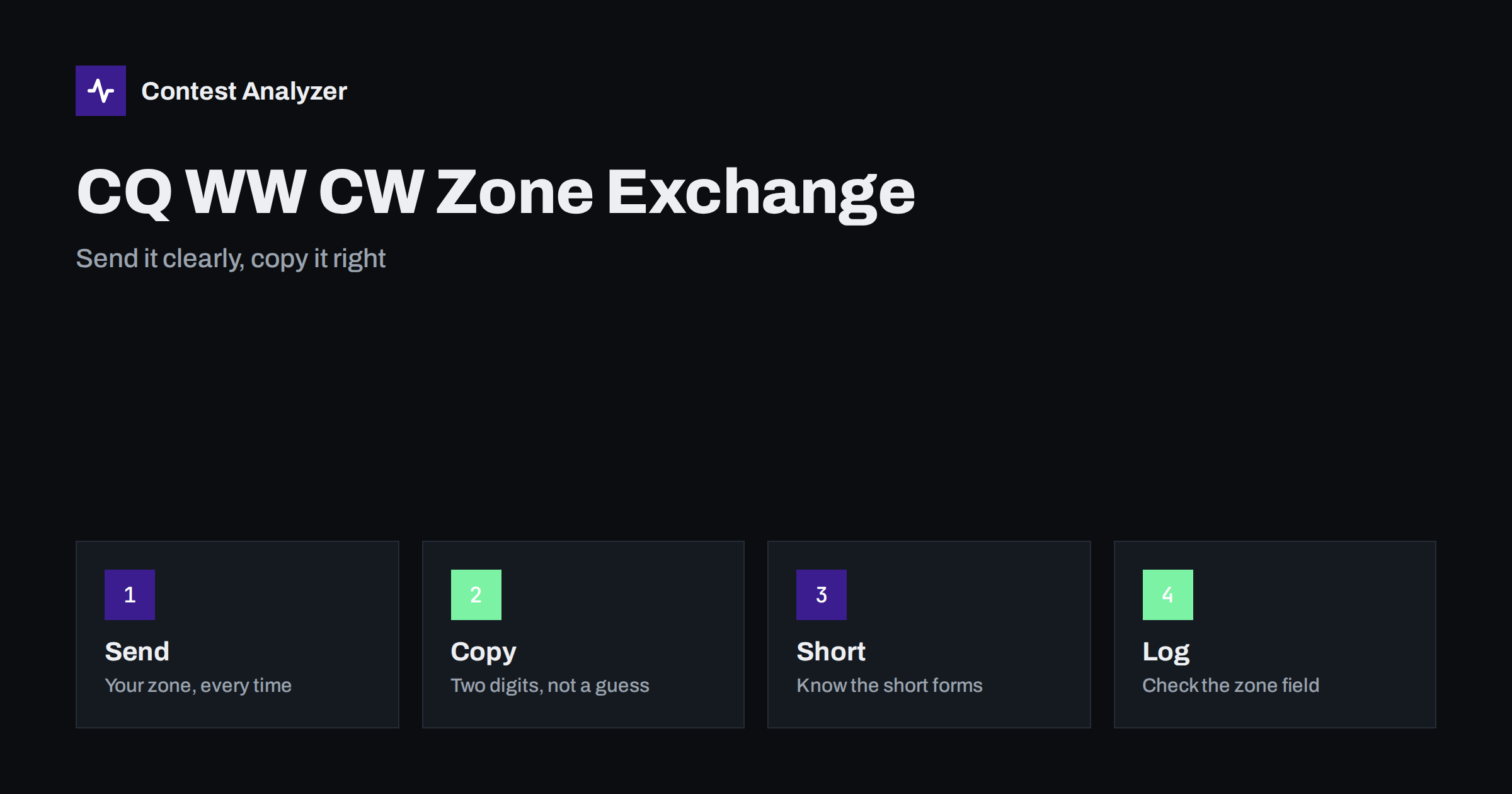
Short answer: In CQ WW DX CW the exchange is a signal report and a CQ zone, and the zone is the part that most often goes wrong. Send your own zone cleanly and at a speed that suits the caller, copy the zone of the other station in two clear steps and ask for a short repeat of the zone only when you are not sure. In the log, check that the zone in the exchange field fits the callsign, because a zone that does not match the station is a typical error that is found afterwards.
What the exchange looks like
In CQ WW DX the exchange is the RST report plus the CQ zone of the station. In CW the report is nearly always 599, and many operators send it in a short form, so the zone is the only part of the exchange that carries information. This is why the zone matters so much. If you miss it, you have missed the whole exchange, and the QSO cannot be completed. If you copy it wrongly, you have a QSO that looks complete but is wrong.
Check the current official rules for the exchange and the scoring of your contest. As a general fact, the rules of CQ WW explain which zone belongs to which station and how stations in countries with more than one zone should choose theirs. The article on CQ zones explained gives the background, and the one on zone errors in multi-zone countries deals with the awkward cases.
Sending your own zone clearly
Your own zone is the easiest thing to get right, and it is surprising how often it is sent badly. A macro that sends 599 and your zone at full speed, with a short pause, is hard to copy under QRM. Set the macro to send the zone with a slightly longer gap before it, or send it twice for weak callers. If your zone has two digits, make sure that the digits are sent clearly and not run together. If your zone is a single digit, some operators send it with a leading zero, and others do not. Choose the form that gives fewer repeat requests and use it all contest.
Listen to your own sending on a recording. If you hear that the zone is hard to catch, change the macro. The article on CW macros in N1MM Logger+ shows how to build and test them, and the one on CW speed in contests helps to choose a speed that matches the conditions.
Cut numbers and short forms
In CW, many operators use short forms for numbers, such as a letter instead of a digit. These are called cut numbers, and they save time. They also create a risk: a cut number may be confused with a letter that is part of a callsign, or with another cut number. A zone that is sent in cut numbers must be copied as the number that it stands for, and the logger must store the number, not the letter. See cut numbers in CW exchanges and cut numbers and zone errors in CW exchanges for the usual pairs.
If you use cut numbers yourself, use them only for the digits that are common and clear, and avoid them when the caller seems unsure. If you copy a zone and the form seems strange, such as a letter that does not fit a zone, ask for a repeat of the zone. Fifty QSOs with clear exchanges are worth more than sixty with doubtful ones.
Copying other stations’ zones
The zone of a station depends on where it is, and a good operator knows the likely zone for most prefixes. This is useful in two ways. First, it helps you to confirm what you heard: if you copy 14 from a station in Germany and you expected 14, the match is reassuring. Second, it warns you when something is wrong: if you copy 25 from a station in Germany, ask again. Do not use this knowledge to replace what you hear, because stations in large countries may be in different zones, and a station can be operating from another place.
Write the zone as soon as you hear it, and confirm it with the call. If the logger shows the expected zone for the callsign, compare it with what you copied. A difference is a signal to listen again or to ask. The articles on callsign history and zones and call history files in contest loggers describe the use and the risks of automatic zone fill-in.
Typical zone mistakes
- Assuming the usual zone: the logger fills in the default zone for the prefix, and the station was in another zone.
- Swapped digits: 15 copied as 51, or 14 as 41, because the digits were sent fast.
- A missing digit: only one digit heard and the other guessed.
- Zone of the operator, not of the station: a portable or visiting operator sends the zone of the location, not of the home address.
- Your own zone changed during the contest: for example after moving to another place, and the macro not updated.
Each of these produces a QSO that looks fine in the log and may be marked as an error afterwards. The article on zone exchange mistakes in SSB shows the same family of errors in another mode. The point is the same in every mode: always log the zone that was sent.
Logging the zone right
In the logger, the zone field should take the number that you copied, and the exchange should be stored in the Cabrillo file in the right column. Check the first twenty QSOs of the contest for this. Does the zone appear in the exchange column after the report? Is your own zone in the sent exchange correct? Does the logger warn you about zones outside the valid range? A short look at the file at the start of the contest saves a lot of work later. The article on the Cabrillo QSO line format shows the columns.
If the logger has a zone prediction from the callsign, treat it as a hint, not as the answer. Many contesters set the logger so that the predicted zone is shown but must be accepted by a key press, and this small step prevents a lot of silent errors.
Checking after the contest
After the contest, check the zones in the log. Contest Analyzer checks every callsign and every zone against official license databases and several independent reference sources and shows only the few QSOs worth a second look. You can edit calls, zones, time and frequency in the report, mark QSOs checked in your own audio recording and download a corrected Cabrillo. It also gives full statistics, including CQ and ITU zones, which show how many zones you worked on each band and where the missing ones are. It works with Cabrillo from N1MM Logger+, DXLog and Win-Test. See the contests page for the list of 22 supported contests.
Use the audio to settle the doubtful zones. Listen to the exchange of the QSO, and write what you hear. If your recording is not clear enough, leave the QSO as it is, or remove it if the rules require. Remember that CQ WW logs have a deadline, which is 48 hours after the end of the contest according to the current rule, so plan the check early. The article on the CQ WW DX CW checklist has a section on this.
Habits that reduce zone errors
A few simple habits reduce errors more than any equipment. Always send your zone in the same form. Always copy the zone with the call, and not later. Ask for a repeat of the zone only, not of the whole exchange. Use the logger as a check and not as a substitute for ears. And at the end of the first hour, look at the log for zones that look unusual, since the first hour is when your own habits are still forming.
Practise before the contest. A short CW practice session with zone numbers at contest speed helps your ear to catch the digits, and a few minutes with a call and zone trainer, or even with recordings of the last contest, can make a difference of several errors over a weekend.
A short drill before the contest
A few minutes of practice before the contest will do more for your zone accuracy than any amount of theory. Pick twenty callsigns from different parts of the world, write down the zone that each of them should send, and have a friend, a training program or a recording send them to you at the speed that you plan to use. Copy the zones without looking at the list, and compare. Pay attention to the zones that you miss: they are usually the same few, and knowing which ones they are tells you where to listen harder during the contest.
Do the same for your own sending. Record a few exchanges with your macro and listen to them as if you were the caller. Is the zone clear? Is the gap before it long enough? Do the digits sound distinct? If you hear a problem, fix the macro before the start, not after the first hour of repeats. A few minutes spent here make the whole weekend smoother, and they cost nothing.
Finally, agree with yourself on how you will handle the doubtful zones. A simple rule is: ask once, and if the second copy is not clear, leave the QSO unlogged and move on. A rule decided in advance saves the argument with yourself at three in the morning.
Related reading
The bottom line
Send your zone cleanly, copy the other zone in two clear steps, ask for the zone only when you need it and check the zone field in the log. Check the current official rules for the exchange.
FAQ
Is the report always 599 in CW?
Mostly yes in practice, but the rules define the exchange. Check the current rules.
Should I use cut numbers for the zone?
Only if they are clear for the caller. Avoid them when the caller seems unsure.
Can I trust the zone from the logger?
Treat it as a hint. The station may be in another zone than the default one.
How do I ask for a zone repeat?
Ask for the zone only, in the way you normally ask for a repeat of a part.
Does Contest Analyzer check zones?
Yes, every zone is checked and only the few QSOs worth a second look are shown.