Short answer: A dupe is a real station that you worked twice, and a busted call is a callsign that was logged wrongly. In your log the two can look almost the same, because both show up as two lines that look alike. To tell them apart, compare the time, the band, the mode, the exchange and the exact letters of the call, and if you recorded audio, listen to both QSOs. Dupes are not errors, but busted calls are, so the distinction matters.
Why the two get mixed up
When you scan a log after a contest, you will often see two lines with very similar callsigns. They may be the same station worked twice, or two different stations, or one station and one error. The human eye is not good at telling the difference between a call that is the same and a call that is one character off, and software does not always help, because a worked-before check works on exactly what you typed.
The first step is to decide what you are looking for. A dupe is a QSO that was made and logged correctly, but that counts for nothing because it repeats an earlier one. A busted call is an error in the callsign that you logged: one or more characters that differ from what the other station really used. The two have different effects. A dupe usually costs nothing in terms of penalty, as described in dupes in contest logs, and a busted call can cost the QSO and sometimes more, as described in busted callsigns in contest logs.
The five questions to ask
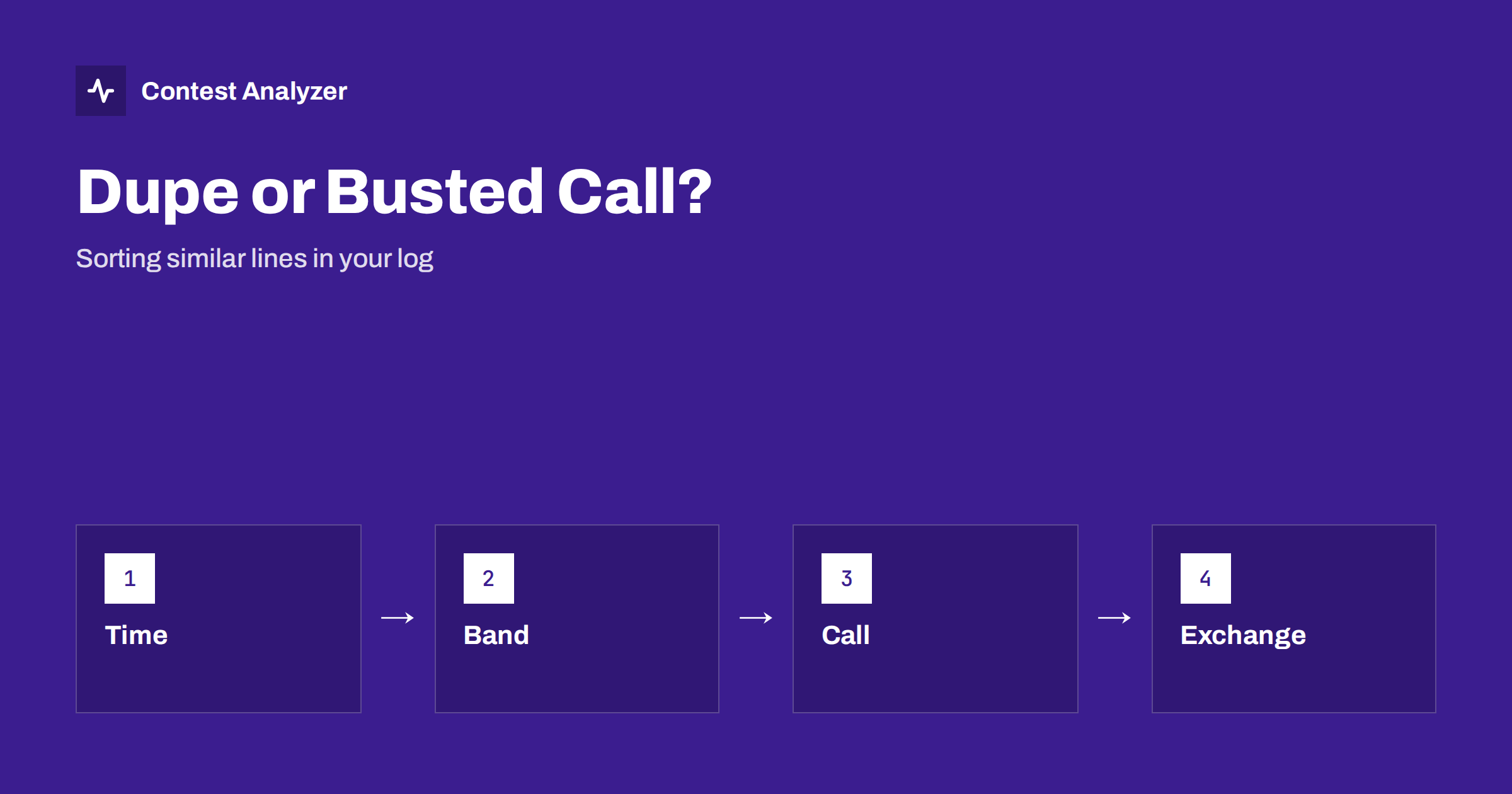
When two lines look alike, go through the same five questions each time. It takes less than a minute for each pair, and it gives a clear answer in most cases.
- Is the callsign exactly the same? Compare letter by letter, including the digit and any portable suffix. If the strings are identical, you have the same station.
- Is the band the same? A station worked on two different bands is not a dupe in a typical band contest. Check the current rules for the contest.
- Is the mode the same? In contests where mode matters, the same station on two modes is two QSOs.
- How far apart are the times? Two lines one or two minutes apart are likely to be a repeat or a correction of the same contact. Two lines many hours apart are likely to be separate calls.
- Is the exchange the same? A station that sends the same exchange twice is a good sign for the same station. A different exchange suggests a different station or a copy error.
When both lines are the same station
If the call, band, mode and exchange match, you have a dupe, and it is not an error. Leave it in the log. Do not delete it because deleting a QSO that really happened can later make the other station’s log show a not-in-log difference. If the contest rules ask for the dupes to be marked, let the logger mark them. See worked-before checks and dupe sheets for the habits around it.
A special case is the pair with identical calls and times only seconds apart. It may be a double entry caused by a key press or a macro that fired twice. In that case, you may have created a line by accident, and you should check whether you really made two QSOs. If the audio shows one QSO only, correct the log. Be careful, because some contests count a duplicate QSO line in a way that can influence the result.
When one line is a busted call
If the calls differ by one or two characters, the exchange is the same or similar, and the times are close or in the same period, then one of the lines is probably a busted call. Which one? The one that does not match a real callsign is the likely candidate. Look at the call in the official lists, at your notes and at the audio. If you have a recording, listen to both QSOs and write down what you hear.
The typical pairs are the same as in all busted calls: letters that sound alike, digits that were confused, a missing letter, a swapped pair. The articles on partial callsign copies and similar prefixes that are easy to confuse show the typical examples. When you find a real error, correct the call in the log and mark the line as checked.
When the lines are different stations
Sometimes two calls look alike but are real, different stations. This is common in the case of related callsigns, such as club calls and members’ calls, or calls with a different digit in the same area. If both calls exist and the exchange is different, you have two QSOs, and neither is an error. Do not “fix” one into the other just because they look alike, as that would turn a good QSO into a false dupe.
A quick check is to see whether both calls appear in the official license data and whether they use the same frequencies and times in a way that suggests two stations. Contest Analyzer checks every callsign and every zone against official license databases and several independent reference sources and shows only the few QSOs worth a second look, which is a convenient way to see which of the two lines needs attention. You still have the last word, because you were at the radio.
Using audio to settle the question
The best evidence is your own recording. If you recorded the contest, go to the time of each QSO and listen. You will hear whether the same station answered twice, or whether two stations used two similar calls. Write down what you hear and correct the log. The articles on using audio to fix log errors and recording audio for the log check describe the steps.
Contest Analyzer lets you mark QSOs as checked in your own audio recording, edit calls, zones, time and frequency in the report, duplicate a QSO line and download a corrected Cabrillo. This keeps all the decisions in one place and avoids editing the log file by hand. It works with Cabrillo from N1MM Logger+, DXLog and Win-Test. Dupes are not errors in the report, so you will not be pushed to remove them.
A simple routine for the log
Here is a routine that takes about half an hour for a typical log. First, sort the log by callsign and scan for pairs that are the same or almost the same. Second, for each pair apply the five questions above. Third, mark the pairs that you cannot solve and listen to the audio. Fourth, correct the calls that are errors and leave the dupes as they are. Fifth, save a corrected file and keep the original.
Do this before you submit the log, and keep a short note of what you changed. A routine like this also helps your next contest, because the pairs you find show which parts of your operating create problems. If the same type of pair appears each time, change the habit that causes it.
A few extra cases are worth knowing. The first is the partial repeat: you worked a station, it asked you to repeat your call or exchange, and your logger recorded two lines with a few seconds between them. This is neither a dupe nor a busted call, it is one QSO written twice, and the correction is to remove the extra line after checking the audio. The second is the change of band by the other station: the callsign and the exchange are the same, but the band differs, and you have two valid QSOs.
The third case is the callsign that was fixed on the air. A station that you logged at first as one call may correct itself during the QSO, and the logger may keep the first version. When you see two lines with calls that differ by one character and times that are close, ask whether you corrected the call in the log or only in your head. The corrected line is the right one, and the earlier line is the busted call that should go.
The fourth is the station that uses two callsigns, for example a club call and a personal call, from the same place. Each is a separate callsign for the log, and both are valid if the rules allow it. Do not merge them just because the exchange is the same. The review of such pairs is a good use of the audio recording, because the voice or the keying style often tells you right away whether the same operator is behind both lines.
Related reading
- Unique calls in contest logs
- Not-in-log QSOs: causes and prevention
- Corrected Cabrillo before submitting
The bottom line
Compare call, band, mode, time and exchange, and decide pair by pair. A dupe stays in the log, a busted call is corrected, and your audio settles the doubtful ones.
FAQ
Is a dupe an error?
No. It is a QSO that repeats an earlier one, and in most contests it is simply not counted again.
Should I remove a dupe from the file?
Usually not. Keep it and let the scoring ignore it, unless the rules say otherwise.
How can I tell a busted call from a similar real call?
Check whether both calls are valid and whether the exchange differs. Your audio gives the final answer.
What if two lines are seconds apart?
It may be a double entry. Check the audio and remove the extra line if only one QSO took place.
Does a busted call always cost the QSO?
Often, but the penalty depends on the contest rules. Check the current rules for details.