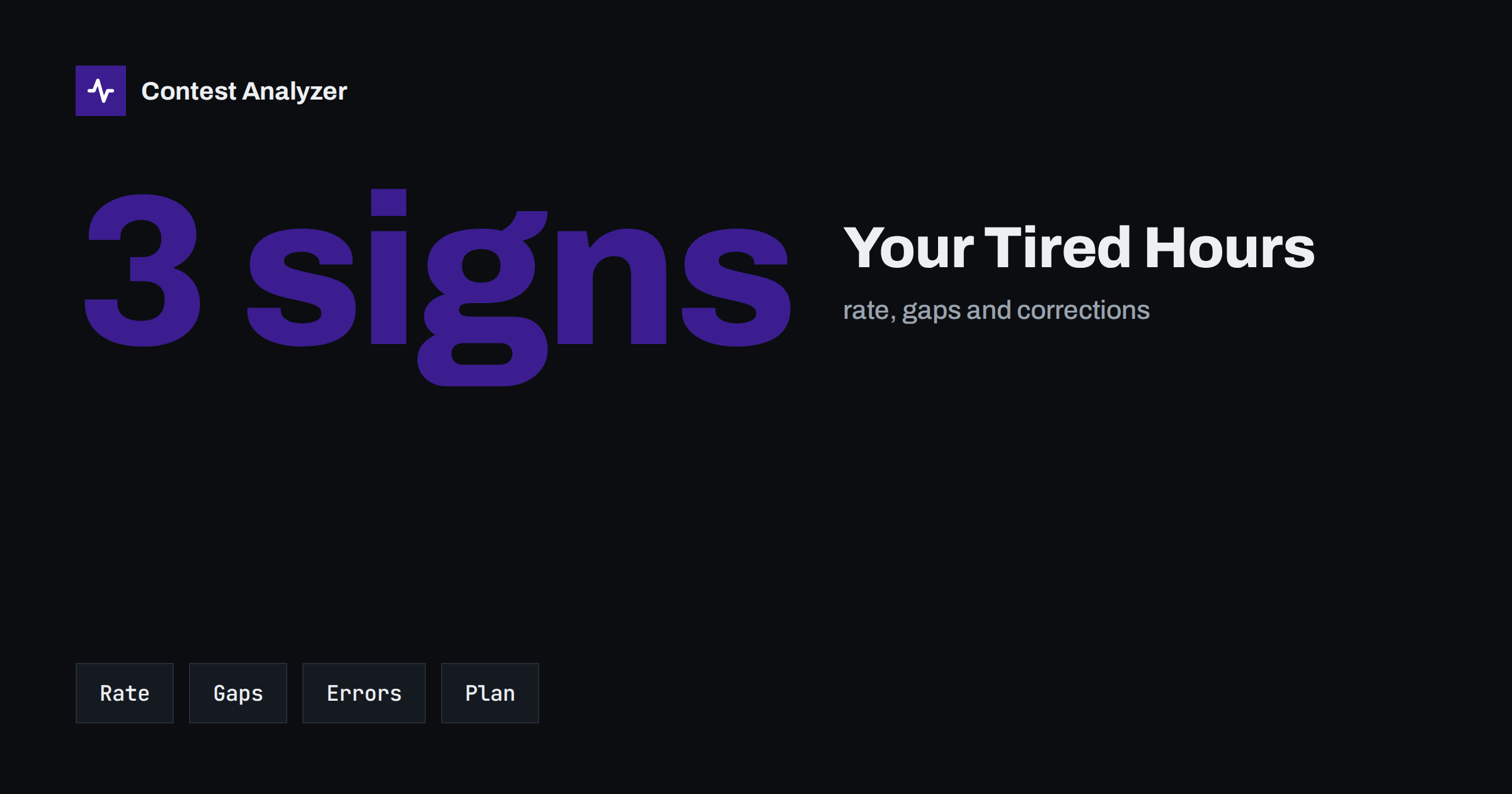
Short answer: Tiredness leaves traces in a contest log: the rate falls without a change in conditions, the pauses between QSOs become longer and the corrections cluster in certain hours. Put the hourly rate, the gaps and the corrected QSOs side by side, and the hours in which you worked below your usual level become visible. Then plan rest and a different routine for those hours in the next contest.
Why look for fatigue in numbers
During a contest, most operators do not notice how tired they are. The brain makes up for it, and the operator feels fine until a clear mistake happens. The log is a more honest witness: it records every QSO with a time, and a drop in performance shows there even when the operator does not feel it. The article on operator fatigue and breaks describes the general reasons, and this article shows how to read them from the data.
The aim is not to blame yourself, but to learn where your limits are. If the same hours are weak in several years, the cause is probably your body and your plan, not the band. That is a useful piece of knowledge, because it can be changed by sleep, food and a better break schedule.
Sign one: a rate that falls for no reason
The first sign is the hourly rate. Every contest has a natural shape, with hours that are strong because the bands are open and hours that are weak because they are not. Fatigue is something else: a fall in the rate that does not follow the conditions. To see it, compare your rate with the same hours in other years, and with your own rate in the hours before and after. If the band was open and many stations were on, but your rate was half of what you did before, look for another cause than propagation.
The hour-by-hour numbers are explained in the hour-by-hour analysis, and the articles on contest rates and multipliers per hour show how to read the rate and the multipliers together. A fall in the rate with a steady number of multipliers is often a sign of a tired operator who still finds the new stations but works slowly.
Sign two: longer gaps between QSOs
The second sign is the time between QSOs. When you run a frequency, the gaps are short and regular. When you are tired, the gaps become longer: you take more time to find the next call, you ask for repeats more often or you stop for short moments that you do not notice. These gaps do not appear as breaks, because the pauses are shorter than the off-time limit, but they reduce the rate.
Look at the longest gaps in each hour, not only at the average. A few gaps of three to five minutes in an hour tell a different story from a steady slow rate. Short gaps that appear often can also be a sign of a technical problem, so check the station notes before you draw conclusions. The article on off time and breaks explains how longer pauses are counted under the rules, which is a separate question from the rate.
Sign three: errors in clusters
The third sign is the position of the errors. After a check of the log, collect the QSOs that you had to correct, such as a busted call, a wrong zone or a wrong time. Put them on a line by hour. Random errors are spread over the whole contest; errors caused by tiredness come in clusters, mostly in the second half of the night and in the final hours. A cluster in one or two hours is a strong sign.
The articles on errors in the night hours and on headphones and audio fatigue describe the typical forms: the wrong letter in a call, a zone copied from the previous QSO and a time that does not fit the rest. If your errors cluster, you have a clear target for improvement.
Putting the three signs together
One sign alone can have another cause. A low rate can come from a closed band, a long gap from a phone call, an error cluster from an unusual pileup. When all three show in the same hours, the picture is clear. Make a simple table for yourself, with the hours in rows and the three signs in columns, and mark the hours in which two or three of them appear. These are your tired hours.
Contest Analyzer gives full statistics, such as rates, QSOs by hour and band, countries, continents, CQ and ITU zones, breaks and off time, callsign length and structure, and a year-on-year comparison with your own logs, so that the first two signs are already in the report. It checks every callsign and every zone against official license databases and several independent reference sources and shows only the few QSOs worth a second look, which gives you the third. The contests page lists the 22 contests that are supported.
Compare years, not single hours
One bad hour proves little. A pattern that repeats in two or three years shows a real limit. Compare the same contest in different years, and check whether the weak hours are in the same part of the day. The method is in the same contest in two years and in comparing results year on year. If the hours move from year to year, the cause is more likely outside your body, such as the conditions or the schedule of the contest.
Keep notes about sleep, food and breaks for each contest. A short note such as “slept three hours, tired from hour 30” is worth more than a memory a year later. The notebook described in a station notebook is a good place for it.
What to change for the next contest
When you know your tired hours, change the plan, not the willpower. Move the main break to the hours in which you are weakest, or add a short rest before them. Eat and drink at fixed times, and keep the room cool and quiet. Choose the work that is easiest in the weak hours, for example a steady run on a band that is open, instead of a long search for new multipliers. Keep the hard, concentrated work for the hours in which you perform best.
If you operate in a category in which off time is counted, remember that the rule decides which breaks count, and check it in the current rules. In CQ WW, for example, single-operator off time counts only for breaks of at least 60 minutes, so a series of short rests does not help the total in the same way. Plan the rest according to the rule of your contest, not only according to your feeling.
Do not confuse fatigue with conditions
Before you decide that you were tired, check the bands. A drop in the rate at the time of a band closing or a sudden fall in the number of stations is a condition, not a person. The same is true for a period of strong noise or a solar event. The article on solar flux and the K index shows how to compare conditions between years. Only when the conditions explain nothing should you look at your own numbers.
A worked example in words
Imagine a log in which the rate is steady at a good level for the first twenty hours, falls by a third in hours twenty-two to twenty-five, and then returns after a two-hour break. In the same hours, the report shows three gaps of more than four minutes and a group of corrected calls that is larger than in all other hours together. The bands were open, and the number of stations on the air did not change. This is a typical picture of a tired operator, and it suggests that the break should have come earlier, before the rate fell, not after it.
Now imagine the opposite: the rate falls for three hours, but the number of multipliers per hour falls too, the gaps stay short and no corrections appear. This is more likely a band that closed, and no change of habit would have helped. The difference between the two pictures is the reason to look at all three signs and not at the rate alone.
How to keep the analysis honest
Use the same method each year, so that the numbers can be compared, and do not choose the hours that fit a story that you already believe. If the data does not show a clear tired hour, accept it. A flat result is also a result: it means that your plan for rest worked, and that the next improvement lies somewhere else, for example in the antennas or in the choice of bands.
Related reading
The bottom line
Look for three signs in the same hours: a rate that falls for no reason, longer gaps and clusters of errors. When they meet, you have found a tired hour, and the next plan can place rest and easy work there.
FAQ
How do I know that a low rate is fatigue?
Compare it with the conditions and with the same hours in other years. If the band was open, fatigue is a possible cause.
Are longer gaps counted as off time?
Only if the rule of the contest counts them. Read the current rules for the minimum length of a break.
Do errors always mean that I was tired?
No. Noise, a strong pileup or unusual calls also cause errors. Look for clusters in the same hours.
How many years do I need for a pattern?
Two or three comparable contests give a useful picture. One contest is only a hint.
What is the easiest fix?
Plan a rest before the weak hours and keep easy work for them.