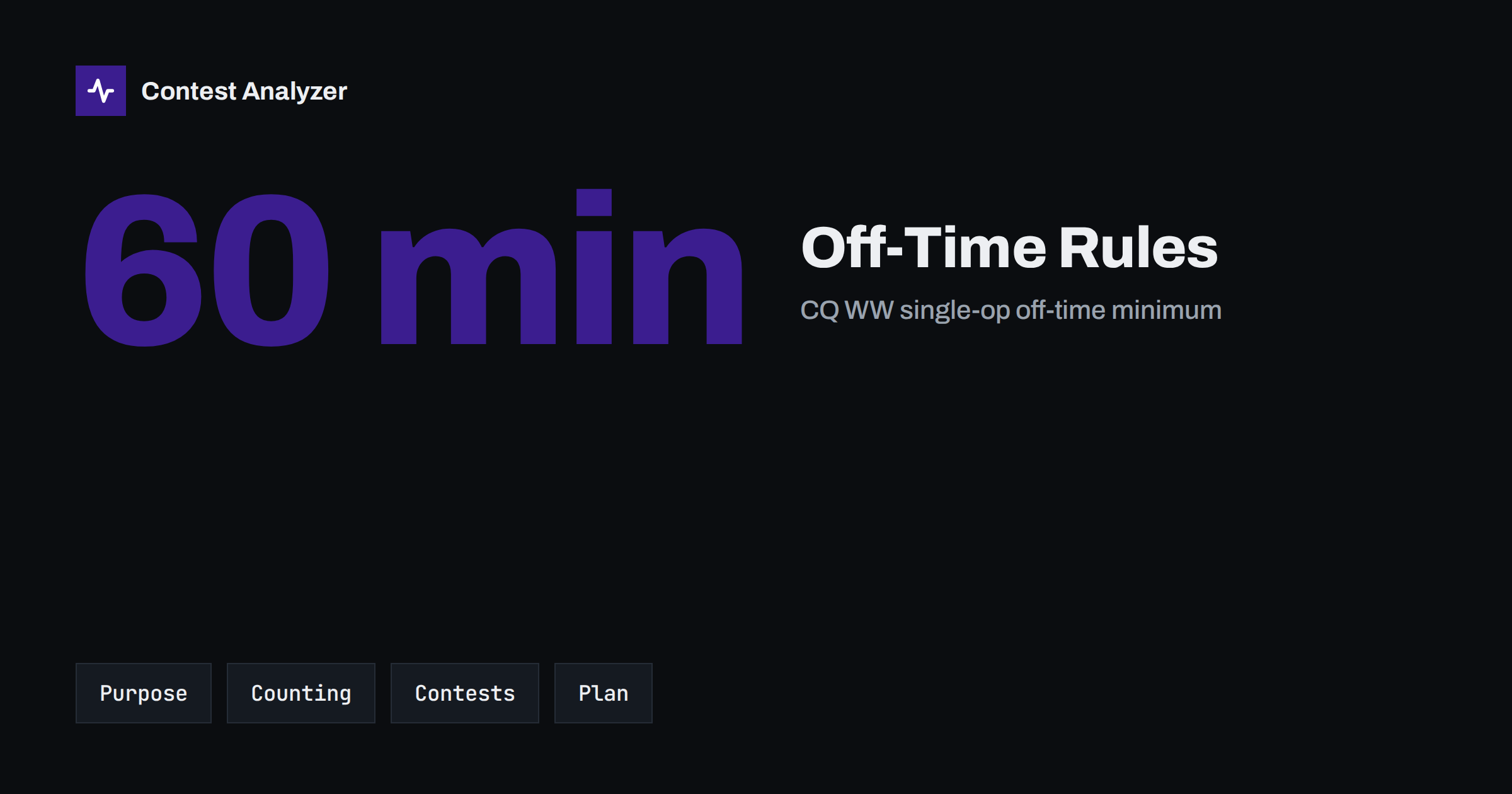
Short answer: Many contests limit the operating time of single operators, and they count only off-time periods that are long enough to be a real rest. In CQ WW, for example, single-operator off time counts only for breaks of at least 60 minutes. Other contests set other limits or none at all, so read the current official rules of each contest, and plan your rest before the start.
Why off-time rules exist
A contest compares stations over a fixed period. A single operator who works the whole time without sleep has no advantage over the one who rests, if there is no rule about time, but there is a practical problem: it is difficult to compare a person who sits at the radio for 48 hours with one who sits for 24. The off-time rules were made to give a fair comparison. They allow some categories of operators to work a limited number of hours, or to count only part of the time as operating time, so that a single operator is not compared with a team of several people who operate in shifts.
The rules also protect the idea of a single operator: one person who operates the station, with limited help. An operator who sleeps for eight hours is at a disadvantage against a multi-operator team, and the rules compensate this by dividing categories. The article on off time and breaks in contest rules gives a general picture. This article looks more closely at the single-operator situation.
How operating time is counted
The principle is simple, but the details vary. A contest may count the whole period between the first and the last QSO, minus the breaks that fit the definition of off time. The definition usually says how long a pause must be to count as off time. In CQ WW, for the single operator, a pause shorter than 60 minutes is not off time, so the short breaks of a few minutes do not reduce your operating hours. Only a break of at least 60 minutes counts, and it is subtracted from the total time.
Look at it from the point of view of planning. Ten breaks of 20 minutes are not counted in CQ WW, so they do not use up the allowed operating time. One break of 60 minutes counts as off time. Other contests may use different thresholds, different rules about the time of breaks or no limit on operating time at all. The only safe method is to read the rules of the contest that you enter. For CQ WW, the official reference is the CQ WW rules page.
Which categories have time limits
Not every category has an operating time limit. In some contests, the limit applies to certain categories, such as single operator with a maximum number of hours, or categories for beginners or for low power. In others the limit is the same for all single-operator entries, and in some there is no limit at all. The names of the categories change from contest to contest. When you compare your options, use the description in the rules, and not the experience from another contest. The article on assisted versus unassisted categories shows how the definitions of categories can differ.
It is also true that rules change from year to year. A category may be added, a limit changed or a definition made more precise. Do not rely on memory or on last year’s description. Read the rules each time, before you choose a category, and again before the contest if the organisers have published updates.
Planning rest within the rules
A good plan starts with the rules and ends with the body. Decide first how many hours the rules allow you to work in your category. Then divide the rest into periods that you can use. Many operators plan one long rest at night, when the bands are weakest at their location, and a shorter rest on the second night. They choose the time for the rest from the statistics of earlier years: the hours of the lowest rate and the fewest multipliers. The article on planning your contest schedule in UTC shows how to do it.
Do not forget that a break that is shorter than the minimum for off time does not count as off time, but it is still a break for you. Short rests are useful. A few minutes of rest keep the accuracy high, and they do not change the total of off time if the rules count only long breaks. The article on operator fatigue in 48-hour contests describes how short and long breaks affect rate and accuracy.
How the logger and the log show off time
The off time is not written in the Cabrillo file as a separate item. It is calculated from the QSO times. The organisers or the program look at the gaps between QSOs, and a gap that is long enough counts as off time. Many loggers show the off time during the contest, so that you can keep track of it. If your clock is wrong, or if QSOs are logged with wrong times, the gaps change, and so does the off time that is calculated from them. The article on wrong PC clock or UTC errors describes the effect.
Keep a note of when you start and stop. A paper note or a simple text file with the times of your breaks is useful if you have to check the result later. If you also record audio, the recording is another source for the time of the first and the last QSO.
Statistics about breaks and off time
After the contest, look at your own breaks. How many did you take, and how long were they? Did you stay within the limit of your category? When did you rest, and what happened to the rate before and after? Contest Analyzer shows breaks and off time, together with rates, QSOs by hour and band, countries, continents, CQ and ITU zones and year-on-year comparison with your own logs. It marks QSOs outside the contest period and outside the band limits for your ITU region, with split QSOs shown as a note. It checks every callsign and every zone against official license databases and several independent reference sources and shows only the few QSOs worth a second look. It works with Cabrillo from N1MM Logger+, DXLog and Win-Test. The contests page lists the supported contests.
Use this report to check that your log does not break the rule without your noticing. If an unexpected gap appears, for example because of a computer problem, it may count as off time, and you will see the effect on the total.
Multi-operator and band changes are different rules
Do not confuse off-time rules with the rules for multi-operator entries. In multi-operator categories the rules limit the number of band changes or the number of transmitters, and they do not limit the operating time of each person. The article on multi-operator categories and band-change rules gives a general view. A single operator should not apply the rules of a multi-operator category, and the other way round.
Also keep the log deadline separate from the operating rules. A deadline for the submission of the log is a different rule, and it has its own consequences. See contest log deadlines for a routine that helps to avoid problems.
What happens when the limit is exceeded
The consequence of working more hours than the category allows depends on the contest and on the decision of the organisers. In some cases the entry is moved to another category, for example from a limited-time class to an unlimited one. In others the log may be disqualified from the category. Because the result can be a change of category, it is a good idea to check the time before you submit, and not to leave the question to the committee. Do not guess the consequences; read what the rules say, and if the text is not clear, ask the organisers before the deadline.
If you realise that you made a mistake in the choice of category, correct the header of the log before submitting. A correct category line is much better than an explanation after the results have been published. The article on the Cabrillo log header explains the category fields.
A short checklist
- Read the rules of the contest and of your category: operating time, minimum break length and how off time is counted.
- Write your plan for the rest periods in UTC.
- Check the clock of the computer, so that the log shows the right times.
- Keep a note of the start and the end of each long break.
- After the contest, check the breaks and the off time in your statistics.
- Write the result in your notebook to improve next year’s plan.
Related reading
The bottom line
Off-time rules are different in each contest and each category. Learn the current rule, plan the rest within it and check your own breaks in the statistics afterwards.
FAQ
Does a short break count as off time in CQ WW?
For single operators, only breaks of at least 60 minutes count as off time under the current rule. Check the current official rules.
Do all contests have the same off-time rule?
No. Limits, minimum break lengths and categories differ between contests.
Where is off time written in the Cabrillo file?
It is not written separately. It is calculated from the times of the QSOs.
Can a wrong clock change my off time?
Yes. Wrong QSO times change the gaps, and so the calculated off time.
Should I rest more than the rules require?
Plan rest for your own accuracy and health, within the rules of your category.