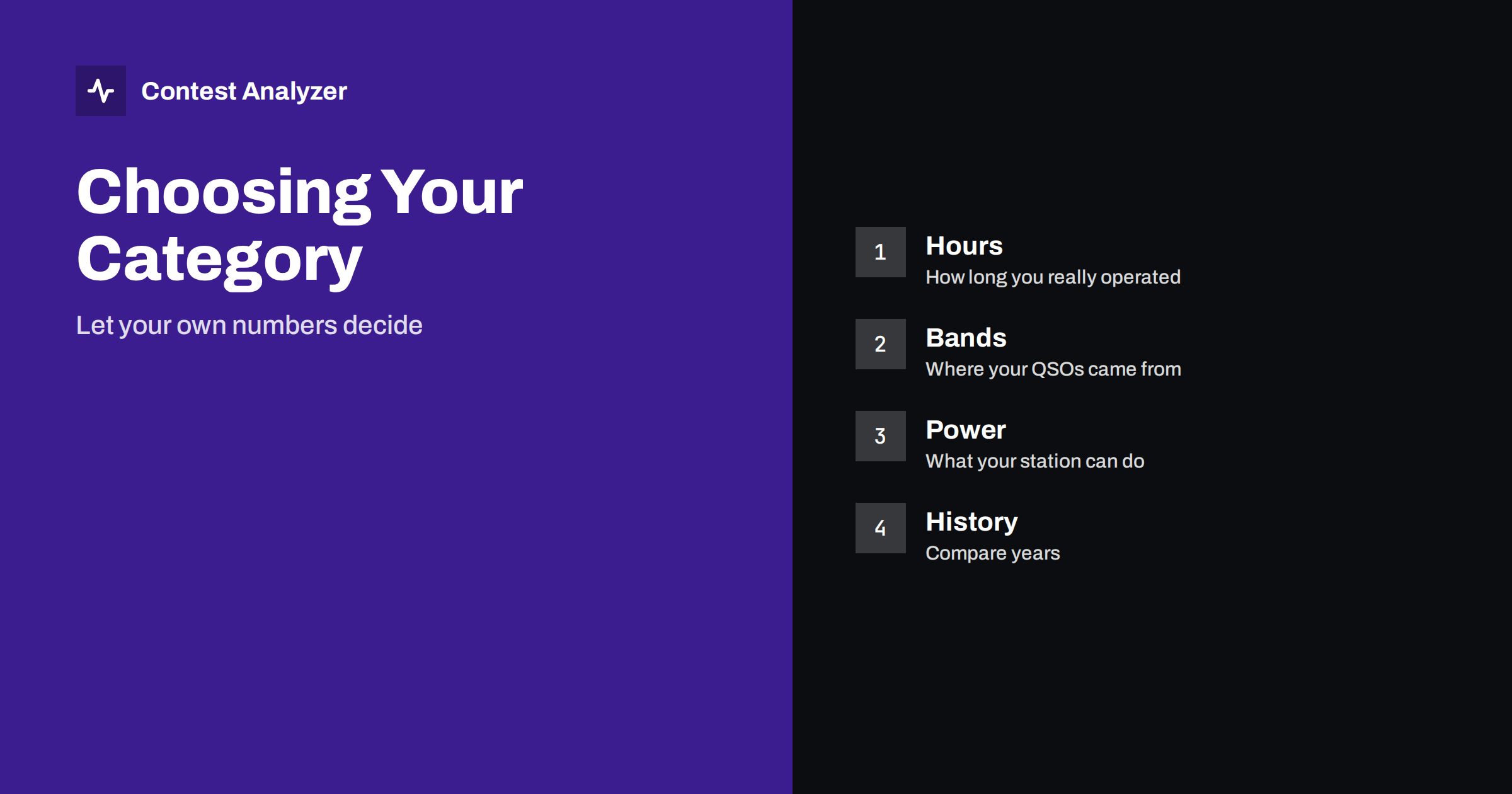
Short answer: The right contest category is the one in which your own statistics show you can do well and enjoy the contest. Look at how many hours you really operated, how your QSOs were spread over the bands, what your rate was and how much assistance or power you used. Then compare the categories in the current rules with those numbers, and choose the one that fits.
Why a category choice needs numbers
Many operators choose a category by habit or by what friends do. This works, but it can also leave points on the table. A station with strong antennas on the high bands may do well in a high-power category that rewards its strengths. A station that cannot be on air for the whole contest may find a better place in a category with a limited time or in a single-band category. The statistics from your last contests show your real strengths, not the ones that you think you have.
The aim is not to find the easiest category, but the one in which your station and your time give the best result against comparable stations. The article on assisted versus unassisted categories and the one on QRP and low-power categories describe the general idea of the main groups. Rules differ between contests, so always read the current official rules before you decide.
The numbers to collect
Take the logs of the last two or three contests of the same type and write down a few facts for each:
- total QSOs, multipliers and claimed score;
- operating hours, and the breaks and off time that you took;
- QSOs and multipliers per band, and the hours of the day in which they were made;
- share of runs and of search-and-pounce QSOs;
- highest and average rate;
- number of QSOs that were corrected or removed after the check.
These numbers are in the statistics of a normal analysis. The article on how to compare your results year on year explains how to make the comparison fair, and the article on the same contest in two years shows what to look for.
Operating time and the choice of category
The number of hours you can sit at the radio is the most important factor. If you operated for the full contest with few breaks, you can enter a category for full-time operators. If your real operating time was much shorter, a category with a limit on operating time, if the contest has one, may give you a fairer comparison. Some contests have such categories and some do not. In others the off-time rule decides which time counts. In CQ WW, for example, single-operator off time counts only for breaks of at least 60 minutes, but check the current rules for details.
Look at your own hours honestly. Many operators say that they will be on air for the whole contest and then find that their log has long gaps. The hour-by-hour view of your log shows this clearly, as described in the hour-by-hour analysis. Choose the category according to the hours that you really operated, and adjust it if your circumstances change.
Bands and the choice of single-band or all-band
If most of your points come from one band, a single-band entry may be worth a try. The statistics show it: if more than a half of your QSOs and multipliers are on one band, and other bands add little, a single-band category may give a better result, because you can focus all the time on the band that works best. If your points come evenly from several bands, an all-band category is more natural, because your multipliers are spread over the bands. The article on single-band entries describes how to choose the band and what to watch.
The same view shows the effect of conditions. A band that was strong last year may be weak this year. Do not rely on one result; look at two or three years and at the solar conditions, as in solar flux and K index.
Power and assistance
Power categories are determined by the power at the output of the transmitter, and the rules are strict. The statistics cannot tell you which power class suits you, but they show what happens at the power that you used: how many QSOs you made on the low bands, how often callers did not hear you and how your rate compared at different times. If you have run low power and your results were good in your own comparison, a low-power category may suit you, and a lower power category often gives more competitive results among similar stations.
The question of assistance, such as the use of spots or decoding aids, belongs to the category definitions, and it is a matter of honesty. Choose the category that matches the way you really operated, and read the exact definition in the current rules. Overlays, such as classic or rookie, are described in category overlays explained.
Compare with others in your category
After you have a short list of possible categories, look at the published results of previous years. How many stations took part in each category in your country and in the world? What scores were at the top, in the middle and near your own results? A category with few entries may give a high placing, but it is less competitive in the sense that few people can compare. A category with many entries is more demanding but gives a better test of your station. Neither is better for everyone.
Use this information to set goals, not to chase a placing at any cost. The article on setting realistic contest goals shows how to translate the numbers into targets that you can reach.
A simple decision table
If you like to decide with a table, make one with the categories that you consider in the rows and four columns: the hours that you can really operate, the bands that give you most points, the power that you can use and the result that you want to reach. Fill in the cells with your own numbers from the last contests, not with wishes. Then read across each row and ask which category has the fewest conflicts with the facts. The row with the fewest conflicts is the first candidate, and the second one is the fallback if the plans change.
Keep the table with your notes. When you look at it again after the contest, you can see which cells were wrong and correct them for the next time. This simple method turns a feeling into a decision that you can check.
Check the log for the chosen category
After the contest, make sure that the header of the Cabrillo shows the category that you really entered. A wrong category line is a common reason for a log to be reclassified. Contest Analyzer shows full statistics, such as rates, QSOs by hour and band, countries, continents, CQ and ITU zones, breaks and off time, and a year-on-year comparison with your own logs, which helps you choose next year’s category. It checks every callsign and every zone against official license databases and several independent reference sources and shows only the few QSOs worth a second look, and it marks QSOs outside the contest period and outside the band limits for your ITU region. It works with Cabrillo from N1MM Logger+, DXLog and Win-Test. See the contests page for the 22 supported contests.
Typical mistakes in choosing a category
The first mistake is to choose a category for the title instead of the result. A category in which you have no chance to finish well is not rewarding, and a category that does not match your real operating style makes the contest harder than it needs to be. The second mistake is to use only the last contest as the basis. One contest may have been unusual, with bad conditions, a station problem or a lack of time, and it gives a false picture. Use two or three contests where possible and look at the averages and the best results together.
The third mistake is to forget the log. A log with many corrected or removed QSOs is a weaker basis for a decision than a clean one, because the final score is lower than the claimed one. Compare final results, not only claimed ones. The article on claimed versus final score explains why the two differ. The fourth mistake is to change the category and the station at the same time, so that you cannot tell which change caused the result. Change one thing at a time, and write it down.
Review the choice every year
Your circumstances change: a new antenna, a different job, a move to another house. Review the category choice each year, based on the new numbers. Write the decision in a notebook, with the reasons, and look at it again after the contest to see if the choice was right. Over a few years, you will see which category gives you the best mix of results and enjoyment.
Related reading
The bottom line
Choose the category with your own statistics: hours, bands, power and history. Read the current rules, compare with earlier results and review the choice every year.
FAQ
Can I change my category from year to year?
Yes. Choose it for each contest according to the current rules and what you plan to do.
Which numbers matter most?
Operating hours, the share of points per band and your rate. They show how your station really works.
Is a single-band entry always a good idea?
Only if your statistics show that one band gives most of your points. Otherwise an all-band entry is more natural.
Where do I check the category definitions?
In the current official rules of the contest. Rules change, so read them every year.
How does the header of the log show my category?
In the Cabrillo category lines. Check them before you submit, because a wrong line can lead to reclassification.