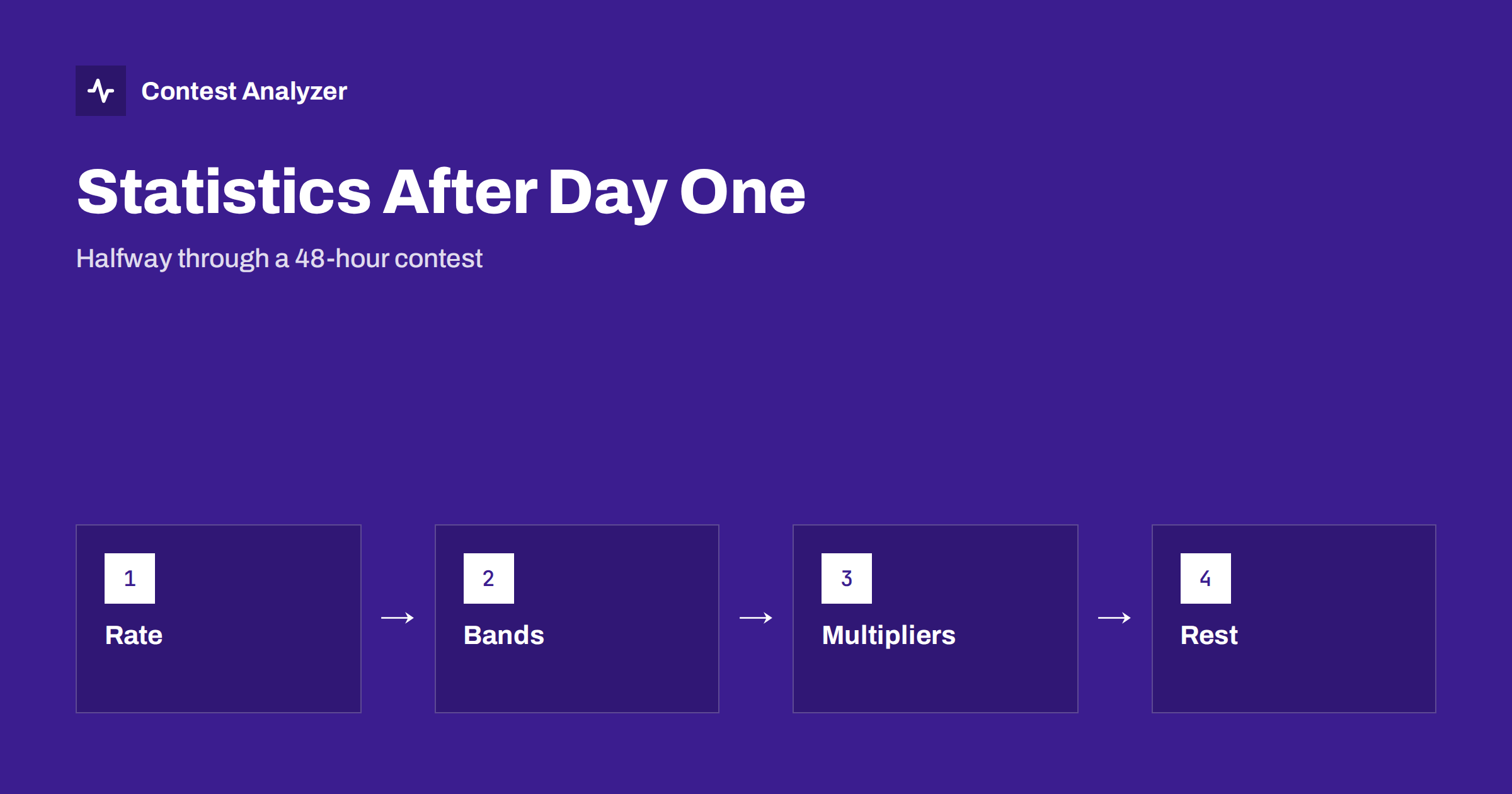
Short answer: After the first 24 hours of a 48-hour contest you have half of your data and half of the time. A short look at your hourly rate, the share of QSOs by band, the multipliers you still lack and your breaks tells you what to repeat and what to change on the second day. Keep the review short, base the changes on the numbers and not on feelings, and do not let it take more time than a meal break.
Why a mid-contest review is worth the time
Most operators look at their statistics only after the contest, when nothing can be changed. Halfway through, the same numbers give you a chance to act. You can see that one band produced much less than you expected, that your multiplier curve flattens early or that the hours after your last break were weak. These facts are visible only in the data, because during the contest you feel the rate more than you measure it.
A review of five to ten minutes is enough. The goal is not to analyse everything, but to answer four questions: how is my rate, where did the QSOs come from, what is still missing and how is my energy. Think of it as the equivalent of looking at a map during a long drive.
Question 1: how is the rate by hour?
Look at the number of QSOs in each of the 24 hours. The pattern is more important than the total. Most contests show a strong start, a dip in the first night, a recovery in the morning and a second peak when the bands open towards other continents. If your pattern differs, ask why. A deep dip may be a planned break, a technical problem or a bad band choice. The article on contest rates explains how to read hourly numbers and 10-minute and 60-minute rates.
Compare the peak hours with the rate that you expected before the contest. If you set a goal, see how far you are from it. The article on setting goals from your statistics is useful here. Do not change the goal at this point, but use the difference to decide how much risk to take on the second day.
Question 2: where did the QSOs come from?
Next, look at the share of QSOs by band and by continent. In the first day, one or two bands usually provide most of the QSOs. Check whether it is the same ones that gave the best results last year, or whether something is different. A band with a very low share may be a sign of a problem with an antenna, or simply of poor propagation. The articles on the band ratio and the continent breakdown describe how to read these numbers.
Also look at the split between running and search and pounce. If you have a high share of search and pounce, you may be spending too much time looking for multipliers early, when running would give more. If the share of running is very high, you may have too few multipliers. The article on run vs search and pounce shows how to think about the balance.
Question 3: what is still missing?
For a multiplier contest the second day is the time when multipliers are valuable, because the easy ones are already in the log. List the countries or zones that you still need on each band, and think about when they may be available. A multiplier that is only possible at a certain hour on a certain band should be put in your schedule, and the rest of the time can be used for running. The article on multipliers per hour shows how to read the curve of new multipliers.
Be realistic. Not every missing multiplier is reachable, and chasing one that does not appear wastes the rate. Use the first day as evidence: if a certain multiplier did not appear in the hours when it was most likely, it may not appear at all this year.
Question 4: how is the off time and your energy?
Look at your breaks. How many hours of off time have you used, and when? Many contests count off time and limit the operating time in some categories, so check the rules of your category. The article on off time and breaks explains the principle. Beyond the rules, think about your own state. If the first night was too long, the second one will be worse, and a planned rest may give a better result than pushing on. The article on operator fatigue deals with this question.
What not to conclude from one day
One day is a small sample. A slow hour may be caused by the band, not by your operating. A very good hour may not be repeatable. Avoid sweeping decisions, such as giving up a band after one weak hour. Use the review to find clear signals, such as a technical fault, a plan that did not work or a break that you forgot. Mark the doubtful points and check them again after the contest, with the whole data.
Do not compare yourself with other stations during the contest. Their conditions, equipment and categories are different, and the information you see on the web may be incomplete. Your own log is the only fair reference for your own decisions.
A short routine for the review
- Choose a time when the rate is low, for example just before a planned break.
- Open the hourly view and the band view of your log, or a report from your logger.
- Write down one thing to keep, one thing to change and one thing to check.
- Update your schedule for the second day, including the rest.
- Close the report and go back to operating. Do not stay in the numbers.
Three points are enough. Too many points will not be remembered, and the contest is not the right place for a long analysis.
What to do with the result
The review is useful only if it changes something. After you have your three points, translate each into a concrete action that you can do in the next hours. If the point is to keep a good habit, write it where you can see it, for example on a card next to the keyboard. If the point is to change something, decide the exact change: a band that you will try at a certain time, a break that you will move, a multiplier that you will look for at a certain hour. If the point is something to check, set a reminder for the time when you can look at it without disturbing the rate.
Write the result in your station notebook as well, with the time of the review. A line such as “after 24 hours: rate dropped in the early morning, 15 m weak, one multiplier hour planned” is enough. When you read it after the contest, it will help you to see how the situation looked in the middle, before you knew the final result. This is useful when you compare the contest with the same event next year, because memory changes the story and the notes keep it as it was. The article on keeping a station notebook gives more ideas.
If you operate in a team, make the review a short shared moment. One person reads the numbers, and the others add what they observed. The team then decides together who operates which band at which hour. A two-minute talk can save much more time than it uses, and it also helps people to feel that they have a clear plan for the second half of the contest.
Finally, accept that the plan will change. The bands will not behave exactly as you expect, and the best operators adjust all the time. The aim of the review is not a perfect plan, but a better starting point for the next hours than the one that you had at the start of the day.
Using a report after the contest
After the contest, the same questions can be answered with all the data. Contest Analyzer gives full statistics: rates, QSOs by hour and band, countries, continents, CQ and ITU zones, WPX prefixes, distance, beam heading, breaks and off time, and callsign length and structure. It also supports year-on-year comparison with your own logs, so you can see whether your first day was better or worse than last year. It checks every callsign and every zone against official license databases and several independent reference sources and shows only the few QSOs worth a second look. The contests page lists the 22 supported contests, and the pricing page lists the plans.
Related reading
The bottom line
A ten-minute review after the first day tells you where your rate, bands and multipliers stand. Answer four questions, choose three points to act on and go back to the radio with a better plan for the second day.
FAQ
Is it worth stopping to analyse during the contest?
Yes, if it takes only a few minutes at a quiet moment and leads to a clear change.
Which numbers matter most after day one?
Hourly rate, QSOs by band, multipliers still missing and the breaks you have used.
Should I change my goal after the first day?
Usually not. Use the difference to decide how much risk to take.
Can one weak hour tell me that a band is bad?
No. One hour is a small sample, so look for repeated patterns.
When should I do the full analysis?
After the contest, when you have all the data and your recording.