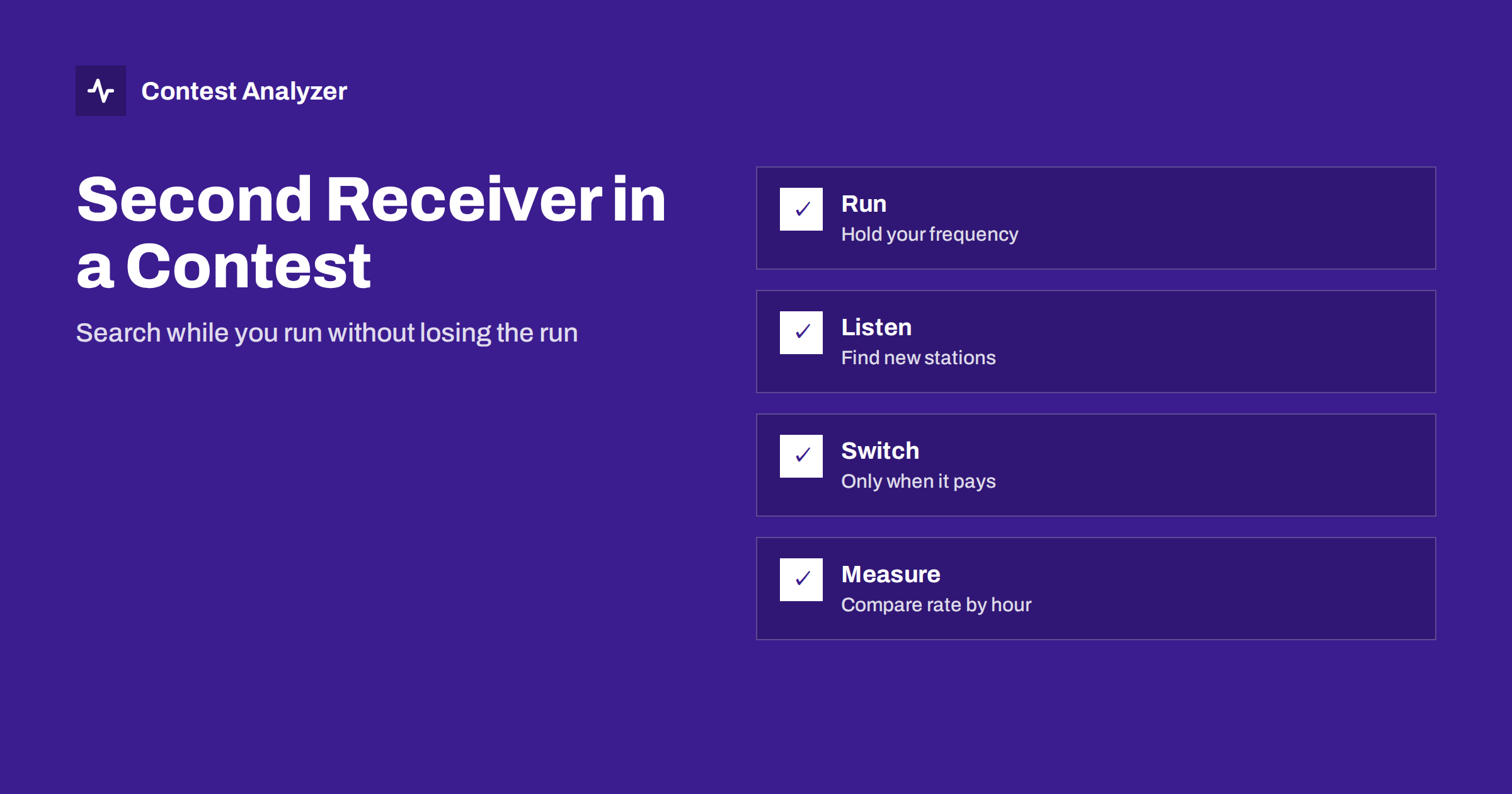
Short answer: A second receiver, or a second VFO on the same radio, lets you listen on another frequency for a new multiplier while your run frequency stays in place. It can raise the number of multipliers without ending the run, but it costs attention, and the quality of your copying can suffer. Whether it pays depends on the contest, the band and your skill, and the best way to decide is to compare your hourly rate and multiplier count with and without it. Check the rules of your category first.
What a second receiver is and is not
A second receiver here means any way to listen on a second frequency while the transmitter stays on the first. It may be a second receiver in the radio, a sub-receiver, a separate receiver or a software-defined receiver on a computer. A second VFO that you switch to for a moment is the simplest version, but it interrupts the listening on the run frequency. In the full version, you hear both frequencies at the same time, one in each ear or on separate speakers.
This is not the same as operating with two radios and two transmitters, which is the subject of the article on SO2R basics. In SO2R, you transmit on both radios in turn. With a second receiver you only listen on the second frequency, and any call to a station you find must wait until you leave the first one. Rules of a contest category may treat the two cases differently, so read the rules before you choose your setup.
Why use it: the case for multipliers
In a run, the callers come to you, but you do not control which stations they are. After the first hours, a run produces many QSOs with stations that you have already worked on other bands. The multipliers come from stations that you do not hear on your own frequency. A second receiver lets you listen for them while you hold the run. When you find one, you wait for a gap in the callers, tell the pile to wait, move to the multiplier, work it and return to the run.
Whether this gain is important depends on the multiplier system of the contest. In CQ WW, new zones and countries on each band count, and in the later hours the number of new ones is small. A single rare multiplier may be worth a larger share of the score than several QSOs. For a deeper look at the numbers, see the article on multiplier strategy in CQ WW.
What it costs: rate and attention
There are two costs. The first is a direct loss of rate. Every time you leave the run to work a multiplier, the callers on your frequency wait, and some of them go away. A short trip of thirty seconds may cost a few QSOs. The second is a loss of attention. While you listen to the second frequency, you hear less of the callers on the first, and the number of partial calls and requests for repeats can increase. Check your own numbers after the contest: the share of repeats and corrected calls is a useful indicator.
For many operators, the best use of a second receiver is limited to certain periods, such as when the run rate falls below a level that they have chosen, or when a specific multiplier is expected to open. Using it all the time is tiring and rarely gives the best result over 48 hours. The article on operator fatigue explains why.
How to set up the audio
- Separate the two sources. Use one ear for the run and the other for the search, or set different volumes. The brain can follow two sources only if they are clearly different.
- Keep the run side louder at first. Callers on your frequency are your income. Raise the second side only when you decide to search.
- Use a different filter on each side. A narrow filter on the run and a wider one for searching helps you to find signals quickly.
- Make a fast way to swap. A key or a button that moves the transmitter to the second frequency saves seconds, but it must not be easy to press by accident.
Test your setup before the contest. A change of audio routing in the middle of the event is a source of mistakes.
How to avoid logging mistakes
The logger is the weak point. When you work a station on the second frequency, the program must show the right frequency and mode, and it must not confuse the QSO with the one that is in progress on the run. If your frequency in the log is taken from the radio by a data connection, check that it follows the transmitter and not the second receiver. A wrong frequency can make a QSO appear on the wrong band, as the article on frequency errors in the logger describes.
The other risk is the call. With attention divided, calls from the second frequency are often partial. Do not accept a half-copied call because you are in a hurry to return to the run. Ask for the repeat on the second frequency, because the pile on the first one can wait for ten seconds.
How to read the result in your statistics
A fair test of the technique needs numbers. After the contest, compare these figures for the hours when you used the second receiver and for the hours when you did not:
- QSOs per hour, from the hourly view of your log.
- New multipliers per hour, especially in the second half of the contest.
- The share of QSOs that you made by running and by search and pounce.
- The number of corrected calls after the review.
If the multipliers per hour rise and the rate falls only a little, the technique pays. If the rate falls strongly and the number of multipliers does not change, you spent attention for little gain. The article on multipliers per hour shows how to read the curve.
Contest Analyzer gives full statistics: rates, QSOs by hour and band, countries, continents, CQ and ITU zones, WPX prefixes, distance, beam heading, breaks and off time, and callsign length and structure. It also supports year-on-year comparison with your own logs, so you can compare a contest where you used the second receiver with one where you did not. It checks every callsign and every zone against official license databases and several independent reference sources and shows only the few QSOs worth a second look. The contests page lists the 22 supported contests.
A trial plan for your next contest
If you want to try the technique, plan the trial in advance so that the result means something. Choose one band where you usually run well, and decide a fixed length for the test, for example sixty minutes in the second day. In the first half of that hour, use the second receiver in the way described above. In the second half, run without it. Write the start and end times in your notes, so that you can find the periods in the hourly view later.
Keep the other conditions as equal as you can. Rate depends on the band, the time and the propagation, and two different hours are never exactly the same. For this reason one trial does not prove anything, and two or three trials in different contests give a better answer. Over the years your logs create a record, and the year-on-year view shows whether the new habit really changed the result.
Do not forget to write down how you felt. A technique that gives a few more multipliers but leaves you exhausted for the next hours may not be a good choice. Listening fatigue and mental load are real limits, and the best operators know their own. The notes about your feeling are as useful as the numbers when you plan the strategy of the next contest.
Who should try it and when
A beginner who still learns to run cleanly should first make the run stable. The second receiver is a tool for operators who already have a steady rate and want to add multipliers. It is more useful in contests where the number of multipliers is large and in the second half of the contest, when the easy ones are done. It is less useful in a short contest, where the rate is more important than the variety. Test it for one hour in a calm period and look at your numbers before you decide to use it for longer.
Related reading
The bottom line
A second receiver can add multipliers without ending a run, but it takes attention and can cost rate. Check the rules of your category, set up the audio carefully and judge the technique by your own hourly numbers.
FAQ
Is a second receiver the same as SO2R?
No. With a second receiver you only listen on the other frequency, while SO2R means transmitting on two radios in turn.
Does it increase my score for sure?
No. It can add multipliers, but it can also reduce rate and accuracy. Compare your hourly numbers.
Can my category forbid it?
It may, so read the current rules of the contest and your category before you use it.
When is the best time to search while running?
Usually when the rate falls or when a multiplier is expected to open, not all the time.
What is the biggest risk in logging?
A wrong frequency or a half-copied call from the second frequency. Check both before you save the QSO.