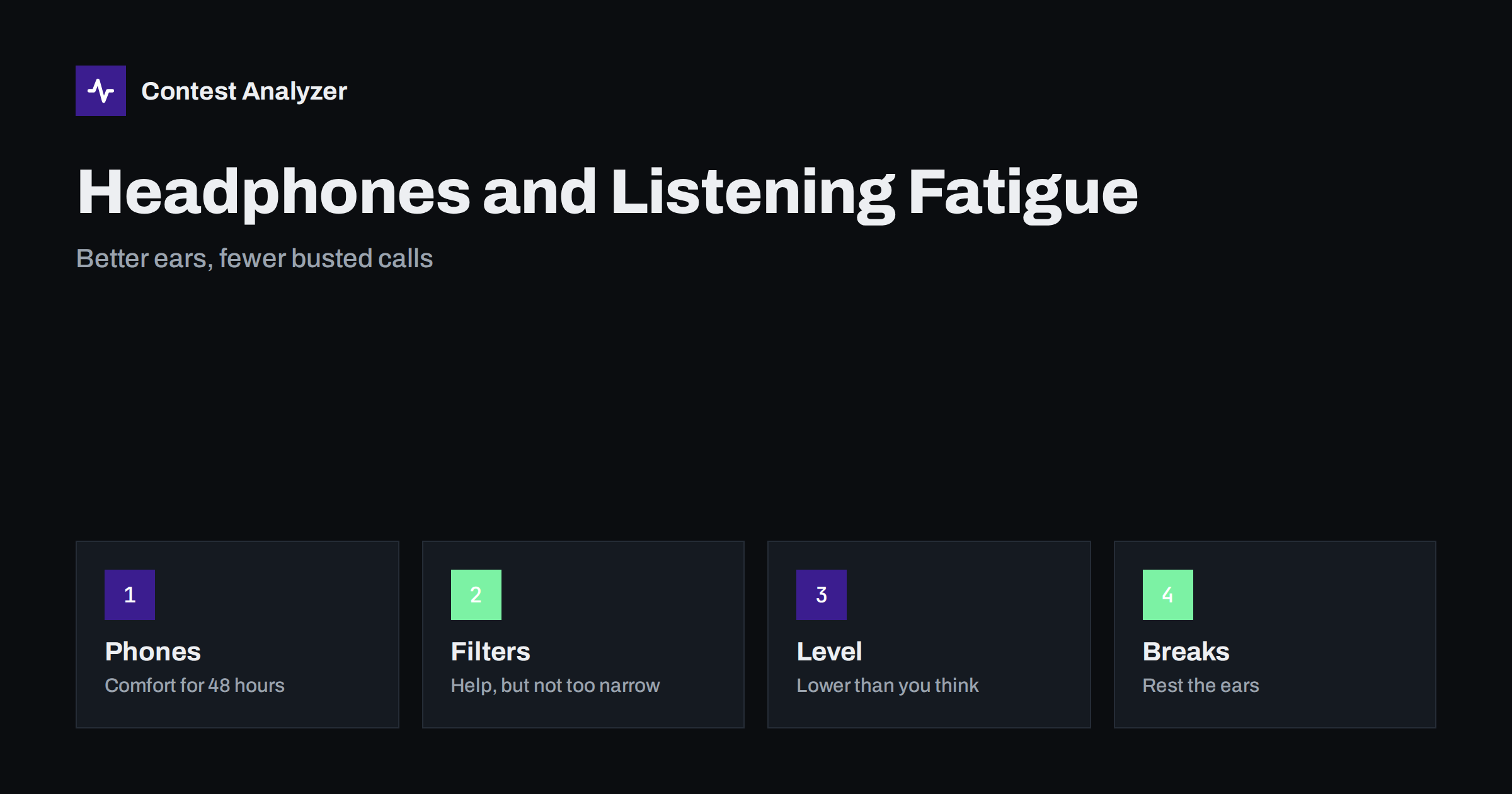
Short answer: In a long contest, the ears tire before the station does, and tired ears copy callsigns less accurately. The setup of headphones, audio level and filters has a direct effect on this. Choose headphones that are comfortable for many hours, keep the volume lower than the level at which you feel strong, use filters to help and not to destroy the signal, and plan short rests. The result is fewer busted calls in the late hours.
Why listening fatigue matters for the log
Every callsign in your log passed through your ears and your attention. In the first hours of a contest the quality of both is high, and you copy at the best level. After ten or twenty hours of continuous listening, the ears are not necessarily worse, but the brain is tired and the signal that you hear is processed with less care. The result is a slow rise in the number of small errors: a letter that you do not hear, a digit that you misread, an exchange that you accept without a check. These errors are the source of many busted calls, as the article on busted callsigns explains, and they appear more often in the late hours, as in the article about night-hour logging errors.
Listening fatigue has a physical part and a mental part. The physical part is the pressure of the headphones, the heat around the ears, the loudness and the long exposure to noise. The mental part is the effort to extract a weak signal from noise and to keep attention for hours. Both can be reduced by a good setup, and both are worth the attention before a contest.
Choosing headphones for 48 hours
The best headphones for a contest are the ones that you can forget that you are wearing. Several points deserve attention.
- Weight and clamping force. A heavy headset or one that presses on the head tires a person after a few hours. Try the headphones for a long period, not only for a minute.
- Ear cups. Over-ear cups that surround the ear give a good seal and a little heat. On-ear cups press on the ear and may become painful. The material of the cushions matters, since some materials become warm and uncomfortable.
- Open or closed. Closed headphones isolate you from the room, which is helpful in a noisy shack, but also can feel closed after many hours. Open headphones are lighter in feeling but let outside noise in and let sound out.
- Frequency response. For speech and CW, a clear response in the middle range is more important than bass. Very bright headphones can be tiring, and very dull ones hide the consonants that carry the callsign.
- Cable and connector. A cable that pulls at the head or catches on the chair is an irritation that grows with time. A coiled cable, a clip or a switch box can help.
- A spare pair. A second pair that you have used before is a good protection against a failure in the second night.
If you wear glasses, test the headphones with the glasses on, since the arms of glasses can add pressure. Some operators use a headset with a boom microphone, and then the weight of the microphone is part of the test.
The volume: lower than you think
A common mistake is to set the audio level too high, in order to hear the weak signal. A high level is tiring and may damage the hearing. It also masks the fine detail, since the ear becomes less sensitive after a period of loud sound. A better way is to set the level so that the weak signal is clear without being loud, and to use the radio’s gain controls and the filters to improve the signal instead of simply turning the volume up. Check the level after a break, since after a rest the same level may sound louder. If you notice that you raise the volume more and more, it is a sign that your ears are tired, and a short rest will be more effective than a louder sound.
Protect your hearing in a general sense. A long contest with loud audio can cause a temporary loss of sensitivity that lasts for hours, and the habit of high volume over years can cause permanent damage. This is a health matter that no contest score justifies.
Audio filters: help and traps
Filters are a great help in contests. A narrow filter in CW removes the neighbouring signals and the noise, and a good filter in SSB reduces the splatter and the noise outside the voice range. The settings of the filter decide how much help you get.
- Too narrow a filter. In CW, a very narrow filter makes a signal sound as a pure tone, and it rings, which makes it harder to recognise the elements of the letters at high speed. It also hides a station that is a little off frequency.
- Too wide a filter. The signal that you want is hidden among neighbours, and you must work harder to copy it.
- Noise reduction. Strong digital noise reduction can make the signal sound unnatural and can remove the weak part of a callsign. Test it with real signals and decide whether it helps you.
- Automatic notch and similar functions. They can remove a heterodyne, and in the same way can distort speech. Use them only when needed.
- Changing the settings too often. Each change needs a moment to adapt. Find a good basic setting and change it only when the situation requires it.
The point is that a filter is a tool for accuracy, and what counts is the result in your own copy, not what the setting looks like. The article on CW copying accuracy in contests and the one on SSB phonetics discuss the operating side of the same problem.
Rest the ears, not only the body
Many operators plan a long sleep, but do not plan short breaks for the ears. A few minutes without headphones every hour or two gives the ears and the head a rest, and it is often enough to prevent the build-up of fatigue. Use a break to drink, to move and to look at something far away. Some operators change from headphones to a loudspeaker for a part of the time, at a low level, for a change of sound and pressure. In a contest where the off time is limited, check how short breaks are counted, as explained in the article on off time and breaks, and plan them in a way that serves both the rules and the ears. For the wider question of rest in a 48-hour contest, see the article on operator fatigue.
What your own log can tell you
You can check whether listening fatigue affects your result. After the contest, look at the corrections you made, or at the QSOs that were flagged as doubtful, and see in which hours they appear. If the doubtful QSOs rise in the late hours, listening fatigue is one of the likely causes. Contest Analyzer helps with this: it checks every callsign and every zone against official license databases and several independent reference sources and shows only the few QSOs worth a second look, and the full statistics give QSOs by hour and band, rates, breaks and off time, and callsign length and structure, with comparison with your own logs from earlier years. You can edit calls or zones in the report and download a corrected Cabrillo. The tool works with Cabrillo from N1MM Logger+, DXLog and Win-Test and supports 22 contests; see the contests page. If the pattern is clear, next year change one thing in the setup and check whether the pattern changes.
The environment around the ears
The shack itself matters too. Fans, amplifiers and computers add background noise that the headphones must overcome, and a quieter room means a lower level and less strain. Keep the room at a comfortable temperature, since a hot head makes headphones feel worse. Good light and a good chair reduce general tiredness, which in turn helps the attention that copying needs. Small changes of this kind cost little and can be tried before the contest.
A simple test before the contest
- Wear the headphones for two hours in a normal operating session and note any pressure or heat.
- Set the level at which a weak signal is clear and not loud, and mark that position.
- Listen to a weak CW or SSB signal with different filter settings and choose the one that helps your copy.
- Prepare a spare pair and check the connector.
- Decide the times of the short breaks for the ears and write them in the plan.
Related reading
- Operator fatigue in 48-hour contests
- CW copying accuracy in contests
- Why logging errors cluster at night
The bottom line
Good copy depends on good ears and a rested mind. Choose comfortable headphones, keep the level low, use filters with a purpose and take short breaks for the ears. Then the callsigns that you log in the last hours will be as accurate as those of the first.
FAQ
Which headphones are best for a long contest?
The ones that are comfortable for hours, with a clear middle range for speech and CW. Test them for a long time before the contest.
Should I turn the volume up for weak signals?
Better to use gain and filters. A very high level tires the ears and can damage hearing.
Is a very narrow CW filter better?
Not always. A very narrow filter can ring and hide stations that are slightly off frequency. Find a setting that helps your copy.
How often should I rest my ears?
A few minutes every hour or two is often enough. Check how breaks are counted in your category.
How do I see if fatigue affects my log?
Look at the hours in which the doubtful QSOs and corrections cluster. A rise in the late hours is a typical sign.