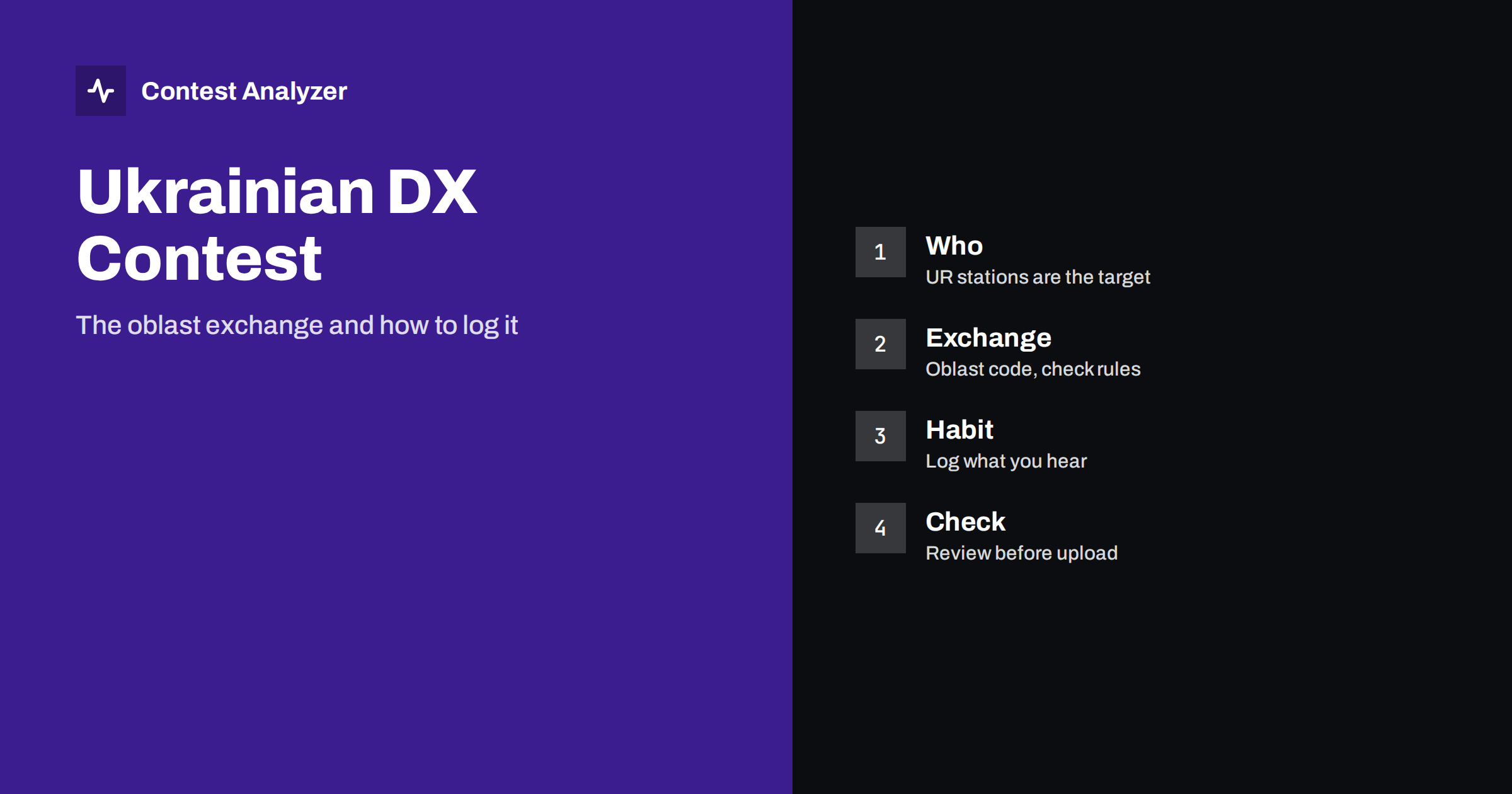
Short answer: The Ukrainian DX Contest is an HF event in which stations from Ukraine are the main target for the rest of the world. In general terms, the Ukrainian side sends a code for its region (an oblast), and other stations send a different exchange, usually a report with a number. The exact format, bands, modes, categories and dates are set by the organisers and change over time, so read the current official rules. For a clean log, learn the codes in advance, log them exactly as sent and ask for a repeat whenever you are not sure.
Why a regional exchange matters
Many national contests use a regional code as the exchange of the home stations. The idea is practical: the code is short, it identifies a place and it gives the visitor a multiplier to look for. In a contest of this type, the oblast code is therefore more than a number in a column. It is a source of points, and for this reason it is also a source of mistakes when the operator is in a hurry.
The difference from contests with a simple report and serial number is that a visitor must listen for a group of letters or a code that he may not hear every day. An experienced operator learns the typical sounds, but the beginner needs a list. If you plan to work the contest seriously, take twenty minutes before the start to read the rules and the list of codes. The time is well spent.
Who works whom
As a rule in such contests, Ukrainian stations work everyone, and stations from other countries work Ukrainian stations. Contacts between two stations outside the host country usually do not count or count differently, but this is exactly the kind of detail to read in the current rules. Also check the rules about the following:
- whether each band and each mode counts separately for the same station;
- whether there are separate parts or sessions;
- which categories exist and how they differ in power and assistance;
- whether stations outside the target country can claim a category for their own region.
Once you know the answers, set your logging software accordingly. Most loggers have a way to define or select the contest, and if the contest is not on the list, the documentation of the programme usually explains what to do. Test the setup with a few sample QSOs and look at the Cabrillo file that is produced.
Logging the oblast code
The oblast code is logged in the exchange column exactly as the other station sent it. There are a few rules of thumb that save trouble:
- Listen first, then type. Do not start filling in the exchange from the previous QSO or from the logger’s suggestion.
- Do not correct from geography. If a station sends a code that you do not expect for its callsign, ask once more. The operator may be outside his home region, and then the code that was sent is the one to log.
- Use one format. Capital letters and no extra characters. If your logger accepts free text in the exchange, you can easily type a different form each time, and the result will be hard to compare later.
- Mark doubts. If you are unsure but the QSO is valid, add a short note in the logger for the review.
The same careful approach applies to the callsign. A station with a single wrong letter in the call is not the station you worked. The article on busted callsigns explains how such errors happen and what they cost, and SSB phonetics and CW copying accuracy give practical habits for each mode.
Modes and conditions
Whatever the exact modes of the current edition, the weak point is usually the same: the exchange is shorter than a callsign, so it is tempting to think that it is easy. In reality, the code is a place where the operator has little context. A callsign can be guessed from the first letters, but a code has to be heard. On CW, short groups of letters are especially exposed to the confusion of similar sounds, as described in the article on cut numbers in CW exchanges. On SSB, the phonetic alphabet is the best protection, and on digital modes the decoder can drop a character without warning.
A simple operating plan
A regional contest rewards a plan more than raw speed. Decide in advance which bands you will start on, and think about the time of day when the target country is easiest to reach from your location. At the beginning, spend a little time listening on each band to find where the activity is, then settle on the band that gives the best rate. Search and pounce is natural in this kind of contest, because many of the target stations call CQ and a visitor with a modest station can work them one by one. The article on run versus search and pounce shows how to measure each style in your statistics.
Keep a short list of the stations that you worked on one band and still want to work on another, if the rules allow it. When a band is changing, the stations you have already logged are a quick source of new QSOs. Take breaks according to a plan and not only when you feel tired, because the later hours of a long session are where mistakes in codes become more frequent. The article on operator fatigue and breaks has practical advice that applies to a short contest as well as to a long one.
Finally, prepare the room. A comfortable chair, good light, a clear screen and a printed copy of the code list are small things, but they take away many of the little errors that otherwise appear after a few hours at the desk.
Keeping the clock and the header right
The time of each QSO should be in UTC and accurate to the minute. A clock that is wrong by several minutes will not stop you from making QSOs, but it may leave a mark on the log in the review; see UTC clock errors in a contest log. The Cabrillo header also needs attention. Check the contest name, the category fields, the callsign and the name and address. If you are not certain which names the organisers accept, use the information on their page. The Cabrillo header guide describes the common fields and the most frequent mistakes.
Reviewing the log and the statistics
When the contest ends, export the Cabrillo file and keep a copy of the original. Then review the log. Contest Analyzer checks every callsign and every zone against official license databases and several independent reference sources and shows only the few QSOs worth a second look, so you do not have to read through thousands of lines. It also gives full statistics, with rates, QSOs by hour and band, countries, continents, CQ and ITU zones, WPX prefixes, distance, beam heading, breaks and off time and callsign length and structure. You can edit calls and zones in the report and download a corrected Cabrillo, and you can compare the result with your own earlier logs. It works with Cabrillo from N1MM Logger+, DXLog and Win-Test and supports 22 contests, which are listed on the contests page. Remember that serial numbers are not checked and that dupes are not errors, so the exchange itself is your responsibility.
The routine described in the post-contest review fits this contest well. Spend some time on the oblast codes you were unsure of, and if the same code gave trouble more than once, add it to your notes.
What the statistics say about a regional contest
In a contest where one country is the target, the statistics have a clear story. You will probably see that most QSOs are on the continent closest to the target and that the number of contacts per hour falls when the band closes in that direction. Look at the QSOs by hour and by band and at the beam heading. If you have an antenna that you can turn, see whether you spent time in the right direction, and compare with the previous year. The article on beam heading statistics explains how to read the figures, and the continent breakdown shows what they tell you about openings.
Related reading
- Russian DX Contest: oblast codes and serial numbers
- How to check a contest log before you submit it
- Beam heading and distance statistics
The bottom line
The Ukrainian DX Contest is a good test of careful listening. The exchange is short, but a short code leaves less room for guessing. Read the current rules, learn the codes before the start, log what you hear and not what you expect, and review the log and the statistics after the contest. A little preparation gives a clean log and a result that you can compare with next year.
FAQ
Is the oblast code sent by every station?
In general, only the home stations send a regional code, and visitors send a different exchange. The current rules give the exact details.
What if a station sends a code that does not match its callsign?
Ask for a repeat and log the code that was sent. The operator may be away from his home region.
Can I log the code in lower case?
It is better to keep one consistent format, usually capital letters, as it makes the log easier to read and to review.
Does the review check the oblast code?
The review checks callsigns and zones. Serial numbers and other exchange details are not checked, so look at them yourself.
Where can I find the current rules and dates?
On the official page of the organisers. Rules and dates change from year to year, so check them before every edition.