Short answer: A guest operator at a club contest station is productive within minutes if the host prepares a clear handover and the guest asks the right questions: which callsign and category, how the logger is set up, what the macros send, how to enter the operator, how to log a QSO and a correction and when the breaks are. Ten minutes of preparation prevent hours of mistakes in the log. Check the current contest rules for what guests and operators must follow.
Why guests need a handover
A club station is a shared place. Several people use the same radios, the same logger and the same macros, and each of them has slightly different habits. A guest who sits down at the keyboard for the first time faces unfamiliar keys, an unfamiliar band map and a log that is already full of QSOs. A small mistake, such as logging a call in the wrong field or leaving the wrong exchange in a macro, can be repeated many times before anyone notices.
The handover is therefore not a matter of politeness but of log quality. It also lets the guest enjoy the contest: someone who knows what the station is doing and why can concentrate on operating. The articles on merging logs from several computers and rate sheets by operator show how multi-operator logs are handled afterwards, and a good handover makes that work easier.
What the host should prepare
The host should write a one-page sheet for guests and keep it next to the keyboard. The sheet should state the callsign of the station, the contest and the category, the exchange that is sent and the way it is entered, the name of the operator field, the bands and times that are planned and the person to ask if something goes wrong. If the contest has rules about who may operate, for example about licences or the presence of the licence holder, write them down too, and check them against the current official rules.
Prepare the logger in advance: the contest loaded, the callsign set, the macros tested, the clock checked and the backup running. The article on setting up N1MM Logger+ for CQ WW and the one on logging software backups and settings list what to check. A station that is set up well can be handed over in two minutes.
What the guest should ask
A good guest asks a few short questions before starting. Which call do I send, and do I say it each time? What is the exchange, and how is it entered? How do I log a QSO and how do I correct a wrong entry? Which key logs the QSO and which one clears the entry line? How do I mark a QSO that I am not sure of? Is there a band plan or a list of multipliers that we are looking for? Where are the notes of the other operators?
It helps to practise a few QSOs while the host is next to you, or to listen for a few minutes before taking over. Watching the host for five minutes shows more than reading a manual. If you are new to the program, ask the host to show you the two or three functions you will use most.
The operator field
In a multi-operator station, each QSO can carry the name or call of the operator who made it. The field is useful for statistics: how many QSOs each person made, at which hours and with what error rates. The Cabrillo header also has an OPERATORS field, and the contest rules say what is required. The article on the Cabrillo header describes the fields. Make sure that each guest enters his or her own call in the operator field before the first QSO, and that the host changes it when guests swap.
Do not leave the field to memory. A simple routine works: when the operator changes, the new operator types the call in the field, says it aloud and the previous one confirms. A note on paper beside the keyboard with the time of each change gives a second record.
Macros and the exchange
The macros send the exchange, and a wrong macro is repeated hundreds of times. A guest should read each macro on the screen before using it. If the station sends a zone, a serial number or a name, check that the data is correct. Do not change a macro unless the host agrees, and if you do, write it down. The same applies to hotkeys: a different keyboard layout or a custom shortcut can lead to logging a QSO by pressing the wrong key.
The article on function-key messages and macros lists the habits that reduce typing errors. For a guest, the most useful is to type the callsign again whenever there is doubt, and not to rely on a click on a partial call. See also call history files in contest loggers, because a prefilled field can lead a new operator to accept data without checking.
Breaks, hand-offs and the clock
Plan the hand-offs in advance. A rota with times is better than an informal agreement, because contests produce moments when nobody wants to leave the chair. A hand-off should take a minute: the outgoing operator says where the run frequency is, what the current plan is, which stations are waiting and what to watch. The incoming operator repeats the key points. Avoid a hand-off in the middle of a pile-up; wait for a short pause.
Keep an eye on the clock. A club station often has more than one computer, and a time difference between them can cause problems in the merged log, as the article on computer time synchronisation explains. Make sure that the guest knows which clock is the reference. Breaks that are long enough to affect the rules are also something to note, as in off time and breaks.
After the contest: checking the log together
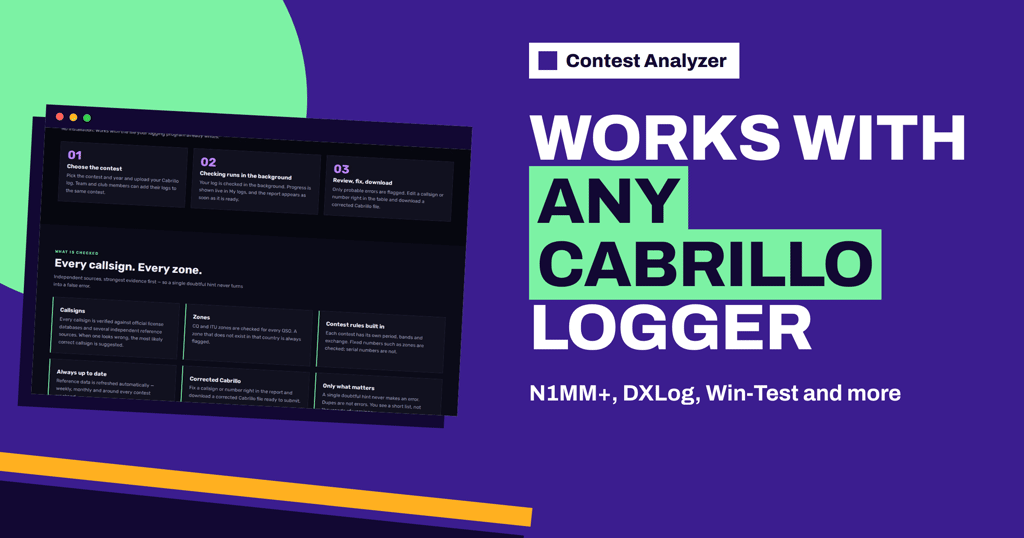
When the contest ends, the host exports one Cabrillo file and keeps the original. The club can then check the log, and the guests can take part in the review. Contest Analyzer works with Cabrillo from N1MM Logger+, DXLog and Win-Test, and checks every callsign and every zone against official license databases and several independent reference sources, showing only the few QSOs worth a second look. The report gives full statistics, including rates, QSOs by hour and band and breaks and off time, which are useful for a club discussion about who operated when.
A log is checked for a verified callsign in an account, as the FAQ says, so the person who holds the callsign of the station is the one who uploads it. Check the contests page for the log deadline of the contest. For a club that takes part regularly, a short routine after each contest keeps the quality high.
What typically goes wrong
Several mistakes appear again and again at club stations. A guest forgets to change the operator field, and a long block of QSOs is credited to somebody else. A guest uses a different band-change habit and leaves the second radio on the wrong band. A guest turns off the automatic backup to stop a pop-up window and nobody turns it on again. A guest closes a window that held the band map and does not know how to reopen it. A guest corrects a callsign by deleting the QSO and logging it again, which changes the time of the QSO. Each of these is small, and each is easy to prevent with a short briefing.
Another typical case is a misunderstanding about who has the right to make decisions. If the guest wishes to change the frequency of the run, the band or the plan, the host or the team leader should be asked. In a competitive club, there may be a plan about which bands to use at which time, and a guest who ignores it can spoil it. A short remark at the start, such as “Follow the plan on the sheet, and ask if you want to change it”, saves a discussion at three in the morning.
A host who has never given a briefing may find a script useful. Here is one in six sentences. “This is the station of such-and-such callsign, entered in this category. The exchange is this, and this key sends it. Enter your call in the operator field here before you start. If you make a mistake in a call, correct it in the log entry with this key, and do not delete the QSO. We are on this band now and plan to go to the next one at this time. If anything unexpected happens, call me.” Speak slowly and let the guest repeat the main points.
After the shift, a brief debrief is also useful. Ask the guest what was difficult and what could be improved on the sheet. Most guests give useful feedback, and next year the sheet will be better. If the club keeps notes for each contest, add a line about the guests, so that the experience is not lost.
A guest checklist
- Read the station sheet: callsign, category, exchange, rules.
- Watch the host for five minutes and ask about anything unclear.
- Enter your own call in the operator field before the first QSO.
- Read each macro before you use it.
- Type calls again when in doubt; do not accept prefilled data blindly.
- Hand off with a short verbal summary.
Related reading
- Multi-Op Band Change Rules in General
- First Contest Checklist for Newcomers
- Helping a Friend Check a Contest Log
The bottom line
A guest at a club station can be a real help if the handover is clear. The host prepares the logger and a one-page sheet, the guest asks a few short questions and checks the macros and the operator field, and everyone keeps the clock and the hand-offs in order. The reward is a clean log that is easy to check afterwards.
FAQ
Can a guest operate under the station’s callsign?
That depends on the licence rules of your country and on the contest rules. Check both before the contest.
Should the guest change macros?
Only with the host’s agreement, and every change should be written down.
Who uploads the log for checking?
The holder of the callsign, from his or her own account with the callsign verified, as the FAQ explains.
How do we see who made which QSOs?
Use the operator field in the logger and check the statistics after the contest.