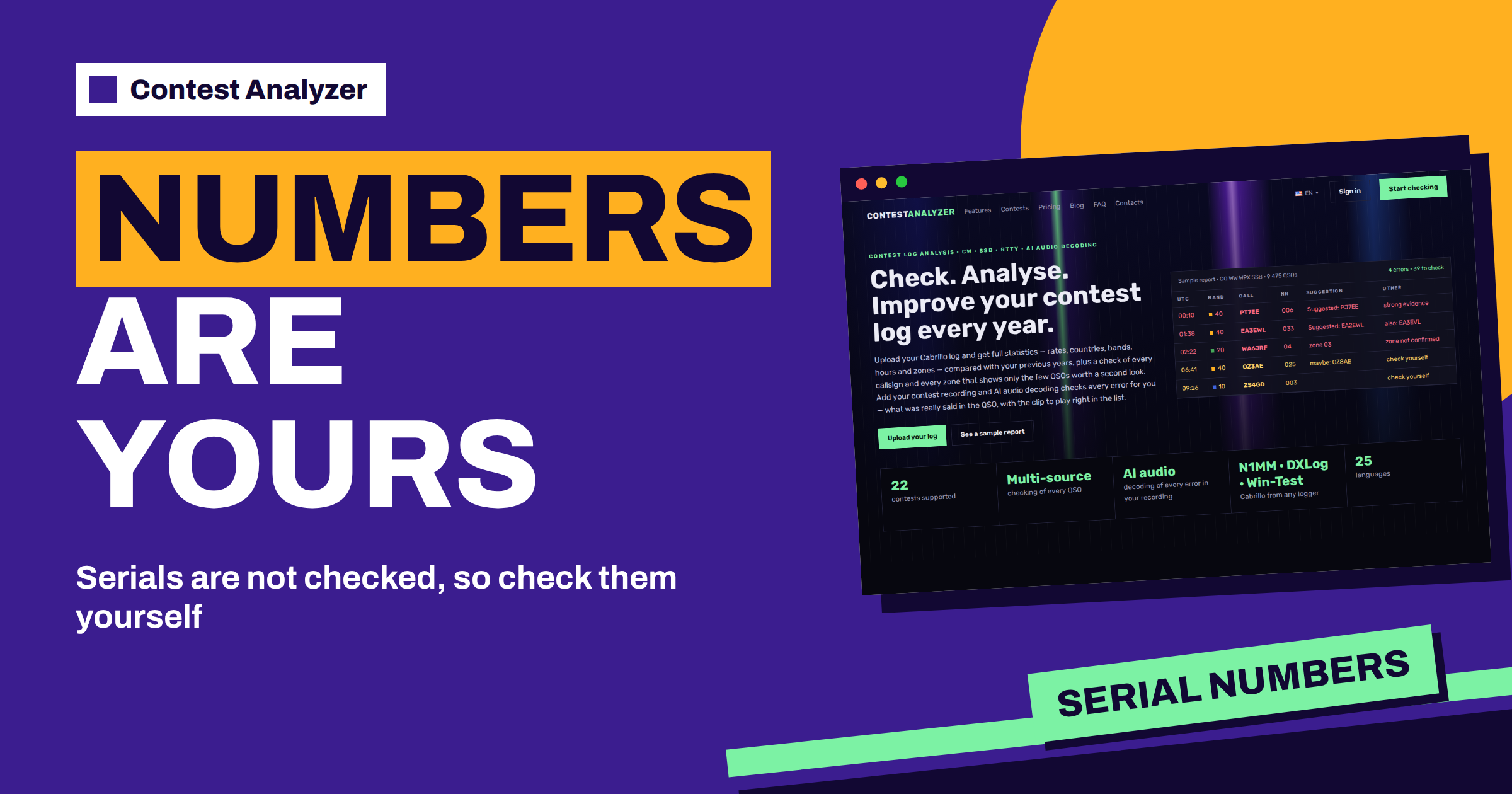
Short answer: The Contest Analyzer FAQ says that every callsign and every fixed exchange, such as CQ or ITU zones, is checked, and that changing serial numbers are not. In a contest where the exchange includes a number that grows from QSO to QSO, the report will not tell you whether a number is right. That part of the review stays with you. Use the habits and the checks in this article to keep your own serial numbers clean, and treat the report as a check of callsigns and zones, which it does very well.
What the service says it checks
The FAQ answers the question what is checked in one sentence: every callsign and every fixed exchange such as CQ or ITU zones. The home page adds that each contest has its own period, bands and exchange, that fixed numbers such as zones are checked and that serial numbers are not. The wording is clear, and it is worth taking at face value. There is no hidden check of serial numbers, and the report is not a promise that your numbers are correct.
The reason is simple when you think about what a serial number is. A zone is a fixed property of a station: a given callsign in a given place has a zone that exists in a table, so it can be tested. A serial number is different. It depends on the order in which the other station made its QSOs, on whether it started at one and whether it made a correction on the way. There is no table to compare it with, and a single doubtful hint should never turn into a false error, as the page says about every check.
Which contests use serial numbers
Many contests include a serial number in the exchange. CQ WPX, for example, uses an RS or RST report and a serial number, as our article on serial numbers in CQ WPX explains. Other contests use fixed values, such as the CQ zone in CQ WW DX or the ITU zone in the IARU HF Championship. Some mix the two. The contests page lists the 22 supported contests, and the rules of each say what the exchange is. Always check the current official rules before you operate.
When the exchange contains a zone or a similar fixed value, the check helps with it directly. When it contains a serial number, the part of the exchange that carries the number is outside the check, but the callsign in the same QSO line is still verified. So a QSO in a serial-number contest can still appear in the report because of its callsign, even if the number is never looked at.
Why numbers go wrong
Serial numbers are a popular source of small errors, and they are not always your fault. The other station may send a wrong number, you may copy it wrongly, or your own logger may send a number that is out of step. A few typical cases are worth knowing.
- Copying under noise. A 5 and a 6, or a 3 and an 8, are easy to mix in a weak signal, especially in CW with cut numbers.
- Numbers that change within a QSO. The other station corrects a number during the exchange, and you log the first version.
- Your own counter. A logger that does not increase the number after a deleted or edited QSO sends a number that repeats or skips.
- A restart. After a computer failure, the counter may start from one again, or from the wrong value.
You can read more in the article about serial number gaps and in the one about cut numbers in the CW exchange.
How to check your own numbers
Since the report does not look at changing serial numbers, build a short routine of your own. It takes minutes and catches the most common problems.
- Open the Cabrillo file in a text editor, or sort the log by time in your logger.
- Look at the numbers you sent. They should grow by one from QSO to QSO, with no repeats and no jumps. A jump points to a deleted line or a restart.
- Check the first and the last number. The last number should be close to the number of QSOs in the log, allowing for any rule that starts counting differently.
- Look at the numbers you received from the same station if you worked it twice. A station that sends 120 in one QSO and 85 in a later one is a clue that something was copied wrongly.
- For a station that worked you on two bands, the second number should be higher than the first, because the other station kept counting.
These checks do not prove that every number is right, but they find most of the structural errors, and they cost almost nothing.
What the report still gives you in a serial-number contest
A contest with serial numbers is still worth checking. The callsign is the most important part of the QSO line, and a wrong callsign costs the QSO regardless of the number. The report verifies every callsign against official license databases and several independent reference sources, and it suggests the most likely correct callsign when one looks wrong. It also gives you the statistics that do not depend on the numbers at all: rates, bands, hours, countries, continents, zones where the contest has them, and the comparison with your previous years.
Dupes are listed separately and are not counted as errors, which the FAQ also states. That is useful in a contest where you work the same station on several bands and each number is different. You can read about it in dupes in a Contest Analyzer report.
Editing a number in the report
You can still edit a number in the report. The FAQ says that you can edit a callsign or number right in the report and download a corrected Cabrillo file ready to submit. That feature is a convenience for your own corrections, whether the service flagged the line or not. If you find a wrong serial number by your own checks, correct it in the table and download the updated file.
Be careful with what you change. A serial number that you sent must match what the other station logged, and a number you received must match what was really sent. If you are not sure, do not guess. Check your notes, a recording or the QSOs before and after, and leave the line alone if you cannot be sure. The article about corrected Cabrillo before submit describes a final check before submission.
How contest committees treat numbers
Contest committees do check exchanges against the logs of other stations, and a wrong number can cost the QSO in the final result. The details differ from contest to contest, and some rules treat a small difference more leniently than others. We do not describe any particular rule here; read the current official rules of the contest you enter. What matters for you is that the number is part of the QSO, and a good habit of your own is the only protection against losing points to it.
The same holds for the logging-side of the process. A good logger sends the number automatically and increases it by one after every QSO. Test it before the contest, with a few dummy QSOs, to see that the number follows the rules you expect. A mistake in the settings repeats on every line.
A short example from a weekend contest
Imagine you operated a weekend contest where the exchange is a report and a serial number, and you made 800 QSOs. You upload the log, and the report shows 25 lines worth a look: mostly callsigns with a suggestion, and a few with a doubtful zone-like field that does not apply to your contest. You correct the callsigns and download the corrected file. Everything seems fine, but you still have not looked at the numbers. You open the file and find that your own number jumps from 412 to 431. Nineteen QSOs are missing from the sequence, which means that either they were deleted or a restart happened in that hour.
This is the kind of finding the report cannot give you, and it is worth the time. You check your notes, find that the computer was restarted during a power cut, and see that the missing lines were recovered from a backup in the wrong order. The fix is in your logger, not in the report. The example is invented, but the pattern is real, and it shows why the two parts of the review belong together.
Plan your review accordingly
In practice, a serial-number contest has two parts to the review. The first is the report: callsigns, and zones where there are any, the short list and the corrections. The second is your own check of the numbers, as above. Do the report first because it takes you through the lines with real problems, and then do the number check on the exported file. Keep notes about what you find, because next year’s contest is a good time to improve the process.
If you want to know which contests on the list use fixed exchanges and which use serial numbers, the contests page shows the dates and the deadlines, and the official rules show the exchange. The FAQ repeats what is and is not checked.
Related reading
The bottom line
Contest Analyzer checks every callsign and every fixed exchange such as zones, and it says plainly that changing serial numbers are not checked. Use it for what it does best, and check your own numbers with a few simple steps. Take the details of each contest from its official rules.
FAQ
Does Contest Analyzer check serial numbers?
No. The FAQ says that changing serial numbers are not checked. Callsigns and fixed exchanges such as zones are.
Can I still use it in a contest that uses serial numbers?
Yes. The callsigns are checked, and the statistics and the corrected Cabrillo download work as in any other contest.
Can I edit a serial number in the report?
Yes. You can edit a callsign or number in the report and download a corrected Cabrillo file.
How can I find serial number errors myself?
Look for jumps, repeats and restarts in the sequence of numbers you sent, and compare the numbers of a station that you worked twice.
Which exchanges are checked?
Fixed exchanges such as CQ and ITU zones. Check the rules of each contest to see what its exchange contains.