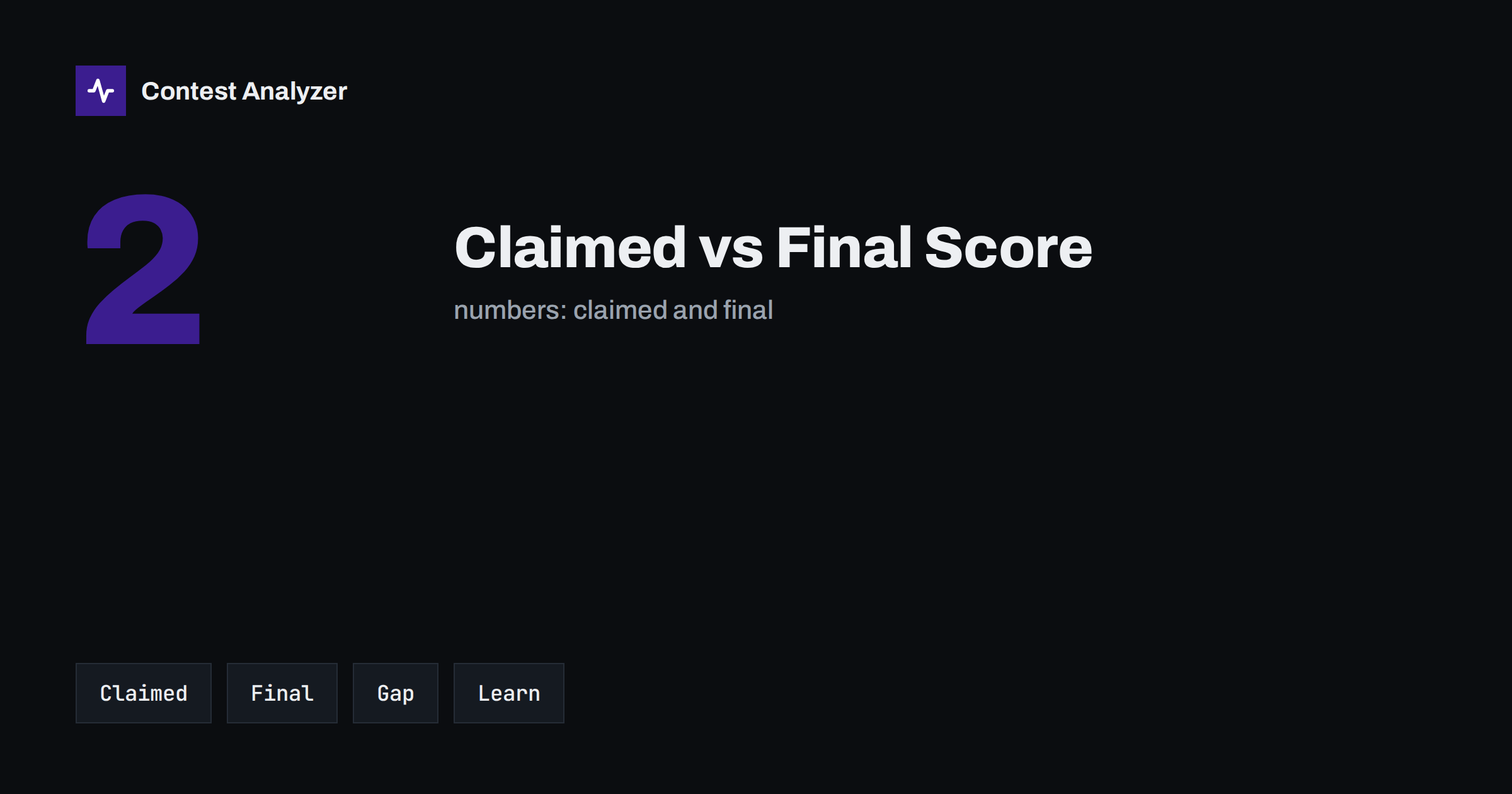
Short answer: The claimed score is the score you calculate and put in the header of your log. The final score is the result published by the organiser after the logs are checked. The final score is usually lower, because QSOs that cannot be confirmed are removed, penalties may be applied and multipliers may be lost. The size of the gap is a useful measure of the accuracy of your log, and a log review can reduce it. The details differ between contests, so check the current rules.
Two numbers, two purposes
When you submit a log, the Cabrillo header carries a claimed score, which is the total you calculated yourself with your logger. It is your own statement of what you believe you achieved. Some organisers publish claimed scores soon after the deadline, and many contesters follow them with interest. The final result comes later, when the organiser has processed the logs, compared them and applied the rules for removing QSOs and for penalties.
The difference between the two is not a sign that someone did something wrong. A reduction is normal in a contest with log checking, because even careful operators make errors under noise and fatigue. What matters is how large the gap is and what caused it. A small gap says that the log was accurate; a large gap says that there were many errors or that a rule was misunderstood. The earlier article on claimed versus final score introduces the topic; here we focus on how to read the difference.
What typically reduces a score
In general terms, three groups of causes appear. The first is QSOs that are removed: a busted callsign, a QSO that is not in the other station’s log, or a duplicate that is not credited. The second is the loss of multipliers: if the QSO that gave you a multiplier is removed, or if the multiplier was based on a wrong zone or prefix, it no longer counts. The third is penalties, which some contests apply in addition to the removal of QSOs.
The exact treatment differs by contest and category, and the rules can change from year to year. Do not assume that last year’s treatment applies this year. Read the scoring section of the current rules, and if the organiser publishes a description of the checking process, read that too. The articles on UBN reports and on log checking reports show the form in which many committees report the changes.
Reading the gap in numbers
Start with the percentage. Divide the difference between claimed and final scores by the claimed score. A very small percentage suggests a clean log. A bigger percentage invites investigation. Do not compare your percentage with those of other stations without care; the effect of one removed QSO is larger in a small log than in a large one, and a contest with many multipliers amplifies the loss of a few of them.
Next, break the loss into parts, if the organiser gives you the information. Many committees send each participant a report with the number of QSOs removed and the reasons for them. Count how many were callsign errors, how many were not in log, how many were duplicates and how many had exchange errors. This breakdown matters more than the total, because each cause has a different cure. A high count of callsign errors calls for better copying habits; a high count of not-in-log may point to a clock problem or a band error.
Compare with your own review
If you reviewed your log before submitting, compare the final report with what you found. The QSOs that you corrected have probably not appeared in the report. The QSOs that appear but were not on your list of doubts are the most interesting: they are errors you did not know about. Study them carefully. They teach you where your blind spots are, such as certain letters that you tend to confuse or hours in which you are tired.
A report from a checking tool can help you estimate the gap in advance. Contest Analyzer checks every callsign and every zone against official license databases and several independent reference sources and shows only the few QSOs worth a second look. When you compare your list of corrections with the organiser’s final report, you can see how many of the removed QSOs your pre-check also pointed to. That is a practical way to learn what the tool catches and what remains the responsibility of your own review. Serial numbers are not checked by the tool, so errors in them are among those you must find yourself.
Use the gap to set goals
A clear target is to reduce the gap year by year. Record your claimed score, the final score and the percentage in your station notebook. If the gap was 4 percent last year, aim for 3 percent this year, and decide what you will change to achieve it. The change might be a slower CW speed, a stricter rule for partial callsigns, a clock check, or a review of the log with a checking tool before the deadline. The article on setting realistic goals from last year’s statistics explains how to choose goals that are measurable.
Remember that the aim is not to claim a low score. Your claimed score should reflect your best calculation. Underclaiming to avoid a gap defeats the purpose. The aim is to make the final score as close as possible to your honest claim by reducing the errors in the log.
Other reasons for a gap
Not all of the difference is due to errors in your log. Some is caused by errors made by the other operator, such as a callsign logged wrongly, which makes your QSO appear as not in log. You cannot control these, but you can reduce their effect by speaking or sending your callsign clearly, and by confirming the exchange. Some gap may come from misunderstanding the rules, for example counting a multiplier in a way the contest does not allow, or using the wrong category. Read the rules again and ask the organiser if the result seems wrong.
Finally, some contests apply late-log rules or adjust scores for other reasons. Check the rules for such items. If a question remains, write to the organiser politely and with specific data; a clear question about a particular QSO is more likely to receive a useful answer than a general complaint.
Keep the records
Keep your submitted file, the corrected file if you made one, the claimed score, the final report and your own notes. Put them in a folder with the name of the contest and the year. When you later compare years, you will have all the material together. A year-on-year comparison of your own logs, which Contest Analyzer supports for the contests it handles, is easier if the files are in good order. See the supported contests.
A made-up example
Suppose an operator claims 1 000 000 points with 2 000 QSOs and, after checking, the final result is 940 000. The gap is 6 percent. The organiser’s report shows that 40 QSOs were removed: 22 for busted callsigns, 12 as not in log and 6 for exchange errors, and that a few of those QSOs carried multipliers. The operator reads the callsign errors and notes that most are on the 40 metre band at night, in the last eight hours. The not-in-log items fall in a block where the computer clock had been drifting, and the exchange errors are all zones from one country with several zones.
The conclusions are specific. First, schedule a longer rest before the night hours on 40 metres, and ask for repeats on callsigns when tired. Second, check the clock on the second day. Third, learn how that country’s zones are divided and log the zone the station sends. Three actions, each tied to a cause, and the operator can test them next year. If the next gap is 3 percent, the changes worked; if it is still 6, the diagnosis was incomplete, and the search goes on.
This example is invented and the numbers are only illustrative. The method is the point: split, compare, decide, test. It is the same approach as in any analysis of your own statistics, and it needs nothing more than the final report, your log and a notebook.
When the report does not arrive
Not every contest sends a detailed report. Some publish only the final scores. In that case you cannot learn the reasons directly, but you can still look at the gap and try to explain it with your own review. Check your log for the usual suspects: callsigns that appear once, zones that do not fit the country, times that fall near the start or end, and QSOs that you flagged in your notes during the contest. If a tool shows you a short list of probable errors, compare it with the gap. The match will not be perfect, but it will tell you whether the largest sources of loss were visible beforehand.
Related reading
- After the Results: What to Compare With Your Claimed Score
- Your Post-Contest Review Routine: What to Check
- Busted Callsigns: Why They Happen and What They Cost
The bottom line
A gap between claimed and final score is normal, and its size and causes are information. Break the loss into reasons, compare it with your own review, write the numbers down and aim to narrow the gap through specific habits. Keep your claim honest, and always check the current rules for how your contest treats errors.
FAQ
Is the final score always lower than the claimed score?
Usually, because unconfirmed QSOs are removed and penalties may apply. Rules differ, so check the current ones for your contest.
What is a good gap?
A small percentage is better, but it depends on the contest and the size of the log. Compare with your own previous years.
Can I reduce the gap?
Yes, by confirming callsigns during the QSO, keeping the clock right and reviewing the log before submission.
Should I claim less to avoid a gap?
No. Claim your honest calculation; the goal is to make the final result match it through accuracy.