Short answer: Logging a partial callsign with the intention of fixing it later feels efficient, because the rate stays high. The risk is that the fix is never made, or that it is made with a guess that looks right but is wrong. A busted call costs the QSO and sometimes more, so the safer habit is to ask for a repeat when it is practical, and to mark every unresolved call clearly so that you can resolve it with evidence after the contest.
What a partial callsign is
A partial callsign is a callsign that you copied only in part: the prefix without the suffix, the suffix without the prefix, or a call with one letter or digit uncertain. In a pileup or under noise, you may catch only a few characters, and the other station may have moved on before you could ask for more. At that moment you have a choice: ask again, skip the contact or log what you have and hope to complete it later.
The tempting third option has a hidden cost. The logger usually offers help, such as matching the typed letters against a list of known callsigns, and the offered match looks like an answer. But a match is a possibility, not a fact. The article on partial callsign copies describes when to ask for a repeat, and the one on logging partial calls in a pileup discusses the special cases. This article looks at what happens when the fix is postponed.
Why “fix it later” fails
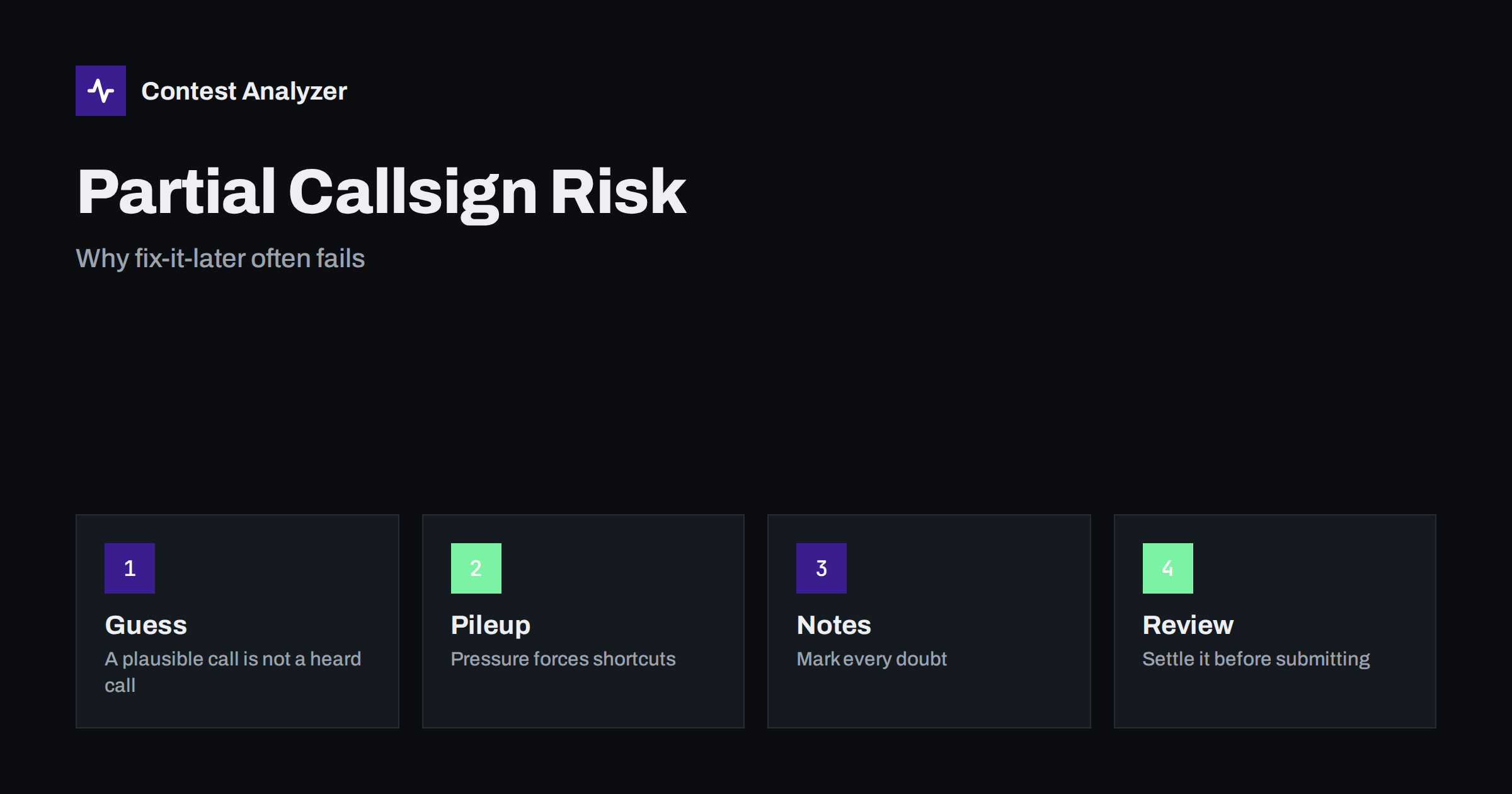
There are several reasons. The first is memory. After a few hours, you will not remember which QSOs were doubtful, unless you marked them. The log looks like a list of equal entries, and a half-copied call looks like any other. The second is time. After the contest, you will have little energy and many tasks, and a vague plan to review the log may be postponed until the deadline. The third is evidence. When you try to fix a call later, you often have nothing but the same uncertain copy, so you fall back on a guess.
A guess based on a list of callsigns tends to choose the most common or the most familiar call. But the station you worked may be a rare one, and the familiar call may belong to someone else. The result is a log in which the callsign is clean and valid, but wrong: it does not match the real station, and it may belong to a station that was not on the air. That kind of error is harder to see than an obviously broken call, because it looks right.
What a wrong fix costs
The cost depends on the contest and its checking rules. In general terms, a QSO with a busted callsign is not credited, and the other station may not have your call in its log either, so the penalty can include the loss of the contact and sometimes an additional deduction. If the QSO also supplied a multiplier, the multiplier can be lost as well. These are the same consequences as described in the article on busted callsigns, and they are the reason why every extra second spent on a clean copy is worth it.
There is also a cost in the statistics. A wrong callsign changes the country, zone or prefix that is counted, and your multiplier counts, your continent breakdown and your distance statistics become less accurate. If you plan to use the numbers for decisions, errors of this kind quietly reduce their value.
Better habits for busy moments
- Ask for a repeat of the missing part only: “suffix”, “prefix”, “last two letters”. A short, specific request is fast.
- Do not log a QSO until the callsign is complete. If you must move on, drop the contact.
- If you log a partial call for a good reason, mark it in the logger with a comment or a flag at once.
- Do not accept an automatic completion unless you recognise the call as the one you heard.
- Use a second receiver, if you have one, to listen to the end of a callsign while you finish the exchange.
The point of these habits is to keep the evidence. A flagged QSO tells you where to look after the contest; an unflagged one hides in the log.
How to resolve doubts after the contest
If you recorded audio during the contest, listen to the doubtful QSOs; the recording is the best evidence you can have. The articles on using audio to fix log errors and on recording audio to check doubtful QSOs describe the routine. Mark each QSO you have checked, so that you know what is done. Without a recording, rely on your notes, the context of the exchange and the pattern of the contest, and be willing to leave a call as it is when the evidence is weak.
Checking tools can help to focus the review. Contest Analyzer checks every callsign against official license databases and several independent reference sources, and shows only the few QSOs worth a second look, with a suggestion when one is likely. A suggestion is a hint, not a verdict: compare it with your notes and your recording before you accept it. You can edit the callsign in the report and download a corrected Cabrillo file, and you can mark QSOs checked in your own audio recording.
Do not over-correct
The opposite mistake is to change everything that looks unusual. A rare callsign that is correct looks strange precisely because it is rare. Special event stations and expedition calls, with unusual structure, are an example. Before you change a call, ask whether you have positive evidence for the new version. If the answer is no, the original may be right. The article on unique calls in contest logs explains the difference between a real unique and a bust.
A balanced attitude is to correct what you can prove, mark what you cannot decide and accept the small remaining uncertainty. No log is perfect, and the goal is to reduce errors to a level that does not hurt your result.
Partial calls and fatigue
Fatigue increases the temptation to log partial calls. After many hours, you are less willing to ask for a repeat and more willing to accept a guess. The problem compounds, since tired operators also make more copying errors. The best remedy is rest. A short break restores concentration and often pays for itself within the hour. See finding your tired hours in contest statistics for a way to see when the problem is greatest.
An example of a plausible but wrong fix
Suppose you hear a station calling CQ and catch “K” and “3” and a final letter that might be a B or a D. The logger offers two matches from its list: a familiar contest station and a less common one. You choose the familiar one and log it. Later, you cannot remember whether the signal was strong or weak, or what the middle of the callsign sounded like. The log now holds a complete callsign that you never fully heard. If the station you actually worked was the other one, you have a bust that looks perfectly valid.
Now compare the alternative. You ask for a repeat, wait three seconds, and get the whole callsign. The cost was a short delay; the gain was a correct entry and no extra work afterwards. Even in a fast contest, a repeat takes less time than the sum of the lost QSO and the later effort to find and fix the error. This simple comparison is why experienced operators tend to ask without hesitation.
Think also about the other side of the exchange. A station that sees that you ask for a repeat knows that you care about accuracy, and it will usually repeat clearly. A rushed answer, on the other hand, can leave both sides unsure. A polite, short request is part of good contest manners, and it improves the quality of both logs.
A short rule for the whole weekend
If you want one rule to remember, use this: never log a callsign that you could not write in full on paper. If you cannot write it, you do not know it. Use the time you save by not correcting later for a few more QSOs now. Combine the rule with a flag for the exceptions, and your log will be cleaner at the end of the contest than at the end of most weekends, with less work on the last evening before the deadline.
Related reading
- Partial Callsign Copies: When to Ask for a Repeat
- Similar Prefixes That Are Easy to Confuse in Contests
- Writing Notes During a Contest to Fix QSOs Later
The bottom line
Partial callsigns are a normal part of busy contesting, but “fix it later” is a weak plan unless you leave a trail. Ask for the missing part, drop what you cannot complete, flag every doubtful QSO, resolve doubts with evidence such as a recording, and do not accept a guess only because it looks plausible.
FAQ
Is it ever acceptable to log a partial call?
Sometimes, if you mark it clearly and can resolve it with evidence later. Without a flag, it is likely to be forgotten.
Should I trust my logger’s auto-completion?
Only if you recognise the completed call as the one you heard. A match in a list is a possibility, not proof.
How can I verify a doubtful callsign afterwards?
The best evidence is your own audio recording. Notes and the context of the QSO are weaker support.
Can a checking tool fix my partial calls?
It can point to likely errors and suggest a correction, but you decide whether to accept it.