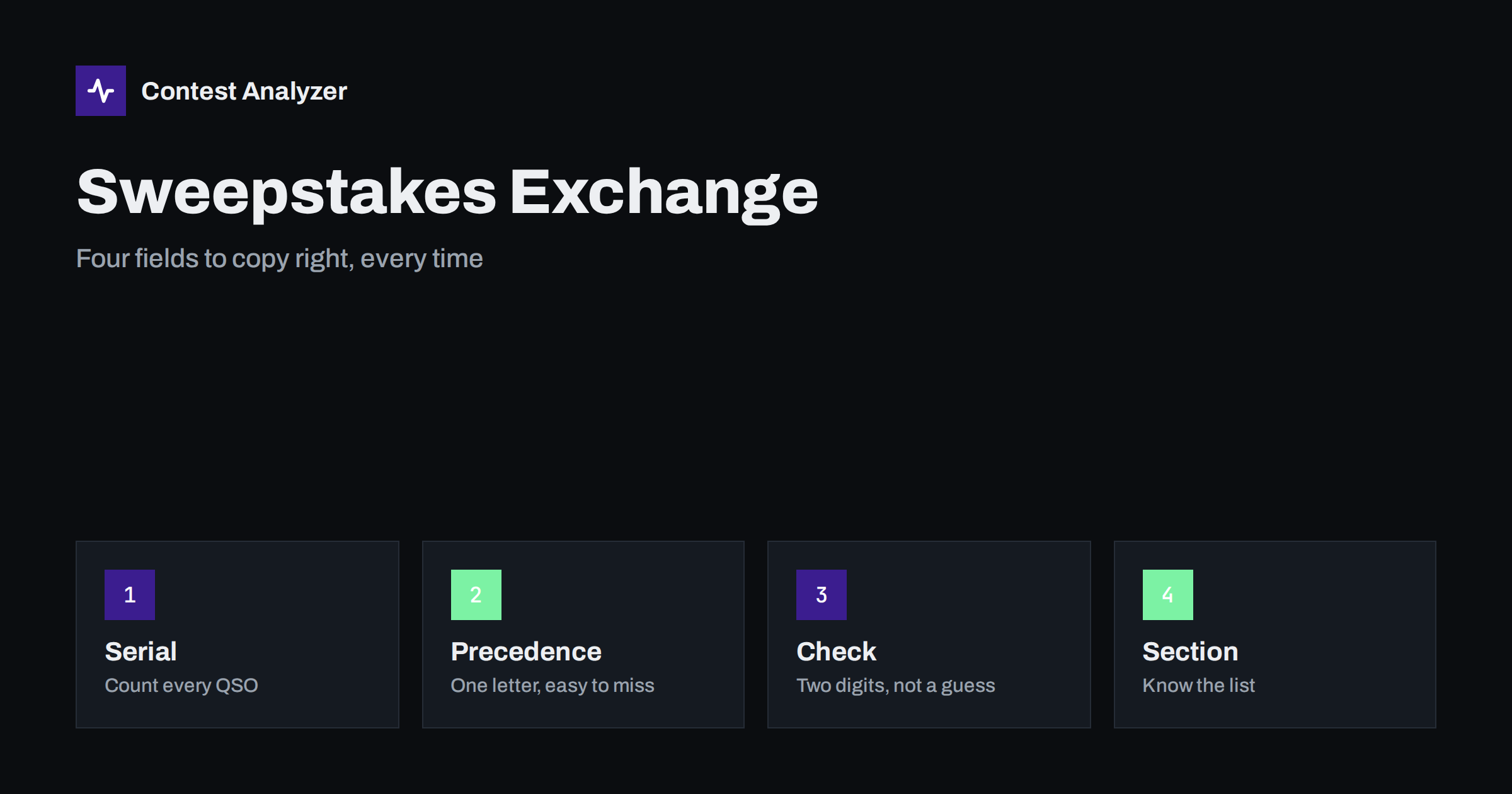
Short answer: The ARRL Sweepstakes exchange is longer than most HF contest exchanges, and each part of it is a place where a copy can go wrong. In general terms it combines a serial number, a precedence letter, your callsign, a check and an ARRL or RAC section. A QSO usually counts only if the whole exchange is right, so careful copying and quick repeats are worth more here than raw speed. Always read the current official rules, because details are decided by the organisers.
Why Sweepstakes is different
Most of the big DX contests ask for a signal report plus one number: a zone, a serial number or a power level. Sweepstakes is a domestic-style North American contest with a long exchange, and it rewards operators who can copy a lot of information accurately at a good rate. The exchange is passed in a fixed order, and many experienced contesters can tell from the rhythm which part they have missed. That makes the contest a good school for copying discipline, even if you only play for a few hours.
The price of the long exchange is that more things can be wrong. In a contest with one exchange field, a single error means one bad QSO. In Sweepstakes a single QSO has several independent places for an error, so the chance of a mistake is higher for the same operator on the same night. The way to manage this is not to hurry the exchange, but to learn which fields cause trouble for you and to build a habit around them.
The fields in general terms
As a general description, the exchange has these parts. Check the current rules for the exact definition, because the organisers can change wording and details.
- Serial number: your own running QSO count, which increases with every contact you make. It is a number you control, so you must be sure that your own logger and your own sending agree.
- Precedence: a single letter that describes your category or power level. Stations send the letter that belongs to their entry, and the rules explain which letter fits which entry.
- Callsign: the callsign of the station that sends the exchange. It is part of the exchange and it is not always the callsign that the other side expects, so copy it as it is sent.
- Check: a two-digit number that, in the traditional definition, is tied to the year when the operator was first licensed. The number is given to you by the other station, not worked out by you.
- Section: an abbreviation for the ARRL or RAC section in which the station is located. The list of sections is published by the organisers.
Do not trust this list as a replacement for the rules. It shows the logic of the exchange, and the rules decide what is correct.
Typical copying errors
The same few mistakes appear again and again in logs of this contest, and they are mostly the same mistakes as in any exchange, only multiplied by the number of fields.
- Precedence letter confused: a single letter heard under QRM is easy to mix with a similar sounding one, and nothing in the rest of the exchange tells you which one is right.
- Check copied as another pair of digits: two digits that were sent quickly can be turned around or one of them can be dropped, and the result still looks like a valid number.
- Serial number off by one: a misread digit in the serial number is a common cause of a lost QSO, especially when a station sends its number at high speed.
- Section abbreviation guessed: if you hear only part of the letters, the logger may offer a section that looks right, and you accept it without a repeat.
- Callsign from an earlier QSO: a station that has called you before may be logged from memory, while the exchange belongs to a different callsign this time.
None of these errors is special to Sweepstakes. What is special is how many places there are for them in a single QSO. For more on the general mechanism, see busted callsigns in contest logs.
Copying habits that help
A good habit is to copy the exchange in the same order every time, and to confirm each field mentally before you move to the next. Write or type fields as they arrive instead of storing everything in your head and typing it at the end. If you are on phone, use clear phonetics for letters and repeat the numbers in the standard way. If you work in CW, use short fills for the part that you missed rather than asking for the entire exchange again. The articles on CW copying accuracy and SSB phonetics and confirming callsigns describe the same discipline in the context of other contests.
Another habit is to repeat back what you logged when the exchange is unusual. A short confirmation after the exchange costs a second or two, and a wrong QSO costs a point and may also create a penalty for the other station. Many contesters decide in advance which fields they always confirm and which they accept at the first copy, and that rule keeps the rhythm steady.
Using fills instead of full repeats
When a part of the exchange is missing, ask only for that part. A request such as the check or the section alone is faster than a full repeat, and the other operator can answer in one short transmission. A full repeat wastes time for both stations and can create new errors if the second pass is also copied under noise. If the band is noisy and you still do not have the part, it is often better to ask the other station to send the entire exchange once more at a slower speed than to guess.
The same logic applies to your own transmissions. Send your exchange cleanly and at a speed that matches the other station, and be ready to repeat the field that others often ask for. If you notice that you are asked about the same field every time, change the way you send it: slower, with a pause before the letter, or with a short extra word that makes it clear.
Reading your log after the contest
After the contest, look at the log for patterns. Are the errors concentrated in one hour? One band? One field? A night with many problems in the precedence letter points to a specific copying habit, and a cluster in the serial number may point to a logger setting or to the speed of the other station. The article on not-in-log QSOs explains how a mistake on either side can end up as a lost QSO, even when your copy was correct.
Contest Analyzer checks every callsign and every zone against official license databases and several independent reference sources and shows only the few QSOs worth a second look. Serial numbers are not checked, and neither is the rest of the exchange in the way that a committee would check it, so the fields above remain your responsibility. What the tool does give is full statistics: rates, QSOs by hour and band, countries, continents, CQ and ITU zones, WPX prefixes, distance, beam heading, breaks and off time, and callsign length and structure. You can edit calls, zones, time and frequency in the report, mark QSOs checked in your own audio recording, and download a corrected Cabrillo. It works with Cabrillo from N1MM Logger+, DXLog and Win-Test, and you can see the list on the contests page.
Logger settings that save errors
Set the logger to the right contest and to the right exchange before the start, not during the first hour. Check that the serial number counter starts correctly, that the precedence letter you send is the one that belongs to your entry and that the check number is the correct one for your own station. Test the macros that send your exchange, and listen to them once on a dummy load or on a spare frequency. A wrong check number sent by your own macro will be copied correctly by every station that works you, and it will still be wrong in every one of their logs.
The logger can also help with the other side. Many programs show a list of valid sections and may warn if the typed abbreviation does not exist. Use that help, but do not let it choose for you. A valid abbreviation that you did not hear is still an error. The article on call history files describes the same risk when a logger fills fields in advance.
Slow down only where it pays
Sweepstakes does not reward a very fast exchange as much as a fast contest with a short exchange does. The time spent on a clean exchange is the same time that a repeat would take, and a repeat costs more because both operators must pay attention again. A realistic plan is to accept a slightly lower peak rate in return for a much lower error rate. Over a whole weekend, the second approach usually wins on points and on the final result after checking.
For more about the effect of rate on accuracy, see contest rates and QSOs per hour. The topic of this article is the same in a different form: speed is useful only when the information survives the trip.
Related reading
The bottom line
A long exchange has more places for errors, so copy it in a fixed order, ask for fills and confirm the fields that give you trouble. Check the current official rules for the exact definition of every field.
FAQ
Is every field in the exchange checked by the organisers?
In general a QSO counts only if the whole exchange matches, but check the current rules for how mistakes are handled.
Which part of the exchange causes most errors?
It depends on the operator. Look at your own log and find the field with the most repeats.
Should I ask for a full repeat or only for the missing field?
Ask for the missing field. It is faster and gives fewer new errors.
Does Contest Analyzer check serial numbers?
No. It checks callsigns and zones, and shows only the few QSOs worth a second look.
Can a logger prevent exchange errors?
It can warn about invalid values, but it cannot know what the other station really sent.