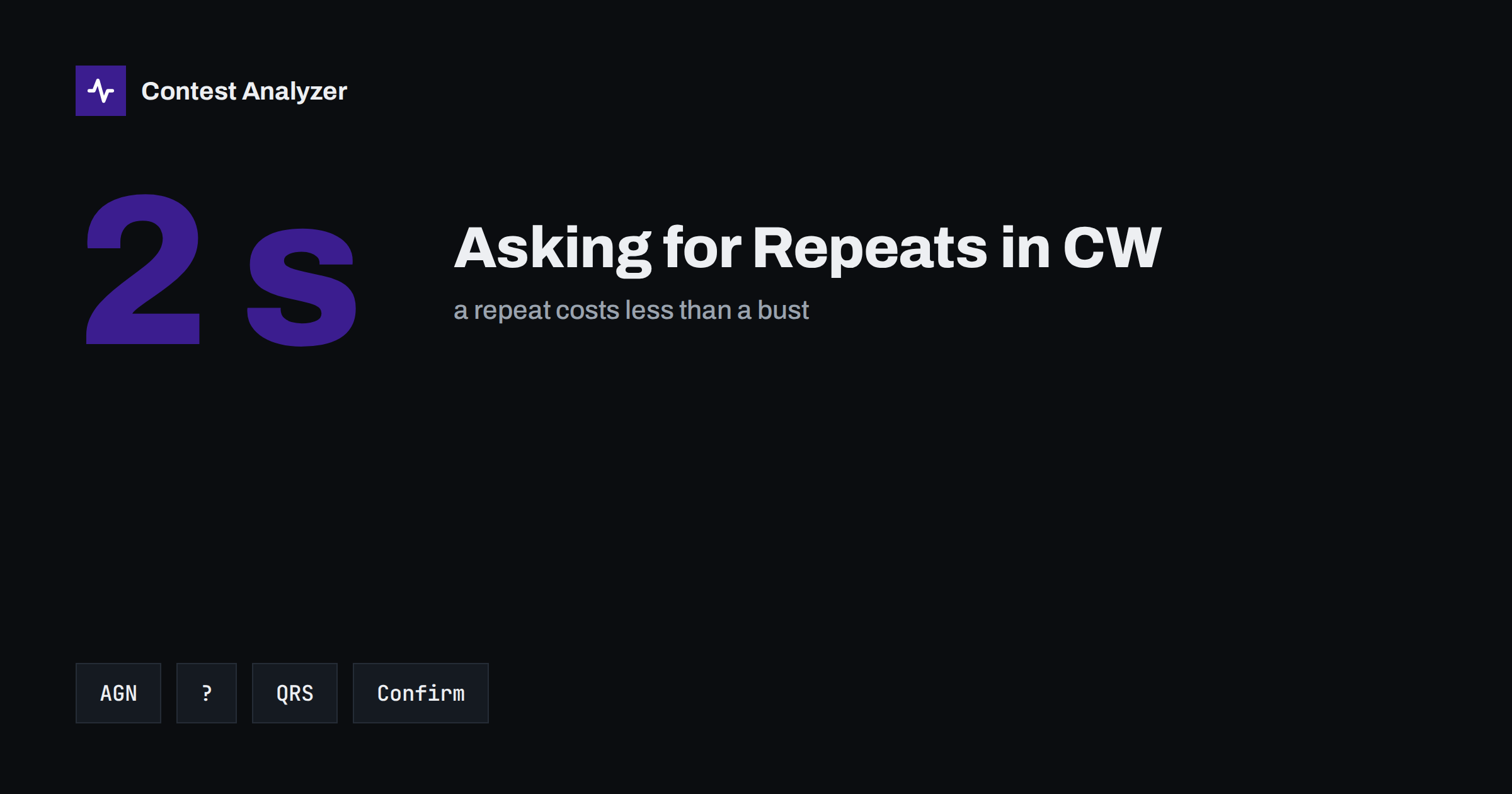
Short answer: In a CW contest, asking for a repeat is part of good operating. Use AGN to ask for something again, a question mark after a partial call to ask for the missing part, QRS to ask the other station to send slower, and a short confirmation of the callsign before you log it. A repeat costs a few seconds. A busted call can cost the whole QSO.
Why asking is better than guessing
Every operator has heard a call that was not fully clear and had to decide: ask, or log the best guess. In a contest the temptation to guess is strong, because the next caller is already waiting. But the arithmetic is on the side of asking. A repeat takes a few seconds, while a wrong call takes the QSO and often adds a penalty. Seen this way, a repeat is a cheap form of insurance.
The other point is that stations on the other side usually expect to be asked. Most operators in a contest are used to repeating their call or the exchange, and many will repeat it without comment. The article on partial callsign copies explains when a repeat is better than a guess, and the article on busted callsigns describes what the guess may cost.
The vocabulary of repeats
CW has short forms that save time and that are understood almost everywhere. The most useful ones for contests are these:
- AGN: again, used to ask the other station to send something again.
- ? after a partial call: asks the station that fits that part to answer.
- QRS: please send more slowly.
- QRQ: please send faster, used only when it is certain that the other station can do it.
- NR: number, used when the exchange contains a number, to ask for it.
- CALL? or a short question: asks for the callsign when it was not clear.
- QSB: fading, sometimes used to explain why a repeat is needed.
Use them sparingly and clearly. A very short request is better than a long sentence, because the other side needs only to know what to repeat. In a fast contest, most of the work is done with AGN and a question mark.
Ask for the part that you need
A general request for a repeat makes the other station send everything again, including the parts that you already have. A specific request saves time. If you have the call but not the zone, ask for the zone only, for example with NR or with a short word that makes the request plain. If you have a part of the call, send that part followed by a question mark, and let the other station answer. If you have missed everything, a simple AGN is fine.
The specific request also reduces the risk of mixing parts of the exchange. A repeat of the whole exchange may arrive with different timing and cause new confusion, while a repeat of the zone alone is a single, short item that is easy to copy. The article on cut numbers in CW contests explains why digits and letters in the exchange deserve this special care.
QRS: asking to slow down
A request to slow down is useful when the other station sends faster than you can copy. Many operators answer by reducing the speed for the rest of the QSO. Do it politely and briefly. If the station keeps the same speed, you can still copy it with a repeat or two, or you can decide to leave the QSO. The best contesters do not spend a long time on one difficult QSO when the rate is high, but they also avoid logging a call that they did not copy.
The opposite request, QRQ, is much less common in contests, and it is usually not needed. If you want to send faster, simply do it. Your callers are free to ask for QRS if they need it. The article on your first CW contest has a few more hints for beginners who are afraid of high speeds.
Confirm the callsign in a short way
A confirmation is not always a repeat request. After you have copied the call, you can send it back with your exchange, so that the station can correct it if needed. The station answers with a short OK or with the corrected call. This gives a built-in check with almost no cost in time, since you would send the call in any case.
Some operators prefer to send the call and wait for a short confirmation signal before continuing. Others add the call at the end of the exchange. Either way, the principle is the same: the call is sent back once, and the other side has a chance to say that it is wrong. If he corrects it, change the log immediately, because later you may not remember the correction. The article on not-in-log QSOs shows how a missing confirmation turns into a NIL.
How the numbers show your habits
If you often ask for repeats, you will see it in your rate, but also in your accuracy. An operator who asks always has fewer errors than one who guesses. Look at your log after the contest: a long line of QSOs without any corrections in the late hours may be a sign of confidence or of too many guesses. The corrected lines and the flagged QSOs in a report tell you the real picture.
Contest Analyzer checks every callsign and every zone against official license databases and several independent reference sources and shows only the few QSOs worth a second look. It gives full statistics: rates, QSOs by hour and band, countries, continents, CQ and ITU zones, breaks and off time, callsign length and structure. You can edit calls, zones, time and frequency in the report, mark QSOs checked in your own audio recording and download a corrected Cabrillo. It works with Cabrillo from N1MM Logger+, DXLog and Win-Test. See the contests page for the supported contests.
Repeats in the exchange and in the log
A repeat does not end when the other station has answered. Check what you have written in the logger against what you heard. If the callsign that appears in the entry window is different from the one that you intended to log, correct it before you press the key for the next QSO. Many busts begin with a correct copy that was typed wrongly, or with a callsign that was changed by a program that suggested another call from its database. Read the call once more on the screen, especially when the logger has filled in the zone or the name for you.
It is also useful to remember what you asked for. If you asked for a repeat of the zone and received it, log the new zone and not the first one that you copied. If the other station corrected his callsign, the corrected one is the right one. A short habit of looking at the entry window for a second before confirming the QSO catches many of these slips. The article on call history files in contest loggers describes the risks of trusting prefilled data without listening.
Common mistakes when asking for repeats
- Asking for a repeat of the whole exchange when only one part is missing.
- Sending AGN over the other station while he is still sending.
- Asking for a repeat three times and then guessing anyway.
- Logging the call before the confirmation arrives.
- Repeating the other station’s call with a different letter and not noticing it.
- Not asking at all in the late hours, when the risk of errors is highest.
The fix for each is simple. Wait for the end of the transmission, ask for what you need, confirm the answer and log the call only when you are sure.
A note on QRM and weak signals
Under QRM, a repeat request is often the only way to get a clean copy. The interference may move or end, and the second transmission may be clear. Under weak conditions, a slower speed helps more than a repeat at the same speed. If both fail, it is acceptable to leave the QSO and work another station. A QSO that cannot be copied is not a QSO, and the time that you save is worth more than the point that you might get from a doubtful contact.
Record the audio if you can. A recording lets you listen to the QSOs that you were unsure about, after the contest, when you have time and a quiet room. The article on recording audio in a contest describes the set-up and the use.
Related reading
- CW characters that get confused
- CW copying accuracy in contests
- SSB phonetics and confirming callsigns quickly
The bottom line
Ask when you are not sure, ask for the part you need and send the call back before you log it. A few seconds spent on a repeat protect the QSO, the multiplier and your final score.
FAQ
What does AGN mean?
It means again. It asks the other station to send the last part again.
Should I ask for the whole exchange or only a part?
Only the part you need. It is faster and easier to copy.
Is it rude to ask for QRS in a contest?
No. Most operators are used to it and will slow down. Ask briefly and politely.
How do I confirm a call without losing rate?
Send the copied call back with your exchange. If it is wrong, the other station will correct it.
When should I leave a QSO?
If you cannot copy the call after a few tries and the rate is high, move on. An uncertain call is not worth logging.