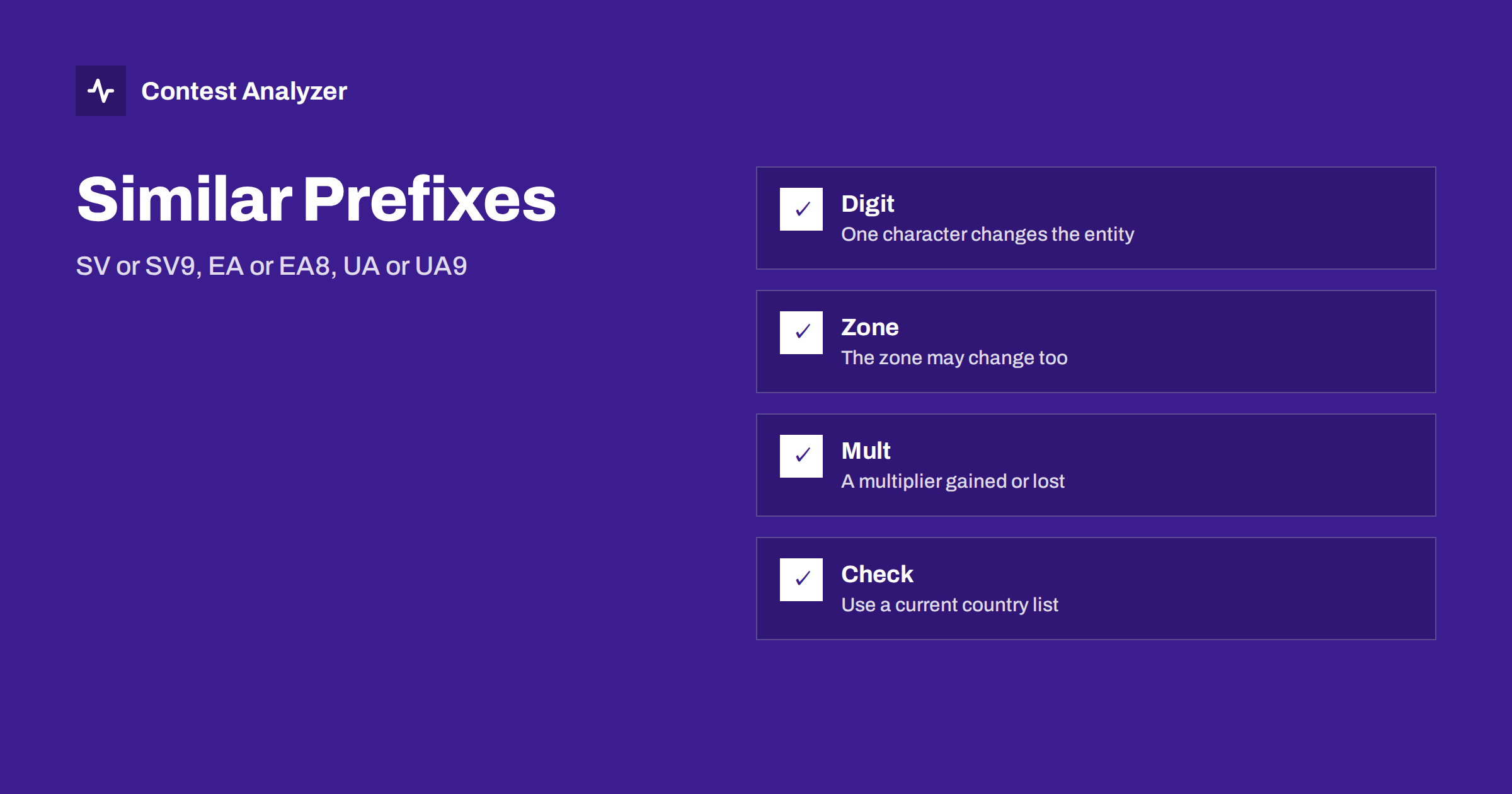
Short answer: Some prefixes differ by one character but belong to different countries or zones. SV and SV9, EA and EA8, and UA and UA9 are typical examples. If you copy the call with the digit wrong, or if your logger assigns the wrong entity, a multiplier can be gained or lost without any visible error. Listen to the digit, ask for a repeat when the call is rare, check the country that the logger shows and confirm the examples with a current country list, because lists change.
Why one character makes a difference
In callsign allocation, a country gets a block of prefixes, and the digit often separates parts of that country that are not in the same place. Islands that are far from the mainland, or regions with a different status, are often given their own digit and counted as separate entities in the country lists. As a result, two calls that look the same except for one digit can be thousands of kilometres apart, in different CQ zones and, in some cases, on different continents.
The examples in this article are general and are meant to teach the idea. Do not use them as a list for your logging. The official lists and the rules of each contest decide what counts, and they are updated, so check the current ones. The article on callsign structure explains the parts of a call, and the article on country lists: DXCC and WAE explains why the list matters.
SV and SV9: the mainland and an island
A Greek call begins with SV. The mainland and several parts of the country share this prefix, while some islands and groups of islands have their own prefixes or digits. In the country lists, some of them are separate entities, and a station from one of them is a different multiplier from a station on the mainland. If you hear “SV9” and log “SV”, or the other way round, the country in your log will be wrong, and so will the multiplier. The error can also change the zone, depending on the list. The same is true for other calls that begin with the letters used by the country.
EA and EA8: Spain and the Canary Islands
Spanish calls begin with EA. The prefix EA8 is used in the Canary Islands, which are counted as a separate entity and are in a different CQ zone from mainland Spain, because the islands are near Africa. The Balearic Islands and Ceuta and Melilla also have their own digits. For a European station, a QSO with EA8 can be a new multiplier and a new zone, while a QSO with EA is neither. A single missed digit on CW or SSB changes the value of the contact.
Because these stations are popular in contests, there are usually several of them on the air, and they are easy to work on the right band at the right time. But the same popularity leads to quick QSOs, in which the digit is easy to lose. If you cannot hear the digit, ask for the call again.
UA and UA9: European and Asiatic Russia
Russian calls start with letters such as UA, RA or R, and the digit shows the region. Calls with the digits 9 and 0 are in the Asian part, and calls with lower digits are in the European part, with some exceptions in the list. The zones differ: European Russia and Asiatic Russia are in different CQ zones, and the Asian part has several zones. For a contest in which zones are multipliers, the digit matters. For the country multiplier, the situation is different, because both parts count as the same country in many lists. This is a good example of how the same confusion can matter for zones but not for countries.
The same principle applies to other large countries. The article on zone errors in multi-zone countries describes what happens in the United States, Canada, Brazil and China.
How the confusion appears in your log
- A wrong digit in the call. You copy SV when the station sent SV9, and the log has the wrong country.
- A wrong assignment by the logger. The call is right, but the country file is old and assigns the wrong entity. Check the date of your file before the contest.
- A prefilled zone. The logger fills in the zone from the main part of the country, and you do not notice that the station is on an island.
- A confusion on the other side. The other station copies your digit wrongly and logs a wrong call for you.
How to avoid the confusion
The first defence is to listen for the digit. In a short call, the digit stands between the prefix and the suffix, and operators send it fast. On CW, a digit is a group of five elements, and a fast sender can make it hard to count. On SSB, the digit is a single word, and noise can hide it. If you are not sure, a short question is better than a guess.
The second defence is to compare the call with the exchange. If a station sends a zone that does not match what you expected for the prefix, there may be a mismatch, and you should check the call again. A station that sends zone 33 and is logged as EA is probably EA8, and a station that sends zone 17 and is logged with a European digit may be in Asia. The zone is a second source of evidence.
The third defence is a country file that is up to date, and the habit of looking at the country that the logger shows after you type the call. If the country surprises you, stop and ask. The article on busted callsigns shows why a single character matters.
A short drill before the contest
You can reduce this kind of error with a simple exercise in the week before a big contest. Take the country list of the contest and pick the countries where one prefix is split into several entities. Write the pairs on a card, for example mainland and island, European and Asian part, home and overseas territory. Add the zone and the continent for each. The card has perhaps twenty lines, and it takes less than half an hour to make.
Then listen to a recording from an earlier contest, or to the live band on a normal weekend, and try to say the entity before you look at the logger. Compare your answer with the screen. With a few repetitions you build a fast reflex: when you hear a digit that belongs to a split prefix, you stop and listen again. This is the same reflex that experienced contesters use when they hear a station with an unusual sound in the call.
Keep the card at the station. During the contest, a glance is enough to confirm that the call, the country and the zone fit together. You will also see that most of the time they do, and the card costs you nothing. In the few cases where they do not, you save a multiplier or a QSO.
The drill is also a good way to check the logger. Type some of the calls from the card, and see whether the country and the zone that the logger shows are correct. If they are not, the file is old or the setting is wrong. Fix it before the contest and not during it. Do the same on every computer if you operate with several, because a different version on each of them will give different answers.
Finally, remember that nobody hears every digit correctly in every QSO. The goal is not a perfect score of copying, but a habit of checking when the situation is risky. A rare prefix, a weak signal and a fast sender are the three conditions in which to slow down.
What the statistics show
After the contest, look at your list of countries and zones for entries that look unlikely. A station from a remote island on a band that was closed, or a zone that appears only once, may be a mistake. Contest Analyzer shows countries, continents, CQ and ITU zones and WPX prefixes in its statistics. It checks every callsign and every zone against official license databases and several independent reference sources and shows only the few QSOs worth a second look. In the report you can edit calls and zones and download a corrected Cabrillo. See the contests page for the supported contests.
Related reading
The bottom line
One character can separate two countries or two zones. Listen for the digit, ask when it is unclear, check what the logger assigns and look at unusual entries in your final statistics.
FAQ
Why do SV9 and SV count differently?
In the country lists, islands and some regions can be separate entities. Check the current list for your contest.
Can a prefix confusion change my zone?
Yes, because the islands or the Asian part of a country may lie in a different zone.
Should I trust the country that the logger shows?
Use it as a check and update the country file before each big contest.
How can I find these mistakes after the contest?
Look at the list of countries and zones for unlikely entries, and listen to the recording for those QSOs.
Are the examples in this article the full list?
No, they only show the idea. Use the official lists and current contest rules.