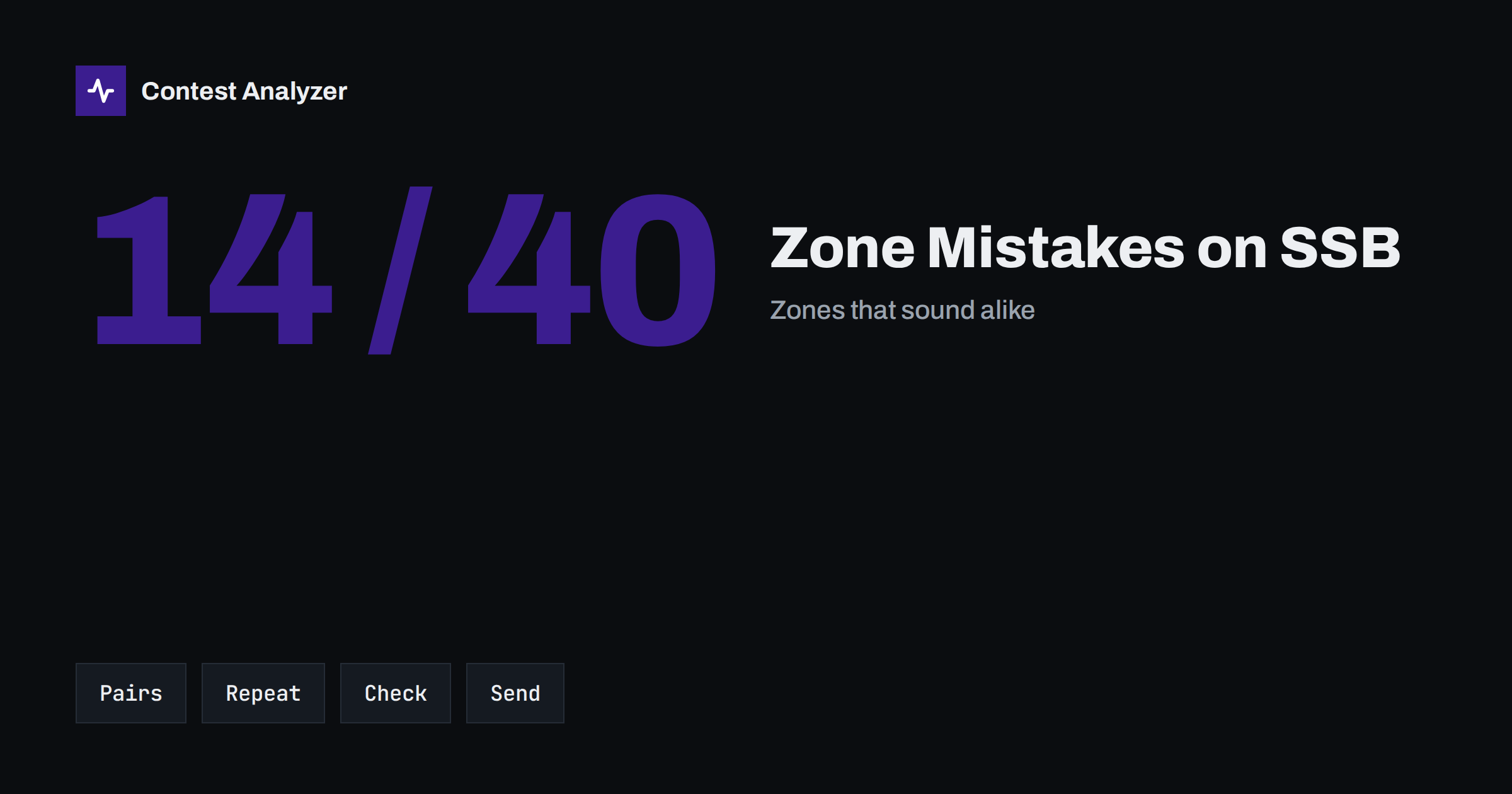
Short answer: On SSB the zone is spoken, and numbers that sound alike are easily confused, for example 14 and 40, 13 and 30, or a single digit lost in noise. A wrong zone in the log can cost the QSO and, if the zone was a multiplier, the multiplier as well. The best defence is to ask for a repeat when the number does not fit the callsign, to send your own zone slowly and clearly and to review the zones in your log after the contest.
Why zones are a weak point on SSB
In contests such as CQ WW the exchange is short: a signal report and the CQ zone. The report is almost always the same, so the only real information is the zone. In a pileup, the other station says the number once, often quickly, and the next operator is already waiting. If the audio is poor, a single wrong digit changes the meaning. Because the exchange has no checksum and no redundancy, nothing in the exchange itself tells you that you misheard.
The same applies to the IARU HF Championship, where the ITU zone is sent, and to other contests with a numeric exchange. The ITU zones go up to higher numbers than the CQ zones, so more pairs of numbers can sound alike. The article on IARU HF Championship and ITU zones explains the difference between the two systems.
Pairs that sound alike
- 13 and 30, because the stress of the word falls on different syllables, which is easy to miss in noise.
- 14 and 40, with the same problem. This pair is the best known in CQ WW, because both zones exist and both are common.
- 5 and 9 in operators who say “niner” unclearly, and 3 and 8 in a weak signal.
- Single and double digits: 5 and 15, or 4 and 14, when the first syllable is lost.
- Zones with a leading zero, such as 05 or 03, when the operator says the zero and you hear “oh five” as “fifty” or the opposite.
With ITU zones in the IARU contest further pairs appear, such as 15 and 50 or 16 and 60, which are very similar. Knowing the typical pairs helps you to listen for the difference.
Use the callsign to test the zone
The best check for a zone is not a better ear but a simple question: does this zone make sense for this station? A callsign gives you a strong hint. A station in Germany will be in the zone for Europe that is used there, and a German station cannot be in zone 40. If your logger shows the zone that it expects for the call, compare it with what you heard. If the two agree, you can log it. If they do not, ask for a repeat. The article on CQ zones explained describes how to know the zone of a station.
Be careful with countries that have more than one zone, such as the United States, Canada, Russia, Brazil and China. In such cases the callsign alone is not enough, and the operator has to say the zone correctly. The article on zone errors in multi-zone countries deals with this special case.
Do not let the logger decide for you
Many loggers prefill the zone from a country file or a call history. This saves time, but it also removes the check. If the logger shows zone 5 and the operator says “14”, you must notice that they differ. If you simply press enter, you will log the prefilled value, and the log will carry the wrong zone with a high confidence. The article on call history files describes the risks.
A good habit is to look at the zone field after the other station has finished and to confirm it with what you heard. If the exchange is long and the call is rare, wait for the second transmission.
How to ask for a repeat without losing the rate
A repeat costs time, but a short one costs less than a lost QSO. In SSB you can use a short phrase such as “Zone again?” or repeat what you heard and ask for confirmation, for example “Fourteen, correct?”. Many operators answer with the number in a clear, slow way. On a crowded band, it is useful to ask only for the zone and not for the whole exchange. Avoid the question “Say again” without a pointer, because the other station does not know what you missed and repeats everything.
Use the phonetic habits that are suitable for numbers. Some operators say the digits separately, such as “one four” for 14 and “four zero” for 40, in order to avoid the confusion. Others stress the first syllable of the teens. Choose a method and use it consistently, and listen to how successful stations send their numbers.
Send your own zone clearly
The same problem exists in the other direction. If you send “14” in a way that is mistaken for “40”, the other station logs a wrong zone for you, and your QSO may be marked as an error in their log, even though your own log is correct. This is one of the reasons why a QSO is sometimes missing or marked as incorrect in a result, although you did nothing wrong at your end. Say your zone at a moderate speed, and add the digits one by one when conditions are bad.
Record your own transmissions if you can, and listen to a few of them. The sound of your own voice on the air is often different from what you think. Check the setting of the speech processor, the microphone gain and the filters, because heavy processing can make numbers less clear.
Training your ear before the contest
Zone mistakes are partly a matter of practice. In the weeks before a big SSB contest, you can improve your ear with a few simple exercises. Listen to recordings of previous contests, if you have your own, and write down only the zones that you hear. Compare them with the log and note the pairs that you confuse most. Many operators find that they have one or two typical mistakes, and knowing them is half of the solution.
Another exercise is to use your own recordings of a quiet period. Pick ten QSOs and listen to the zone only, without the callsign, and try to say the number before you see the log. If you hear it correctly every time, the problem is not your ear but your attention under pressure. If you do not, a different headset or a different filter setting may help. The article on headphones and listening fatigue shows how the audio chain changes what you hear in the late hours of a contest.
Finally, think about the hours when mistakes happen. Zone errors are not equally likely at all times. They cluster at night and in the second half of the contest, when the operator is tired, and the article on logging errors in the night hours shows how to see this in your hourly statistics. If you know that the third night is a weak point, you can plan a break or switch to a more careful style of copying at that time. A slower QSO with the right zone is better than a fast QSO with the wrong one.
Practice is cheap, and it does not need any special equipment. A few minutes a day in the week before the contest, with a pen and a recording, can make a visible difference in your accuracy and in the number of repeats that you have to ask for.
What the review after the contest shows
After the contest, look at the zones in your log. A station from Spain with zone 40 or a station from Japan with zone 14 is a sign of a mistake. You can also group QSOs by country and see whether the zones are consistent. If the same country appears with two different zones, either the country has two zones, or one of the entries is wrong. The articles on letters that sound alike on SSB and the CQ WW DX SSB checklist give related advice for callsigns and preparation.
Contest Analyzer checks every callsign and every zone against official license databases and several independent reference sources and shows only the few QSOs worth a second look. You can edit the zone in the report, mark a QSO as checked in your own audio recording and download a corrected Cabrillo. The report also shows your QSOs by CQ and ITU zone. See the contests page for the supported contests.
Related reading
The bottom line
Zones are short, but on SSB they are easy to mishear. Compare the zone you heard with the callsign, ask for a repeat when they disagree, send your own zone clearly and review the zones in your log after the contest.
FAQ
Which zone pairs are confused most often in CQ WW?
14 and 40, and 13 and 30, because they sound similar in noise.
Can a wrong zone cost more than one QSO?
Yes, if the zone was a multiplier on that band, the multiplier may be lost as well. Check the current rules for penalties.
Should I trust the zone that my logger fills in?
Use it as a check, not as the answer, and confirm what the other station really said.
How do I say my own zone clearly?
Speak at a moderate speed and, when conditions are poor, say the digits one by one.
How can I find zone mistakes after the contest?
Group QSOs by country and look for zones that do not fit, or use a report that shows only doubtful ones.