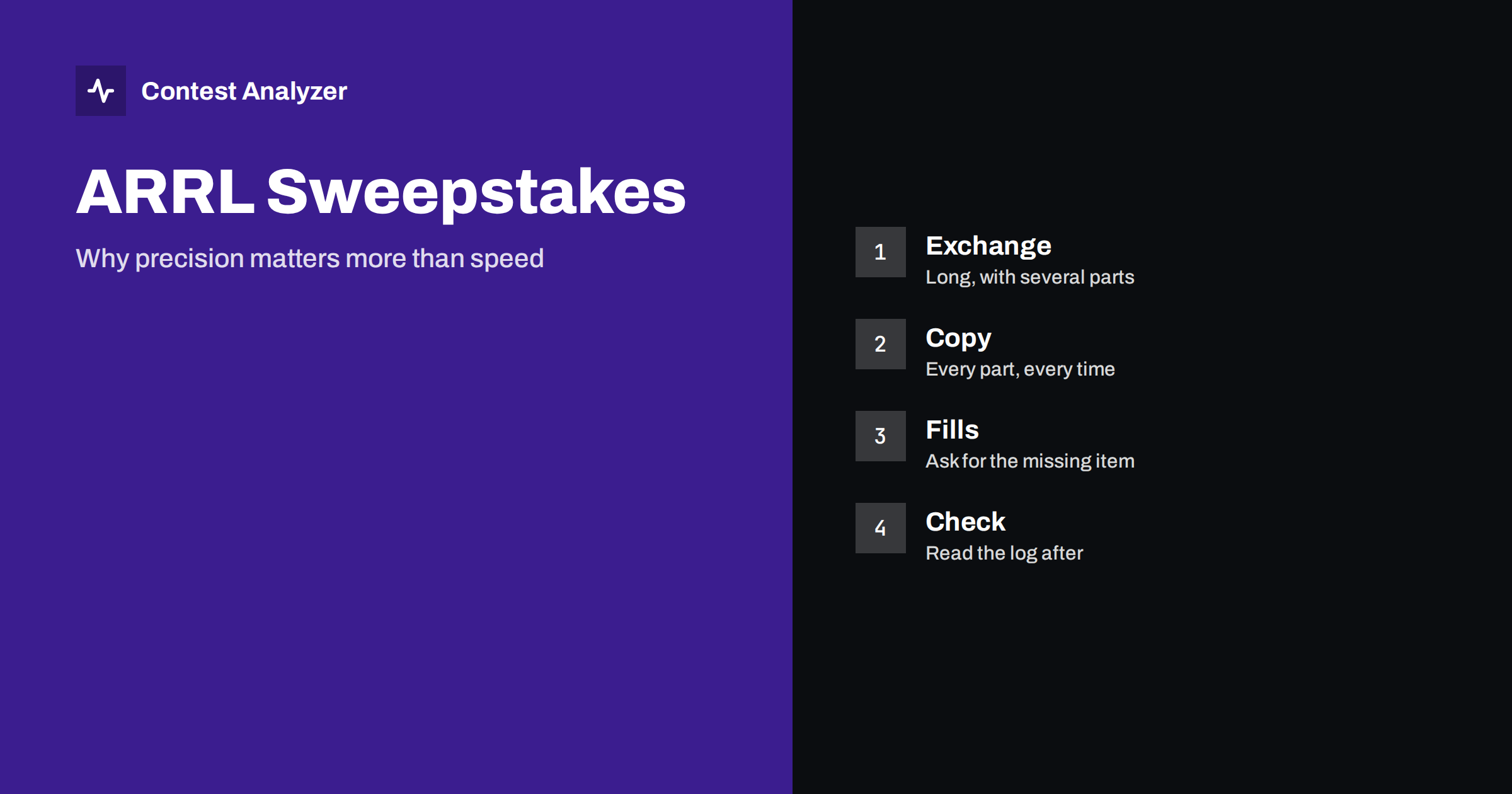
Short answer: The ARRL November Sweepstakes is a North American contest with a longer exchange than most HF contests, so each QSO takes more time and each QSO has more parts that can go wrong. Precision matters more than speed: a missed or wrong item can make the whole contact fail. Read the current official rules for the exact exchange and categories, and build a logging routine that catches errors while the other station is still on frequency.
What the Sweepstakes is
The Sweepstakes is one of the long-running contests in the ARRL calendar, held in November. In the usual format there are two separate weekends, one for CW and one for phone, so many operators take part in one of them or in both. The contest is built around North America, and stations outside it are generally able to take part as well, although the details of scoring and multipliers are set by the organisers. Because the rules, the dates and the categories may change between years, always check the current official rules before you plan your entry.
For many operators it is a different kind of contest. There are no zones or prefixes to chase in the way that there are in CQ WW or CQ WPX. The challenge is to complete a longer exchange quickly and correctly with many stations, again and again, for many hours.
Who takes part
Participants range from large stations with several operators to a small station with a modest antenna, and from experienced contesters to operators who come only for this contest. The Sweepstakes has a reputation as a friendly contest where a small station can still make many contacts, because most stations are active and reply to calls. This also means that the band is busy and the exchanges are frequent, so a method that works for the pace matters.
The long exchange in general terms
In general, the exchange in the Sweepstakes has several parts instead of the one or two of other contests. As a general description, it includes a serial number, a precedence letter that depends on the power or category, a check number related to the year when the operator was first licensed, and the ARRL or RAC section of the station. Check the current rules for the exact definition of each item and for the way each is to be sent. The important point for the log is that all the parts must be copied correctly for the QSO to be fully valid, and that each part is a place where an error can happen.
Because of this length, the exchange is usually sent in a fixed order, and experienced operators learn the order so well that they can follow it with little effort. A missing part is therefore easy to notice: if you expect four items and hear three, you know something was lost, and you can ask for exactly the item you need.
Why precision beats speed here
In a contest with a short exchange, a small copying error usually affects one field, and the cost is a single QSO. In a contest with a long exchange, the number of fields multiplies the chance of an error. If you copy each field correctly 98 times out of 100, then with several fields the chance of a fully correct exchange is noticeably lower. The numbers are only an illustration, but they explain why the operators who do best in this contest are often the ones who ask for fills quickly and without embarrassment.
The second reason is time. A QSO that has to be repeated in full costs more than a QSO in which you ask for one item. Asking early, with a short precise request such as the name of the item, is faster than hoping that the error does not matter. The article about partial callsign copies describes the same habit for callsigns, and it works for the other parts of the exchange too.
A method for copying the exchange
- Write while listening. Type each item into its field as you hear it, not at the end. In most loggers the Tab or the space key moves you from field to field.
- Use the same order as the sender. If your logger fields follow the order of the exchange, you do not have to think about where each item goes.
- Do not guess. If an item is not clear, ask for it before you send “TU”. A short request costs a few seconds. A wrong guess may cost the QSO.
- Repeat important items back. When the other station asks you to confirm, give the complete exchange, not only the part that was in doubt.
- Keep the callsign and the exchange together. The most common problem in a busy band is typing an exchange into the wrong QSO.
Logging habits that protect the QSO
Because a QSO takes longer, there is a greater risk that you start the next QSO before the previous one has been fully logged. Develop a habit: the QSO is logged only when the last item has been entered and checked on screen. Some operators say the callsign of the other station again when they confirm, because this gives a second chance to hear a mistake in the callsign. The article on busted callsigns explains what such a mistake costs, and the note on dupes explains why working a dupe may be better than refusing a contact when you are not sure.
If the exchange includes a number that increases with each QSO, take care that the logger does the counting and that you do not change it by hand. Check the serial number from time to time against the QSO count on the screen. If the logger gets out of step, the number in the log may differ from what you actually sent. The principles in the article on serial numbers in CQ WPX apply here, too: the number you send should be the number that you log.
The long hours and the error rate
Sweepstakes is a contest where the operator is working with a slower rate than in some others, but the concentration is continuous. In the late hours, errors become more frequent, and many of them are small: a digit swapped, an item in the wrong field, a callsign with a letter missing. The article about night-hour logging errors explains why this happens and how to recognise it. The practical answer is the same as in other contests: plan your breaks, drink water, and slow down slightly when you notice that you are making mistakes.
Check the log before you submit
When the contest is over, export the Cabrillo file and read it. Check the header, the category and the QSO lines. Look at the unusual exchanges: an item that is outside the expected range, a section that does not exist, a callsign that appears only once with an exchange that looks different from the others. Compare these entries with the audio recording, if you made one. The article on checking a contest log before you submit it gives a general routine.
Contest Analyzer helps with the callsigns and zones in your log. It checks every callsign and every zone against official license databases and several independent reference sources and shows only the few QSOs worth a second look, and you can edit the callsigns or zones in the report and download a corrected Cabrillo. It also gives full statistics: rates, QSOs by hour and band, countries, continents, CQ and ITU zones, WPX prefixes, distance, beam heading, breaks and off time, and callsign length and structure, and a comparison with your own logs from earlier years. It supports 22 contests, as shown on the contests page, and works with Cabrillo from N1MM Logger+, DXLog and Win-Test. Check the list for the contest that you enter. The items of the exchange itself, such as the serial numbers, are not checked, so they remain your responsibility.
A short plan for your first Sweepstakes
If you have not taken part before, start with the rules and read the exchange definition twice. Write a sample exchange on paper and send it to yourself in the logger, so that you see which field comes in which order. Operate for the first hour at a speed that is a little slower than you want, and watch the logger. As you become confident, increase the speed. Do not worry about the final score in the first year; the goal is a clean log and an understanding of how the contest feels. The notes in the article about your first HF contest are a good companion.
Related reading
- Partial callsign copies: when to ask for a repeat
- Operator fatigue in 48-hour contests
- Your post-contest review routine
The bottom line
The long exchange in the ARRL Sweepstakes rewards the operator who copies carefully and asks for fills without delay. Learn the order of the items, log each part as you hear it, and check the log after the contest. Read the current rules for the details and leave the speed for later.
FAQ
Is the Sweepstakes a CW or a phone contest?
In the usual format there are separate CW and phone weekends. Check the current rules for the dates and the rules of each part.
Why is the exchange longer than in other contests?
That is how the contest is defined by its organisers. The current rules describe each item and how to send it.
Should I ask for a fill or guess?
Ask. A short request for the missing item costs seconds, while a wrong guess may cost the QSO.
Can a small station do well?
Yes. Many stations are active and reply to calls, so a clean log and steady work give a good result for a small station too.
Does Contest Analyzer check the whole exchange?
It checks callsigns and zones and shows the few QSOs worth a second look. Serial numbers are not checked.