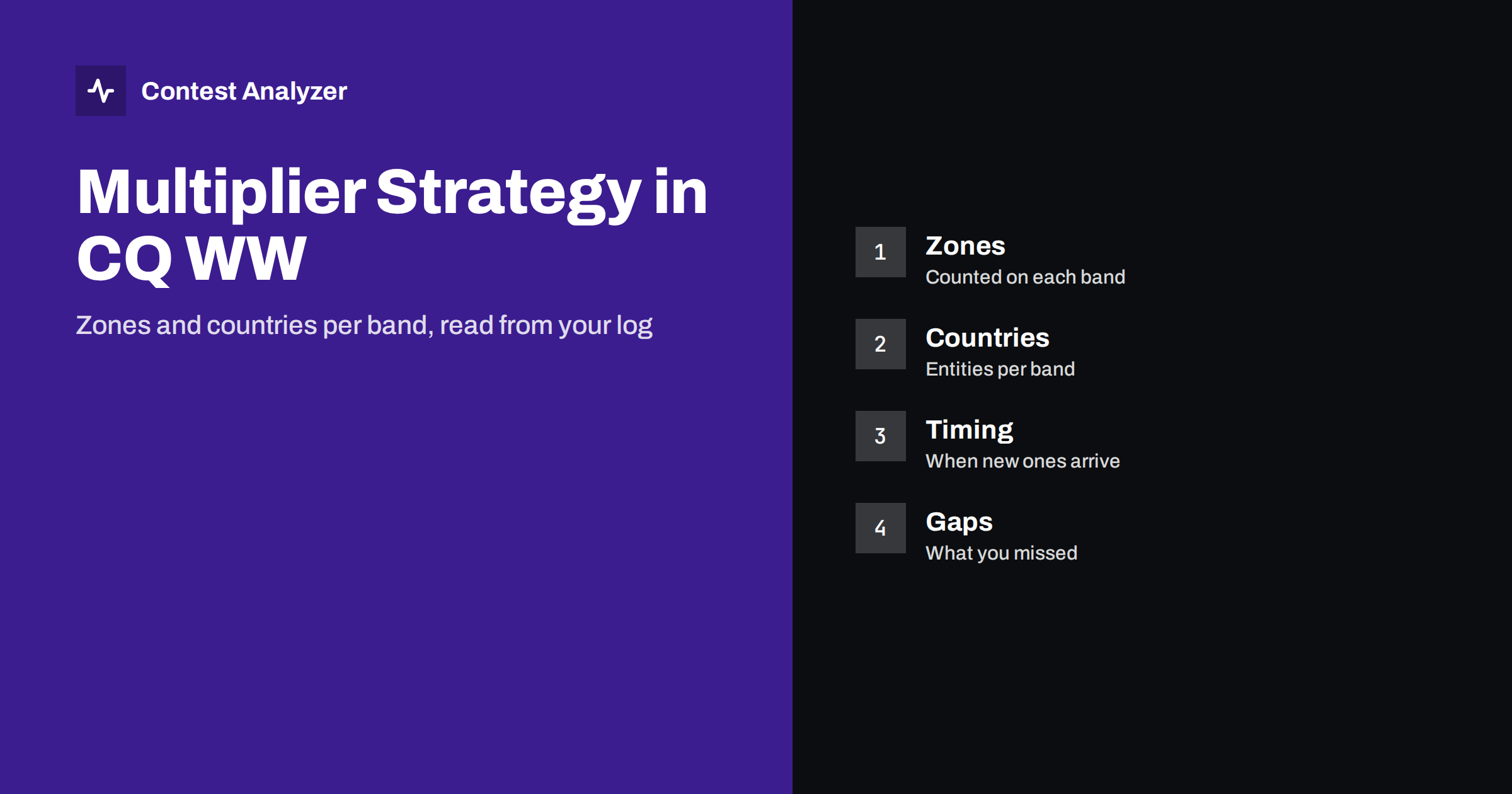
Short answer: In CQ WW DX the score is the QSO points multiplied by the number of multipliers, which are CQ zones and countries counted separately on each band. That makes multipliers worth far more than any single QSO. To use them well, look at your log in three ways: how many you have on each band, when during the contest new ones arrived, and which zones and countries are missing. Always confirm the current scoring in the official rules.
How multipliers work in CQ WW
The CQ World Wide DX Contest asks stations to exchange a signal report and a CQ zone. For scoring, the log earns points for QSOs and then multiplies the total by the multipliers. The multipliers are the CQ zones and the countries you work, and each of them counts once on each band. That means working Zone 14 on 20 metres and Zone 14 on 15 metres gives two zone multipliers, not one. The same applies to countries.
The details of the point values, the country list and any special cases are rules of the contest and can change. Read the current rules at cqww.com before you plan. The article on CQ zones explains the zones themselves, including the countries that are split between several zones.
Why multipliers matter more than their count suggests
The multiplier structure has a simple consequence. Because the total is points times multipliers, each new multiplier raises the score by a share of the whole, and that share is larger when your QSO count is high. A multiplier early in the contest is therefore worth more than one that arrives late, in the sense that it applies to the points you earn afterwards on that band. But a multiplier on a new band after the main rush may still be easier to find than the thousandth QSO.
In practice, this means two things for operating. During the early hours, new multipliers come easily and a good run rate helps. Later, they become scarce, and each new one needs effort. The question that separates strategies is how much time you devote to hunting multipliers in the later hours, as opposed to continuing to run for QSOs. There is no single correct answer; the numbers in your own log will tell you which pays off at your station.
Reading multipliers per band
The first view to build is the multiplier count per band. For each band you used, count how many zones and how many countries you worked. Compare the bands with each other and with the previous year. A few patterns are common.
- A strong main band. Most operators have a band where their antenna works best. Zones and countries are highest there, and the total follows.
- A band with plenty of QSOs and few multipliers. This usually means you worked a limited region, such as Europe, in large numbers. It may be right for a run band, but it signals that you are not exploiting the band for distance.
- A band with few QSOs and many multipliers. Often a sign of an effective search and pounce approach, or a band that opened for a short time and gave you a range of rare entities.
- An unused band. If one band shows almost nothing, ask whether the cause was propagation, antenna or time. A few short visits to a band can add several multipliers cheaply.
The continent split of your QSOs, covered in the article on the continent breakdown of a contest log, helps to explain why some bands carry more multipliers than others.
Reading multipliers by hour
The second view is the arrival time of new multipliers. Plot or list, hour by hour, how many new zones and countries appeared. The typical curve is steep at the start and flat at the end: the first few hours add many multipliers, then the rate of new ones falls away as the easy ones are all worked. Look for the following.
- When did the curve flatten? The sooner it flattens, the sooner you ran out of new things to work on that band, and the sooner a band change might help.
- Are there bursts later? A sudden rise in the middle of the contest usually indicates a band opening or a deliberate hunt. Note the hour and the band, because it is repeatable knowledge.
- How many multipliers came from search and pounce? If you can tell run QSOs from search and pounce QSOs, you may find that most of the multipliers came from the latter. The article on run vs search and pounce shows how to measure that.
- How did the last two hours go? In the closing hours, short visits to other bands may give final multipliers. If they did not in your log, consider whether to plan them next time.
Finding the gaps
The third view is the list of what you did not work. For each band, list the zones you missed. The numbers are small: there are 40 CQ zones, and a good operator on a main band may be missing only a handful. For each missing zone, ask whether it is a realistic target on that band at some time of day. Zones on the opposite side of the world are best on the long-path openings; nearby zones may be reachable at any time. The article on band strategy hour by hour shows how to use the QSOs-by-hour view to see when each part of the world was possible.
For countries the list is longer, and it is better to focus on groups: a region, a continent, or a type of entity (small islands, for example). The beam heading and distance statistics, described in the article on beam heading statistics, show you in which directions your multipliers came from and which directions are empty.
Balancing QSOs and multipliers
A simple way to compare the two is to calculate the number of QSOs per multiplier for each band. If a band shows a very high ratio, you worked many contacts for each new zone or country, and a visit to a different part of the band, or to another band, is probably more valuable. If the ratio is low, the band gave a good spread. Compare the ratio year on year, which is a fair way to see whether your approach has changed; the article on comparing contest results explains how to make such comparisons fair.
Two caveats apply. First, the ratio depends on the number of QSOs you make, so do not read too much into small differences. Second, the best strategy depends on the rest of the station: a high-rate station that can run all night may rationally prefer QSOs; a lower-power station may gain more from multipliers.
Protecting your multipliers
A multiplier is only worth what it is worth if the QSO behind it is correct. A busted call can remove the contact, and with it the multiplier, if that contact was the only one with that zone or country on that band. An incorrect zone in the exchange has a similar effect. Because a multiplier is worth many QSOs, it pays to be more careful with stations that offer a new zone or a new country: ask for a repeat, confirm the zone, and read the call twice.
A pre-submission review is a good time to look at these QSOs in particular. Contest Analyzer checks every callsign and every zone against official license databases and several independent reference sources and shows only the few QSOs worth a second look. You can correct callsigns and zones directly in the report and download a corrected Cabrillo. Its statistics cover countries, continents, CQ and ITU zones, WPX prefixes, QSOs by hour and band, distance and beam heading, and you can compare with your own previous logs. Serial numbers are not checked and dupes are not shown as errors. See the list of supported contests and the FAQ for more information.
A simple plan for next year
- Write down the multiplier count for each band this year.
- List the five zones and five countries you most wanted and did not get.
- Note the hours in which the multiplier curve flattened.
- Decide on one change: a band to visit earlier, a time to hunt, or a direction to point.
- Check the same numbers next year, and see whether the change worked.
Related reading
- CQ zones and CQ WW explained
- Continent breakdown of a contest log
- Band strategy hour by hour
- CQ WW DX SSB checklist
The bottom line
In CQ WW the multipliers decide a lot, so they deserve their own analysis. Read them per band, per hour and as a list of gaps, protect them from errors, and pick one change each year. A modest, repeated improvement in multipliers is one of the most dependable ways to raise a score.
FAQ
Do CQ WW multipliers count once per band?
Yes, zones and countries are counted separately on each band under the current structure of the contest. Always confirm the details in the current official rules.
Should I hunt multipliers or keep running?
It depends on your station and the hour. Early in the contest running usually brings new multipliers by itself; later, compare the QSOs-per-multiplier figures in your own log to decide.
How many CQ zones are there?
There are 40 CQ zones. Some countries are split between several zones, so check the zone for each station. The article on CQ zones explains the main cases.
Which statistics help to plan multipliers?
Multipliers per band, new multipliers per hour, QSOs by hour and band, continents and beam headings. Together they show where and when your multipliers came from.
Can an error cost me a multiplier?
Yes. If the only QSO that gave you a zone or country on a band is removed, the multiplier may be removed with it. Pay special attention to new multipliers when you copy and when you review the log.