Short answer: In most HF contests the RST report is a formality. Operators send 59 on phone and 599 on CW or RTTY almost every time, because the exchange has to be fast and the report is not used for scoring. The part that matters is the other item in the exchange, such as a zone or a serial number, together with the callsign. Log the report you actually sent and received, but spend your attention on the items that decide the QSO.
What RST means
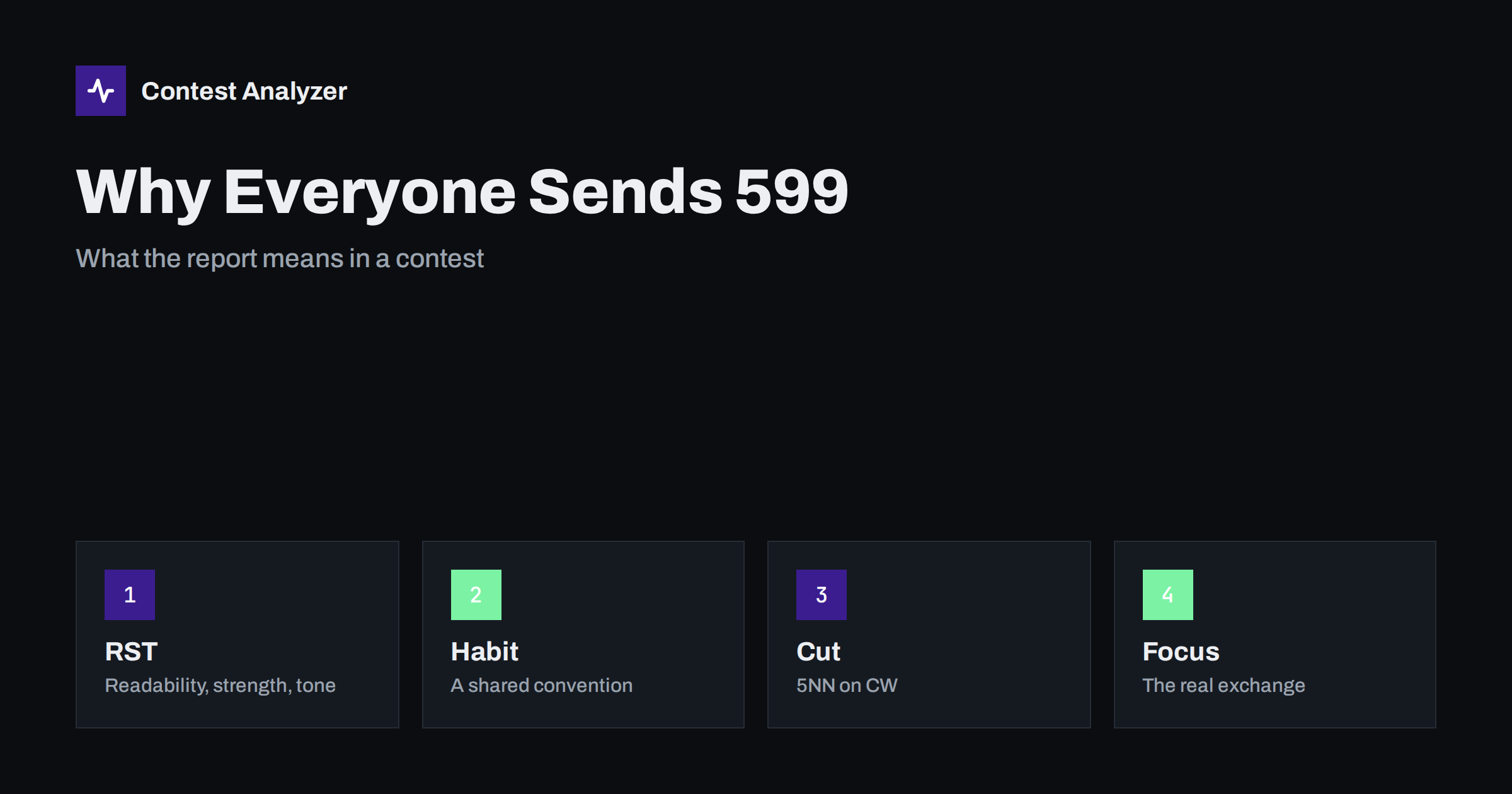
RST is a code for a signal report. R stands for readability, a number from 1 to 5. S stands for signal strength, from 1 to 9. T stands for tone and is used only in Morse and digital modes, again from 1 to 9. A report of 59 means perfectly readable and very strong, and 599 means the same with a perfect tone. In ordinary conversation, a report is meant to tell the other operator how well you hear them, and it should change from QSO to QSO.
The scales have a long history, and a few details are worth knowing. The readability scale has five steps, the strength scale nine and the tone scale nine. Some tones are not used in modern CW because stations are now mostly transistorised and the tone is nearly always clean. In RTTY and other digital modes, the report is usually just a convention. Because of all this, it is no surprise that the contest world has settled on a fixed answer.
Why the standard report is 59 or 599
A contest is a race for QSOs. Every second matters. If every report were a real assessment, each would need a moment of thought and might be different, which would slow the exchange and invite mistakes. A fixed report is quick to send and quick to copy. The other operator does not have to listen carefully for it, because it is almost certain to be 59 or 599. The result is a shorter exchange and a higher rate.
In many contests the report is simply not used in the scoring or the checking. The organiser may still require it in the exchange, and the logging program will fill it in by default. In the Cabrillo file, the RST appears as a field in the QSO line, and you can see it in our article on Cabrillo QSO lines. Do not remove it. The format needs a value there, and the log checker may read it.
Cut numbers: 5NN
On CW, operators often send the report as 5NN, where the letter N stands for the digit 9 in a short form of the dash. It saves time and is understood by everyone. A logger may display the full 599 while you hear 5NN. Other cut numbers are used in serial numbers and in zone numbers, for instance T for 0 or A for 1, and different operators prefer different choices. The article on cut numbers in CW contests describes the common ones and explains how to log them.
The rule for logging is simple: log the real number, not the cut. If you copy 5NN, enter 599 or let the logger do it. If you copy a zone in cut form, enter the digits. The mistake to avoid is writing the letters into the exchange field where the checker expects a number. A short test before the contest, with a friend or with the logger’s own simulator, shows whether your program converts correctly.
When the report is not 59 or 599
Sometimes a station does send a different report. A very weak signal, a bad tone or a real problem might get 33 or 449. In a contest, such a report is a courtesy or a warning. It does not stop the QSO. You log what you hear, and you try to be accurate if your logger allows you to edit the field. In a serial-number contest or a zone contest, the number or zone that follows is what counts.
If a station sends a different report in every QSO, it is probably not a contest operator. This is nothing to worry about. Work the station, log the report and go on. An unusual report in a digital mode may be an error in the software settings, and it is worth watching if it repeats.
What still matters in the exchange
The items that determine the QSO are the callsign and the exchange element. In CQ WW, it is the CQ zone, as in CQ zones explained. In CQ WPX, it is the serial number, covered in serial numbers in CQ WPX. In ARRL DX, it is the state or province from North America and the power from other stations, as in the ARRL DX exchange guide. In IARU HF, it is the ITU zone or the society, as in IARU HF and ITU zones. Check the current rules for each contest.
These are the places where a log can lose points. A report that was logged as 59 when it should be 599 is rarely penalised. A wrong zone, however, can cause the QSO to be marked as an error. That is why the sensible allocation of attention in a contest is to relax about the RST and concentrate on the callsign and the exchange.
Logger defaults and habits
Loggers fill the report field automatically. On SSB the default is 59, on CW 599. Check that the right default is set for the mode before the contest. A logger left on SSB defaults during a CW contest will log 59 for every QSO, which is a harmless error in most cases but looks untidy. A logger left in CW mode during an SSB contest may log 599 instead. The article on logger settings to check before a big contest has a full checklist.
Some operators like to give a real report when a signal is very weak. If the rules allow it and the QSO is not slowed, this is acceptable, but be consistent in the log. Edit the field at the time of the QSO, not afterwards.
What a log checker looks at
Contest committees compare the logs of both stations. They look at callsigns, time, band and the exchange items that are part of the scoring. The report is seldom decisive. This does not mean that the rest is unimportant. A tool that checks every callsign and every zone against official license databases and several independent reference sources, such as Contest Analyzer, concentrates on what matters: it shows only the few QSOs worth a second look. Serial numbers are not checked, and dupes are not errors. See the FAQ for details.
RST in digital modes
In RTTY and other digital contests the report has even less meaning. The tone element has no practical value, and the signal strength shown by the software does not match the traditional scale. Nevertheless, the convention is the same: send 599 and move on. In some digital contests the exchange is built into fixed messages, and the report is not sent at all. Read the rules and the description of the software mode, since this is one of the details that change from event to event. The article on RTTY decoding errors shows where the real risk in digital logs lies.
If you are a beginner, it may seem odd to send the same report to everyone, even to a weak station that you can hardly hear. The explanation is that the contest is a different kind of QSO from a rag-chew. The contact is a quick, formal exchange of information, and the report plays the role of a handshake. Outside the contest, you can return to honest reports.
Teaching the habit to newcomers
If you help a newcomer, tell them early about the convention. A first-time contester who sends a long, careful signal report to every station will find the contest frustrating and slow. Explain that the standard report keeps the rate up and that the information that counts is the callsign and the exchange. At the same time, encourage them to listen well, to ask for repeats when needed and to double-check their entries. A calm, accurate operator with a modest rate produces a better log than a fast one who makes many errors.
It is also worth explaining that the habit should not become carelessness. A report is easy to send, but the exchange that follows is where attention is needed. A beginner who relaxes completely after the report and then guesses the zone will make errors. The right attitude is to treat the report as automatic and the rest as precise.
Related reading
- Cut Numbers and Zone Errors in CW Contest Exchanges
- Zone Exchange Mistakes on SSB and How to Avoid Them
- Your First HF Contest: A Practical Guide for Beginners
The bottom line
599 is a convention that keeps the exchange fast. Send it, log it correctly and move on to what decides the QSO: the callsign and the real exchange item. Check your logger defaults for the mode and keep the rest of your attention for accuracy.
FAQ
Is it wrong to send a real report?
No, but it can slow the exchange. In most contests the standard report is expected.
What does 5NN mean?
It is the CW short form of 599, with N standing for 9.
Does the report affect my score?
Usually not. The scoring is based on the callsign and the exchange items. Check the current rules.
Should I log the cut numbers?
Log the real digits, not the cut letters, unless the rules ask for another form.