Short answer: During a contest you cannot stop to solve every doubt, but you can leave yourself a short note: the time, the problem and one or two words about it. After the contest those notes tell you which QSOs to check first, and together with your audio recording they let you fix real mistakes quickly. Keep the note short, keep it out of the exported file and clear the list during your post-contest review.
Why a note is better than memory
In a 48-hour contest you make hundreds or thousands of QSOs, and your memory of any single one fades within minutes. A doubtful call at 03:12 on Saturday is gone from your head by the time the next hour begins. After the contest you have a log of thousands of lines and no way to know which ones were doubtful. You can listen to all of them, but this takes as long as the contest itself. A list of notes cuts the work to a small part of the log.
The note does not have to be a sentence. It is a pointer. It says “look here” and gives a reason. A pointer costs a second to write during the contest and saves a minute or more for each QSO afterwards. The ratio is large, and this is the reason why experienced operators keep notes even when they are very busy.
What kind of problems deserve a note
- A callsign that you did not copy completely, or copied after a repeat that you did not trust.
- An exchange that you doubt, for example a zone number that sounded unclear.
- A problem with the equipment or the logger, such as a frequency that was not updated or a keyer that sent a wrong character.
- A clock or time problem, such as a moment when the computer clock was corrected or the logger froze.
- A QSO that you cannot recognise, for example an entry that you do not remember typing.
- A change of operator or equipment, which helps to explain differences in the log later.
Not everything needs a note. Routine QSOs and clear exchanges do not. The skill is to note only what you may need to check, so that the list stays short.
Where to write the note
There are three practical places, and many operators use two of them together.
The comment field of the logger. Most loggers have a field that is saved with the QSO but not exported to the Cabrillo file. It is the best place, because the note stays attached to the QSO and you can sort or filter by it. Check your logger’s documentation, and do a test export before the contest to confirm that the note is not written into the file. If it is, use another method.
A separate text file. A simple file on the computer, with one line per note and the time first, is quick to type and independent of the logger. It is also safe when the logger crashes.
Paper. A sheet next to the keyboard is the oldest method and still works. It is slow to search, but it does not depend on any software. Write the UTC time, not the local time.
The format of a good note
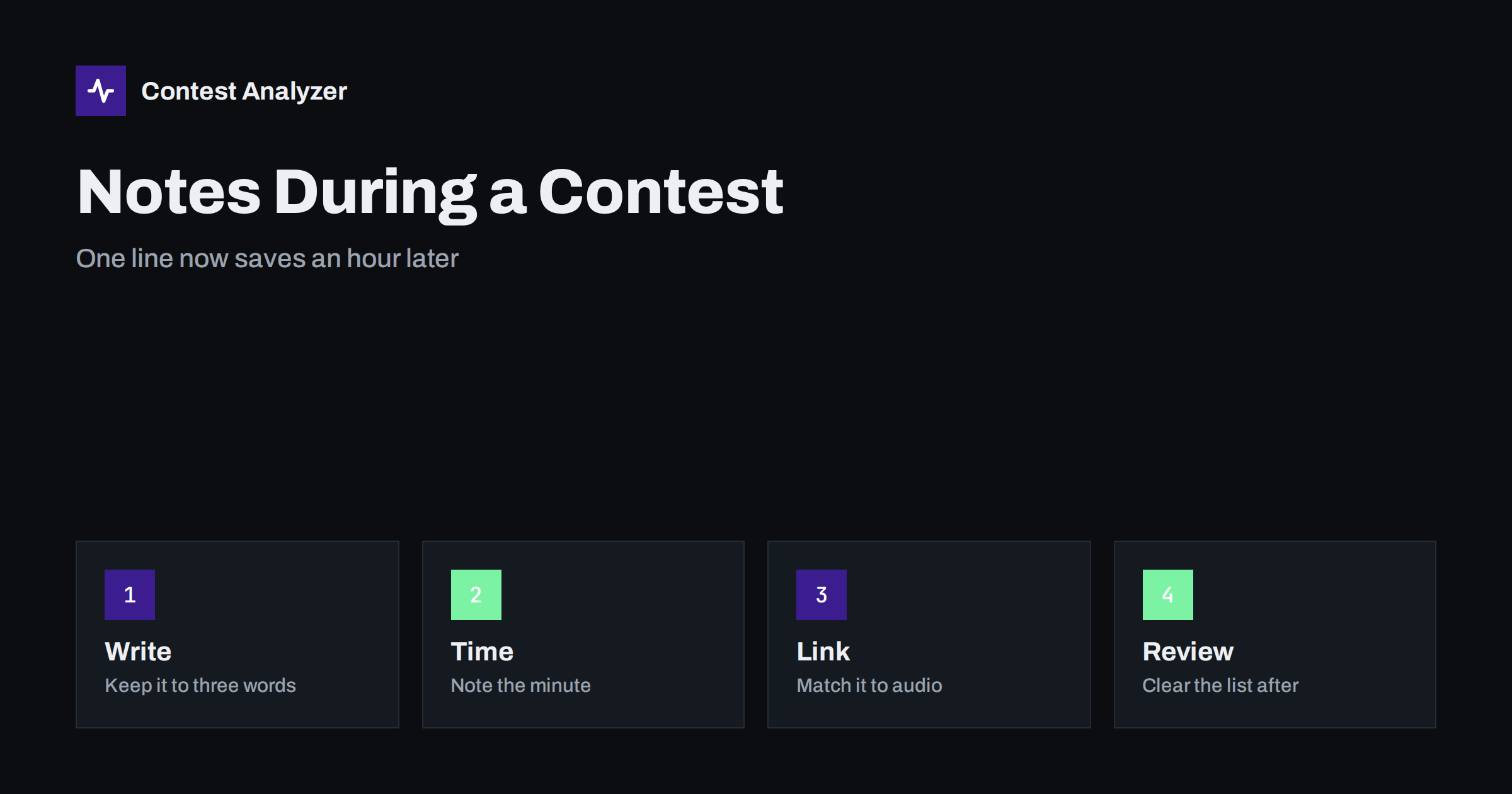
A good note has three parts: the time, the object and the reason. For example: “0312 call? K2… suffix lost”. Another example: “1405 zone unclear 14 or 40”. The time lets you find the moment in the recording. The object tells you which field to check. The reason helps you decide what to listen for. Use the same abbreviations every time, so that you can read them when you are tired.
Use UTC for the time, as in the log. If you write local time in a text file, you must convert it later, and a mistake in this conversion is easy to make. The article on planning your contest schedule in UTC explains why the whole contest should be thought of in UTC.
Notes and the audio recording
The notes are most useful when you also record the audio. The time in the note leads you to the right place in the recording, and you can listen to the exchange again. The article on setting up audio recording describes how to record in a way that you can search by time, and the one on using audio to fix log errors describes the review itself.
If you do not record audio, the notes are still useful, but they only tell you where the doubt was. Without a proof you often cannot fix the QSO, and you must decide between keeping it and removing it. The notes at least make that decision informed and quick.
Notes in multi-operator and team contests
When more than one person operates the station, notes become even more valuable, because one operator does not know what the other one saw. Agree on a single place for notes and a single format before the contest starts. A shared text file or a shared field in the logger works well. Each note should carry the operator’s initials and the UTC time, so that the person who reviews the log can ask the right question to the right person.
A hand-over note at each change of operator is also a good habit. It can be as short as the band, the mode, the frequency, the state of the equipment and any problem that is still open. This avoids the typical situation in which the new operator discovers an hour later that the logger had been recording the wrong frequency since the change. In team contests these small notes make the review after the contest much shorter, and they make it easier to explain unusual numbers in your statistics.
If you merge the logs of several computers, notes help to explain differences between them. The article on merging logs from several computers shows where the problems usually come from.
What not to put in a note, and how to build the habit
Do not use the notes to store information that belongs in the log. The exchange, the frequency and the time are fields of the QSO, and they must be right in the log itself. Do not write long comments, because you will not read them. Do not copy notes into the exported Cabrillo file. The article on Cabrillo encoding and line endings is a good reminder that anything extra in the file can be read by a robot as an error. Finally, do not put personal opinions about other stations in the notes if the log or the notes may be shared.
Building the habit before the contest. A note system that is invented in the middle of the contest rarely survives the first night. Practise it in a smaller contest or in a weekend of normal operation, and refine it until the keystrokes are automatic. Decide which key opens the comment field, how you write the time and which abbreviations you use. Print the abbreviations on a card if you need to, and put it next to the keyboard.
Afterwards, look at the notes of the practice session and ask whether you could understand them a week later. If not, make them clearer. A note that you cannot read after the contest is only noise. The best systems are the simplest, and they are used every time because they cost almost nothing. Over several contests the list of notes also becomes a short history of your typical problems, which is useful when you plan the next preparation week.
Using the notes after the contest
- Sort the notes by time and go through them in order.
- For each one, open the log at that time, and listen to the recording if you have it.
- Decide: correct, keep as it is or remove the QSO. Only correct what you can prove.
- Mark the note as done, so that you know the progress.
- When the list is empty, create the corrected Cabrillo and keep the original, as the article on the post-contest review routine suggests.
It is helpful to count the notes by type. If most of them are about partial calls, your habit of asking for repeats needs work. If many are about the clock or the equipment, fix the station before the next contest. A list of notes is also a list of lessons.
Where Contest Analyzer helps
When the notes are done, a second look at the whole log finds doubtful QSOs that you did not mark. Contest Analyzer checks every callsign and every zone against official license databases and several independent reference sources and shows only the few QSOs worth a second look. In the report you can edit calls, zones, time and frequency, mark QSOs as checked in your own audio recording, duplicate a QSO line and download a corrected Cabrillo. It works with Cabrillo from N1MM Logger+, DXLog and Win-Test, and you can see the supported contests on the contests page.
Related reading
The bottom line
A short note with the time and a reason turns a long search into a short list. Keep notes out of the exported file, match them to your recording and use the list as a source of lessons for the next contest.
FAQ
Will a note in the comment field appear in my Cabrillo file?
It should not, but test an export before the contest to be sure.
How long should a note be?
A few words: the time, the field in doubt and the reason.
Which time zone should I use in notes?
UTC, the same as in your log, so that you can find the moment in the recording.
Are notes useful without an audio recording?
Yes, they show where the doubt was, but without proof you may have to remove the QSO.
Should I note every QSO that I am unsure about?
Only those that you may need to check. A long list is hard to review.