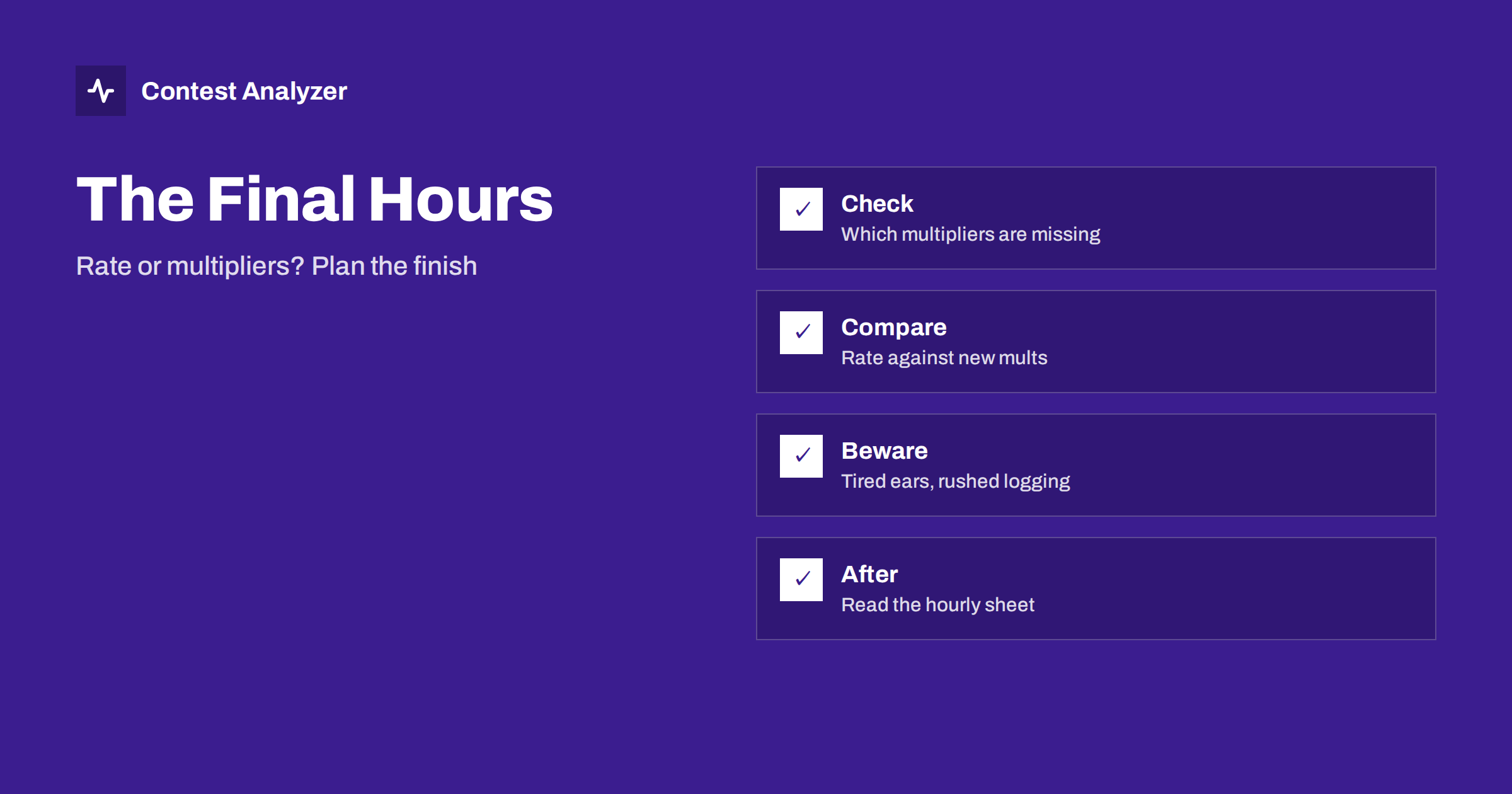
Short answer: In the last hours of a contest, the question is whether each remaining minute is better spent on rate or on multipliers. There is no single answer, but your own statistics help you decide: if the rate has fallen and there are many multipliers still missing, searching for them usually pays; if the rate is still good, keep running. Also watch accuracy, because tired operators make mistakes at the end, and a clean finish is worth more than a few rushed QSOs.
Why the end of the contest is different
The beginning of a contest is full of energy and activity. The end is different. Many stations have already left the air, the bands are thinner, you are tired and the rate has probably fallen from its peak. At the same time, the number of multipliers you still need may be easy to count, and a few of them could change the final score noticeably. This combination makes the last hours a place where a clear plan helps more than at any other point.
In practice, the final hours show who has prepared the end. Some operators simply continue as before until the clock stops, and some change the way they work in the final stretch. Neither is wrong, but the second approach is the one that can be supported with numbers.
Rate against multipliers
The basic idea is simple. Every QSO adds points. Every new multiplier adds a fraction of the whole score. Early in a contest, when you have few multipliers, each new one is worth a lot, but there are many to find and the QSOs are plentiful. Late in a contest, you have most of the multipliers that are easy to get and each additional one is harder to find, but still multiplies everything you have done.
A rough way to compare the options is to ask two questions. First: how many QSOs could I make in the next hour if I stay on this run frequency? Second: how many multipliers could I add in the next hour if I search for them, and how much would that raise the total? The first answer comes from your current rate. The second needs a list of what is missing. Compare the numbers by thinking about how the score is calculated in the contest you are playing; the exact formula is in the current rules. For the multiplier side of the question, the article on multiplier strategy in CQ WW gives a way to think about zones and countries on each band.
Read the missing multipliers
Good loggers show a list of the multipliers needed on each band. Use it in the last hours. Look at which zones or countries or prefixes are missing and which of them are likely to be on the air at this time of the day. A multiplier that is possible at this hour, such as a nearby zone on a band that is open, is worth looking for. A multiplier that needs a path that is closed at this time is better left alone. If you have your own statistics from earlier years, they can help: they show at what time of the contest you usually worked each continent on each band.
This is a use of the statistics that the article on continent breakdown and the one on band strategy by hour describe in more detail. If the same continent opened at the same time in the last years, it is likely to open again.
When to keep running
If the rate is still good, staying on a good run frequency is hard to beat. A hundred QSOs in an hour are worth more than five multipliers if the multiplier count is already high and each new one adds little. Keep running when:
- the rate in the last hour is close to your average for the contest;
- the multipliers that are still missing are not likely to be heard at this time;
- the QSOs you are making are worth more points because they are with distant stations;
- you have a good frequency that would be lost if you left it.
A quick look at the rate meter and the article on the rate meter help here. If the rate drops lower and lower despite your effort, it is time to think about a change.
When to search for multipliers
Search and pounce for multipliers is the better choice when the rate is low, the band is thin and the list of missing multipliers is long. In the final hour, it can be worth tuning across the bands for stations you have not worked, even if each QSO takes more time. Search and pounce QSOs are slower, but each new multiplier counts. See the article on run versus search and pounce for the effect on the numbers.
Do not forget that multipliers must be worked and logged correctly. A multiplier that is based on a busted call or a wrong zone may be removed during the checking of the log by the contest committee. In the excitement of finding the last multiplier, ask for the call and the exchange again. This costs only seconds, and the multiplier is worth the care.
A worked example
Suppose that with three hours to go your rate has dropped to about half of your best hours, and your logger shows that five zones and a handful of countries are still missing on the band you are on. Two of the zones are normally reachable at this time of day, and the others are not. In this case, a sensible plan is to spend the next hour on search and pounce, concentrating on the two zones that can be heard, and to return to running afterwards if the rate picks up when a new group of stations arrives on the band. Now suppose that the rate is still strong and only two multipliers are missing, both of them difficult. The better plan is to stay on the frequency and keep working stations, and to check for the two multipliers only in the short pauses between calls.
The point of both examples is not the specific numbers but the habit of looking at the figures and making the choice consciously. It is easy to continue by habit for hours and to find after the contest that the plan could have been better. A short look at the rate and at the missing list every hour in the second half of the contest costs almost nothing.
Accuracy at the end
The final hours are the hours in which fatigue is strongest. The statistics of many operators show more corrections after the middle of the second night than at any other time. The article on night-hour logging errors describes the pattern, and operator fatigue and breaks gives ideas for managing it. In a contest with limits on breaks, the way you plan the rest in the previous hours determines how fresh you are at the end. If you can, take the last longer break a few hours before the finish and use the end for a short, clear push.
Another danger is the clock. In the last minutes, some operators watch the time and hurry. Do not start a QSO that you cannot finish before the end, and note the rules on QSOs that start before and finish after the end of the contest; they differ between contests, so check the current rules.
Reading the hourly sheet afterwards
After the contest, the final hours are easy to analyse. Look at the QSOs by hour and by band for the last six or eight hours, together with the rate. Did the rate fall as expected? Did you switch bands? How many new multipliers did you work in the last hours, and how long did each take? When you compare the final hours of different years, you will see whether your plan for the finish is improving.
Contest Analyzer checks every callsign and every zone against official license databases and several independent reference sources and shows only the few QSOs worth a second look. It also provides full statistics, with rates, QSOs by hour and band, countries, continents, CQ and ITU zones, WPX prefixes, distance, beam heading, breaks and off time and callsign length and structure. You can edit calls or zones in the report and download a corrected Cabrillo, and compare with your own logs from earlier years. It works with Cabrillo from N1MM Logger+, DXLog and Win-Test. It supports 22 contests, which are listed on the contests page. Serial numbers are not checked and dupes are not errors. The article on hour-by-hour analysis explains how to read the sheet view with its gaps and peaks.
Make a plan for next time
Write down what you learned: the hour at which the rate usually falls, the multipliers that were missing and the time when they were possible, and what you would do differently. A short list of a few lines will help you to prepare the next contest. If your goals for the next year are based on the numbers, see setting realistic goals from last year’s statistics.
Related reading
The bottom line
The last hours of a contest are a decision between rate and multipliers, and the best guide is your own data: the current rate, the list of missing multipliers and the openings that the earlier years showed. Keep running when the rate is good, search when the rate is weak and the list is long, and protect accuracy throughout. After the contest, read the hourly sheet and plan the next finish.
FAQ
Is it better to run or to search at the end?
It depends on your rate and on how many multipliers are still missing and possible. Compare both options with numbers.
Should I take a break near the end?
Plan rest earlier, so that you are fresh in the final hours. A short pause may still be sensible if accuracy drops.
What happens to a QSO that is unfinished at the end?
Rules differ, so check the current rules of the contest you are in.
How can I find out which multipliers are missing?
Most loggers show a list of needed multipliers per band. Use it in the last hours.
How do I improve my finish next year?
Review the hourly statistics of the last hours and write down the rate, the new multipliers and what you would change.