Short answer: A log checking report (often shortened to LCR) is feedback from a contest committee about your log: usually a summary of how your score was reached and a QSO-by-QSO list of the contacts that were removed or questioned, with a reason. It is available in different forms and at different times depending on the contest. Its value lies in the patterns: group the entries, find the two or three causes that repeat, and turn them into habits.
What the term covers
There is no single international standard for these reports. Different contests and different committees use different names and formats: UBN reports, log checking reports, log check results, score reports. The idea is the same. After the committee has compared and checked your log against its rules and against the other logs it received, it can give you a record of what it found. The abbreviation LCR is commonly used for “log checking report”, and this article uses it as a general term. The more specific UBN format is explained in the article on UBN reports.
Whether you receive a report at all, how you obtain it (an email, a download, a request on the contest website) and when it becomes available are all matters for the individual contest. Check the current official rules and the results page of the contest you entered. If a report is offered, it is worth getting every time.
What a typical report contains
The layout varies, but most reports have the same building blocks.
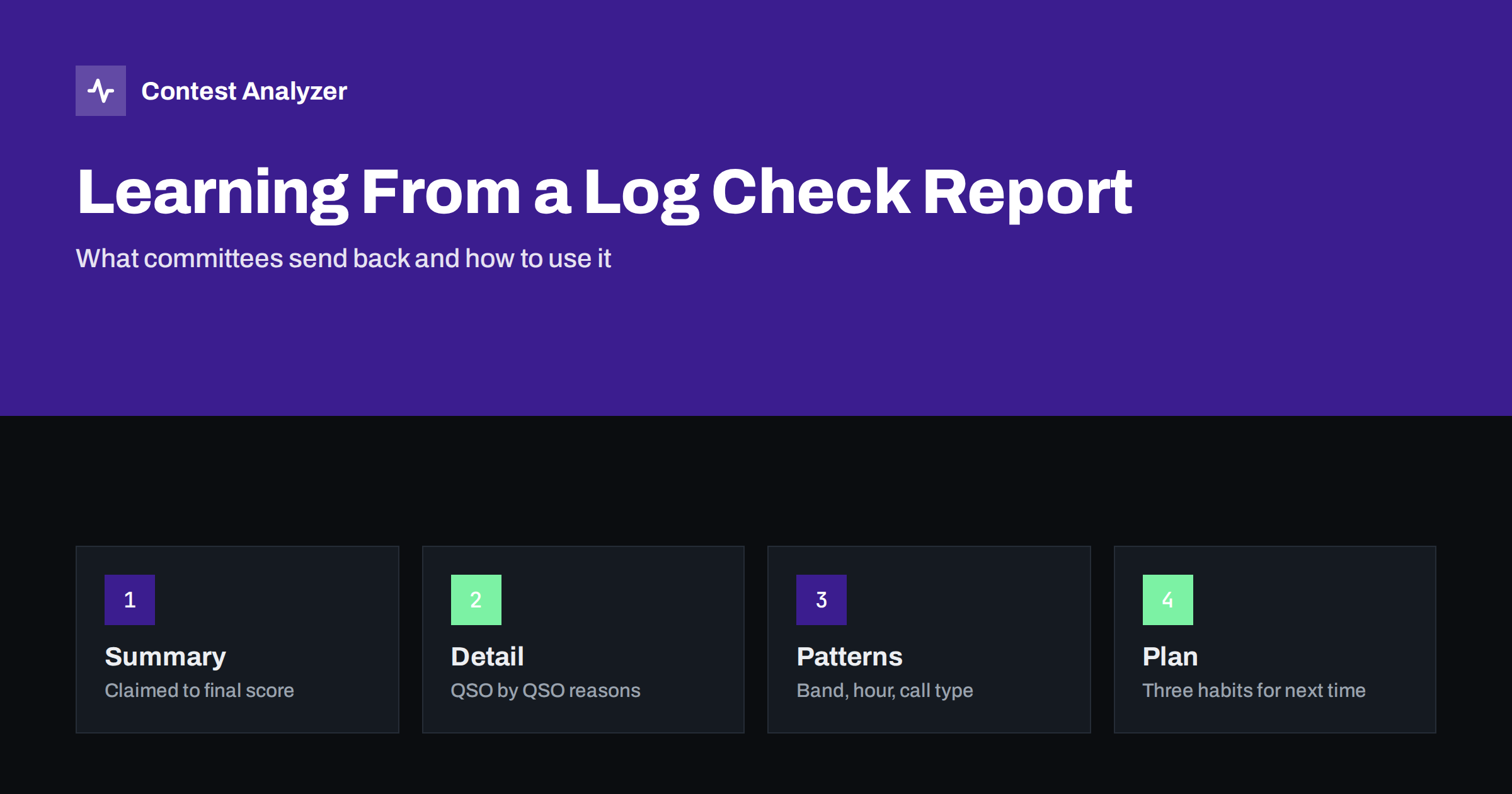
- A summary section. Your callsign, category and band, the number of QSOs claimed and accepted, the multipliers claimed and accepted, and the resulting claimed and final scores. Some reports show the number of removed QSOs by type.
- A list of QSOs with problems. Each entry typically shows the band, the time, the callsign you logged and the reason the QSO was questioned. The reason may be a busted call, a QSO that could not be matched, an exchange error, a duplicate, or a time or band problem.
- Corrections, where the committee has them. For busted calls, the report often shows what the committee believes the correct callsign was.
- Notes on category or rules. If your log was reclassified or a rule was applied, there is usually a line to say so.
- Statistics. Some reports include a rate or error percentage, or a comparison with the average for the contest.
Not all reports have all of these. Some are just a short text file with a few lines of numbers and a list; others are long and detailed. Read the explanatory notes at the top; they explain the abbreviations and codes used in that contest, and those differ from one report to the next.
Start with the summary
Before looking at individual QSOs, read the summary and answer three questions. How many QSOs were accepted compared with the number you claimed? How many multipliers did you lose? How large is the difference between the claimed and the final score, in per cent? These three numbers give you an idea of the scale of the problem. A loss of a few QSOs and no multiplier is a small matter. A larger loss, or the loss of several multipliers, is worth a thorough look. The difference between the claimed and the final score is the single clearest measure of how well your log held up.
Sort the detail by type, band and hour
The list of problem QSOs is where the learning happens, but a flat list of a hundred entries is hard to read. Copy it into a spreadsheet or write it on paper and group it.
- By type. How many are busted calls, how many are not-in-log, how many are exchange errors, and how many are dupes or time problems? Each type has a different cause. Not-in-log QSOs, for example, may well be the other station’s error, as the article on typical NIL causes explains.
- By band. Do the errors cluster on one band? A noisy band or a band with a pile-up behind every call produces more errors.
- By hour. Do they cluster in the early morning or in the last hours? That suggests fatigue or a change in conditions.
- By run or search and pounce. If you remember which mode you were in, check whether the errors come more often in one of them.
- By callsign structure. Short calls, long calls, calls with portable suffixes. Portable and unusual calls are a frequent source of trouble, as the article on portable and maritime stations shows.
The aim is not to understand every single entry. It is to find the two or three groups that account for most of the loss.
Read busted pairs side by side
If the report shows both your callsign and the committee’s version, line the pairs up. Look at what changed: one character, two characters swapped, a missing suffix, a digit instead of a letter. You may find that most of your busts share a feature, such as always the last letter, always a certain pair of letters, or always a call with a digit in the second position. This is the most reliable way to discover a blind spot in your copying, whether the mode is CW, SSB or RTTY.
The corrections also tell you what kind of station you tend to bust: rare DX, strong neighbours, stations that sounded just like another station worked earlier. That is useful for deciding where to be more careful.
Check what the report cannot tell you
A report is a view from the committee’s side, and it has limits. It rarely tells you whether you were operating alone or with others, how tired you were, or what the band was like at the moment of the QSO. It may say that a contact was not found in the other log without explaining whether the other station made an error. It shows the consequences of errors, not always their cause.
For that reason, go back to your own log and notes. Open the Cabrillo file, find the entries from the report and read the surrounding QSOs. Look at the time stamps and the rate at that moment. You will often remember what was happening. Add that to your list of causes.
Share it, but compare carefully
Many clubs and groups discuss their reports after a big contest, and this is useful. Hearing that other operators had the same trouble with a band, a prefix or an exchange helps you separate a problem of conditions from a problem of habit. Be careful with direct comparisons, though. Different categories, power levels, antennas and numbers of QSOs make raw error counts hard to compare. Compare patterns and causes rather than totals, and use your own earlier reports as the main yardstick.
Turn the findings into a short plan
A long list of resolutions is easily forgotten. A plan of three habits is something you can take into the next contest. Examples of the form it can take:
- “Ask for a fill whenever I am not sure of the suffix.”
- “Check the zone on screen against the country before I send the exchange.”
- “Slow down my CQ speed by two words per minute after midnight.”
Write them in a notebook or on a sticky note by the radio. After the next contest, check whether the same type of error has dropped. Over several contests this becomes a record of improvement, and it helps you compare years fairly, as described in the article on comparing contest results year on year.
Before the report: a check you can do yourself
A committee report arrives after the results are fixed. You can get a first, partial view of the same problems earlier. Contest Analyzer checks every callsign and every zone in a Cabrillo file from N1MM Logger+, DXLog or Win-Test against official license databases and several independent reference sources, and shows only the few QSOs worth a second look. You can correct callsigns and zones in the report and download a corrected Cabrillo. It also provides full statistics, including QSOs by hour and band, countries, continents and zones, and comparison with your own earlier logs. Serial numbers are not checked, and dupes are not shown as errors. It does not replace the committee’s report, but it can reduce what the committee will find. See the FAQ for more details.
Related reading
- UBN report explained
- Comparing contest results year on year
- How to check a contest log before you submit it
- Unique calls in contest logs
The bottom line
A log checking report is one of the few places where you can see your operating through the committee’s eyes. Read the summary first, sort the detail by type, band and hour, compare the busted pairs, and end with a plan of three habits. Used that way, it turns the disappointment of a lost QSO into the best coaching you can get for the price of a download.
FAQ
Does every contest send a log checking report?
No. Some contests provide detailed reports, some a short summary, and some nothing. The current rules and results page of the contest explain what is available and how to get it.
Are LCR and UBN the same thing?
They overlap. UBN refers to the Unique, Busted and Not-in-log categories; LCR is a more general name for a committee’s log checking feedback. The format depends on the contest.
Can I challenge an entry in the report?
Some committees accept questions or corrections within a set time, others do not. The procedure, if any, is in the contest rules.
What should I look at first?
The summary: accepted versus claimed QSOs, lost multipliers and the difference between claimed and final score. Then group the list of problem QSOs by type, band and hour.
Can I find some of these problems before I submit?
Yes. A pre-submission check such as Contest Analyzer flags the few QSOs worth a second look, so you can correct callsigns and zones before the log goes to the committee.