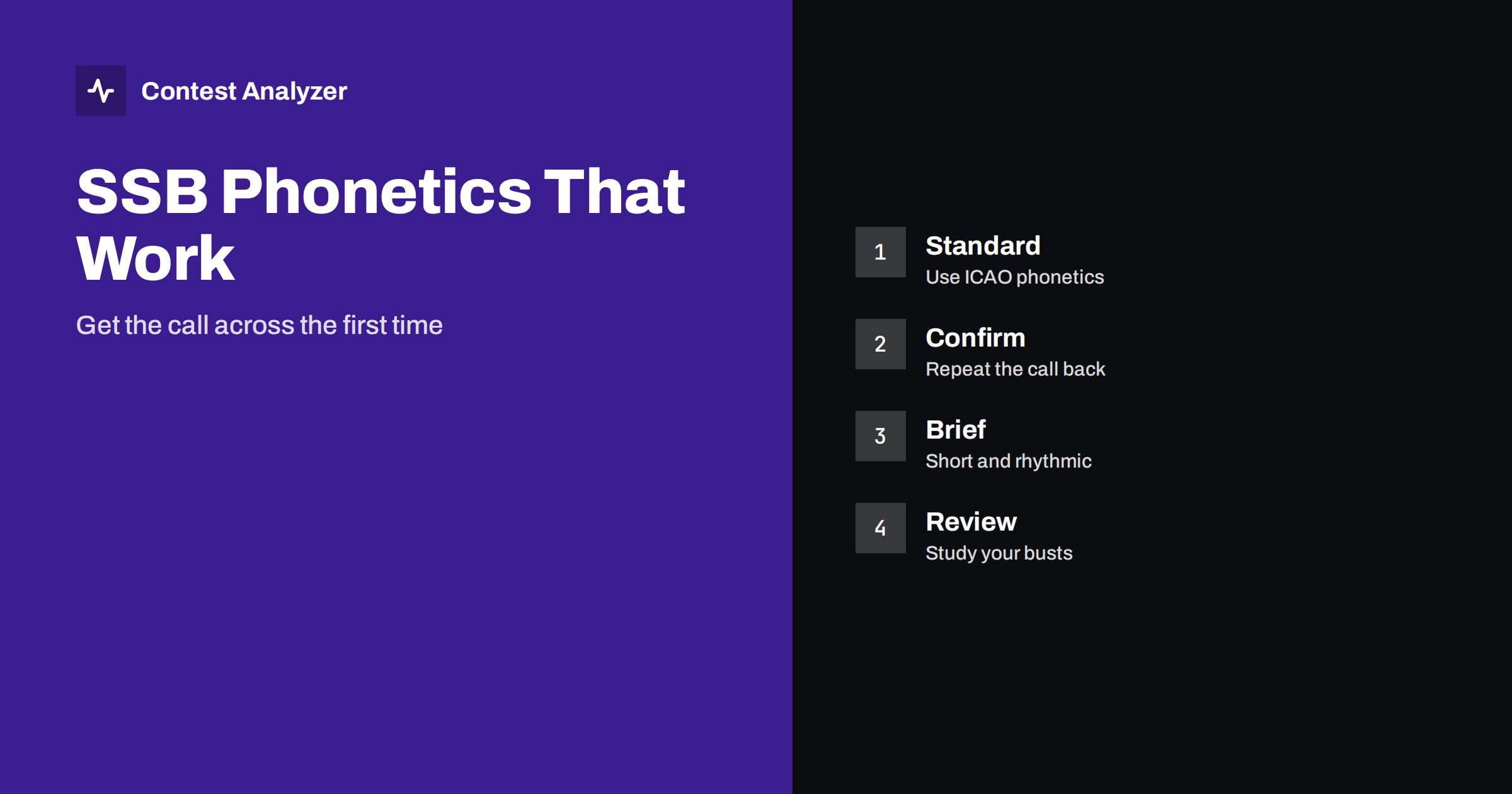
Short answer: On SSB, most busted callsigns come from letters that sound alike over a noisy channel. The cure is simple: use standard phonetics, give the full call once clearly rather than three times quickly, repeat the other station’s call back before you send the exchange, and ask for only the part you missed. Done well, this costs a second or two per QSO and removes a whole class of errors.
Why phone callsigns go wrong
On phone, a callsign is carried by the voice, and voice has less redundancy than CW. Several letters are acoustically close: B, D, P, T, V, C, E and G all end in a similar vowel sound, and M and N, F and S, and 5 and 9 can be almost indistinguishable through a narrow filter with a bit of QRM. A listener in a different country with a different native language hears the sounds through their own ear, and may fill gaps with the sounds they expect.
The result is the same family of errors that you meet in CW: a missing letter, a swapped letter, a wrong digit, or a suffix that gets lost. The fix is also similar in principle, though the tools are different. On phone, phonetics are your main tool for making every character robust. The wider topic of why busts happen and what they cost is covered in the article on busted callsigns in contest logs.
Use standard phonetics, not clever ones
The internationally recognised alphabet used by amateurs for voice is the ICAO one: Alfa, Bravo, Charlie, Delta, Echo, Foxtrot, Golf, Hotel, India, Juliett, Kilo, Lima, Mike, November, Oscar, Papa, Quebec, Romeo, Sierra, Tango, Uniform, Victor, Whiskey, X-ray, Yankee, Zulu. It was designed so that each word is distinct in many languages and under poor conditions.
Operators like to use their own words, such as a first name, a city or a word from a hobby. In a casual QSO this is friendly. In a contest it creates a problem: the listener must first understand the word and then identify the letter it stands for, and that may take a moment, especially for a non-native speaker. If you use “Mother” for M or “Nancy” for N, a listener who is not familiar with them may hear the wrong letter. Keep non-standard words for casual contacts.
There is a small allowance for contest practice. Many experienced operators use a shorter, well-known word for certain letters, or take one common alternative that is widely recognised. The test is simple: if a listener in a different part of the world is likely to understand it instantly, it is fine; if it needs a second to translate, use the standard word.
When to use phonetics and when not to
Running a station on SSB often means calling CQ many hundreds of times. The usual pattern is to give the callsign in plain letters in the first call, and in phonetics in the next cycle, or to alternate, or to use phonetics for the suffix only. When the frequency is crowded, the last method is often the most efficient: the prefix and digit are generally recognisable, and the suffix is where the confusion lies.
For answering, a good rule is “short unless asked”. If the other station copies your call at once, a phonetic spelling is not needed. If you are asked to repeat it, give phonetics for the letters that are in question, not for the whole call. This keeps the rate up and still fixes the problem.
A common mistake is to speak phonetics too fast. A string of five phonetic words spoken at a gallop is no easier to copy than the plain letters. Rhythm and clarity matter more than speed. Say the words steadily, give each one its own beat, and pause slightly between the prefix and the suffix.
Letters that need extra care
The following table lists pairs that are easily confused on phone and the phonetic words that help separate them. It is a guide, not a rule: use whatever works for the person on the other end.
| Easily confused | Helpful phonetics | Comment |
|---|---|---|
| M and N | Mike, November | Both end in a nasal sound; stress the first syllable. |
| B, D, P, T, V | Bravo, Delta, Papa, Tango, Victor | The “ee” sound makes the plain letters almost identical. |
| F and S | Foxtrot, Sierra | High-frequency hiss hides the difference. |
| 5 and 9 | Five, “niner” | Many operators say “niner” for 9 to avoid confusion with 5. |
| C and Z | Charlie, Zulu | Differences between languages make plain letters unreliable. |
Confirm before you move on
The quickest way to avoid busted calls on SSB is to repeat the call back as you understood it, before you give the exchange. A station that hears its call returned wrongly will usually correct it, and that correction costs two seconds. A station that hears its call repeated correctly will say “roger” or give the exchange. Either way, you gain information at the moment it is cheap.
Some practical points:
- Say the call, then the exchange. “Delta Lima one Alfa Bravo Charlie, five nine zero five” is the usual pattern. The call comes first, and the other station can stop you before you go on.
- Do not rely on a callsign suggestion list alone. A logger’s matching list is useful as a prompt during operating, but it does not prove that you heard the right station.
- If the answer is unclear, ask for the part, not the whole. “Say the suffix again” or “last two letters” is faster than starting over.
- Keep the question short and consistent. Use the same few phrases each time so the other side recognises your request immediately.
Sending your own call
Your own callsign is the one you can control completely. If you are calling CQ, say it at a steady pace and use phonetics at least once every few calls. If you are answering a CQ, send your call once, clearly, and wait for the answer. Repeating it several times without waiting is rarely an advantage. It occupies the frequency, and the CQing station may not be able to separate the individual calls anyway.
In a pile-up, a short, regular answer is easier to pick out than a long one. Many operators send the callsign once in plain letters and then a second time in phonetics if there is no answer. Others use phonetics throughout for a call with difficult letters. The right balance depends on your own call and on the other station’s habits.
Language and accent
Contests are international, and many of the people you work speak English as a second or third language. Speak slowly enough to be understood, avoid slang, and keep your phrases to the minimum required. A call spoken clearly with a foreign accent is easier to copy than a fast one with perfect pronunciation. Learn to say the numbers and the exchange elements in the language of the contest, and where possible, a couple of words in the local language to help the caller.
When you listen to a station with a strong accent, be patient and use phonetic words they are likely to know. If the other operator is struggling, slow your speech a notch and use the standard phonetics. A quick, calm routine saves more time than frustrated repetition.
Find your own error pattern
As with CW, the best coaching tool is your own log. After a contest, list the calls that you had doubts about, and sort the doubts by type. If most of them involve M and N, the answer is to be careful with those two letters. If they cluster in the late hours, tiredness is more likely to be the cause than the phonetics. If the majority involve a single band, the noise level or the filter setting may be the culprit.
Contest Analyzer helps with that review. You upload the Cabrillo from N1MM Logger+, DXLog or Win-Test, and it checks every callsign and every zone against official license databases and several independent reference sources, and shows only the few QSOs worth a second look. You can correct callsigns and zones in the report and download a corrected Cabrillo. Serial numbers are not checked, and dupes are not treated as errors. The statistics, including QSOs by hour and band, make it easy to see whether trouble clusters at a particular time. The routine for the whole log is described in the article on checking a contest log before you submit, and the FAQ answers common questions about the service.
Related reading
- Busted callsigns in contest logs
- CQ WW DX SSB checklist
- Not-in-log QSOs: typical causes
- How to check a contest log before you submit it
The bottom line
On phone, a callsign is only as good as the clarity with which it is spoken and confirmed. Use the standard alphabet, keep it steady rather than fast, repeat the other station’s call before the exchange, and ask only for the part you missed. Then study your own doubtful calls after the contest, and turn the pattern into a habit for the next one.
FAQ
Should I use phonetics for every callsign?
No. Use them when the call is in doubt, for the suffix when the frequency is crowded, and at intervals when you call CQ. Plain letters are fine when the signal is clean and the other side copies at once.
Are non-standard phonetic words acceptable in a contest?
They work only if the listener understands them instantly. Standard words are safer, especially with stations from other countries.
Why repeat the other station’s call back?
It gives them a chance to correct you before the QSO is logged. A correction takes a couple of seconds, and a busted call can cost the QSO and a multiplier.
How do I ask for a fill on SSB?
Ask for the missing part, for example the suffix or the last two letters. It is faster than a full repeat and the other side knows exactly what to send.
Can a tool find busted calls from my SSB contest?
A pre-submission check such as Contest Analyzer flags the few QSOs worth a second look, and you can correct callsigns and zones and download a corrected Cabrillo before sending the log.