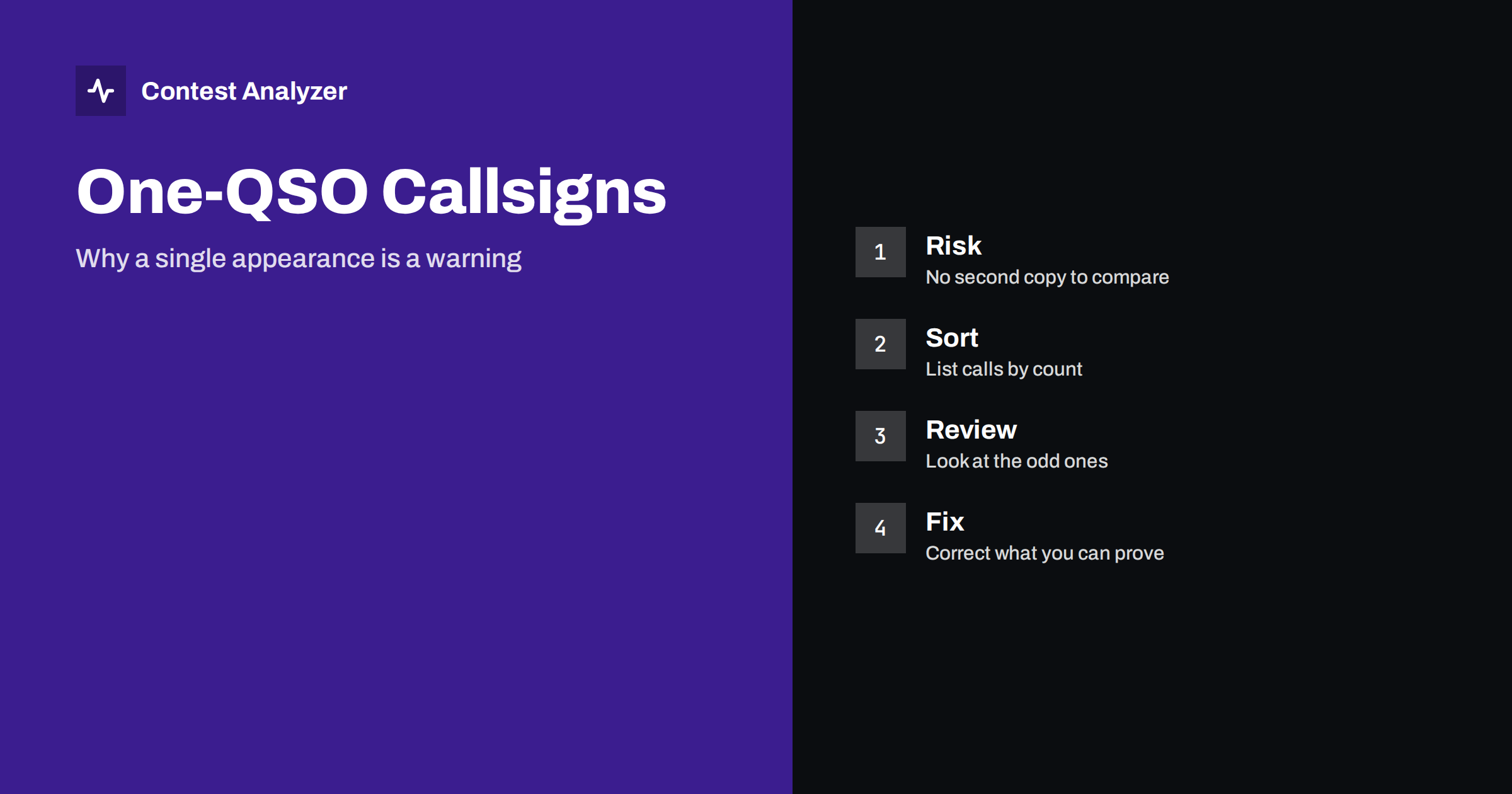
Short answer: A callsign that appears only once in your log is not wrong, because most stations are worked once. But if a call was copied badly, it will almost always be one of those single appearances, since a busted call rarely repeats the same mistake. Sorting your calls by count and reviewing the singles that look odd is a quick, sensible check before you submit.
What a one-QSO callsign is
In a large contest log, most callsigns appear once. You work a station on one band, log it and move on. A callsign that appears more than once usually means that you worked the station on several bands or modes, or that you logged a dupe. A single appearance is therefore the normal state, and the log of a busy weekend will contain hundreds or thousands of such calls.
The reason to look at them is arithmetic. A correct callsign can be written many times in many logs. A mistaken callsign is an accident, and an accident rarely repeats exactly. So when you look at the calls that appear only once, you are looking at the group that contains nearly all of your errors, along with a very large number of correct calls. The earlier article on unique calls in contest logs explains how contest committees look at this problem from the other side. Here we look at it from your own desk.
Why singles carry more risk
When you work a station twice, on two bands, you have two chances to copy the call right, and the second copy often confirms the first. When you work a station once, you have one chance, often in a pileup, with noise and with another station talking over the end of the call. If you made a mistake, nothing in your own log contradicts it.
Weak and short contacts are particularly exposed. A fast exchange at the end of a long run, a call copied in the middle of a crowd, or a QSO finished in a hurry because the next caller was already waiting all belong to this category. The result is a call that looks plausible but contains one wrong letter, one wrong digit or a missing suffix. Articles on busted callsigns and on partial callsign copies show the typical patterns.
Sort your log by callsign count
You do not need a special program for a first pass. Many loggers can show the QSOs sorted by callsign, and a spreadsheet can count how often each call appears. Make a list of the calls that appear once and read it as text, not as a table of QSO lines. Your eye will catch things in a plain list that it misses inside a log: a prefix that does not exist, a suffix that makes the call look like a different station or a call that seems too long.
Set aside any call that you find odd, then look at the details of the QSO. What band was it? What time? What was the exchange? If you have audio recordings, note the time so that you can listen later. A short list of twenty or thirty doubtful calls is manageable. A review of two thousand lines is not.
What to look for
Several signs deserve attention. A prefix that does not match the country you expected, or a zone that is wrong for the prefix, suggests a copy error somewhere in the QSO. A callsign with an unusual structure, for example an extra letter in the suffix or digits where letters usually appear, is another sign. Calls that differ by one character from a very active station are common busts. See how a callsign is built to review the parts that are fixed and those that vary.
Zone and exchange mismatches also help. If the exchange you logged does not fit the station, either the call or the exchange is wrong. Do not try to guess which. Mark the QSO and return to it with other evidence.
Evidence you can use
A correction should be based on something you can prove. Your own audio recording is the best source, if you made one: listen to the QSO, hear what was really sent and then change the log. Your notes made during the contest are a second source. Without either, an educated guess is not enough. If you cannot establish the right call, leave the log as it is, because an invented correction can turn a minor error into a larger one.
The article on listening to doubtful QSOs and fixing the log describes this routine. When you have reached a firm conclusion, change the callsign and keep a note of what you changed and why.
How Contest Analyzer helps with the review
Contest Analyzer checks every callsign and every zone against official license databases and several independent reference sources, and shows only the few QSOs that deserve a second look. That is a practical way to avoid reading a whole list of singles by hand. You can edit calls, zones, time and frequency in the report, mark QSOs as checked in your own audio recording, and download a corrected Cabrillo file. Serial numbers are not checked, and dupes are not errors. See the FAQ for the short version.
Do not over-correct
A single appearance does not mean an error, and many real stations are unusual. Expeditions, special event stations and new licences all appear once, and they may look odd to you. A rare call that you heard clearly and that matches the zone and the country is probably right. Spending hours on calls that are correct takes time away from the dozen that are not. Concentrate on the doubtful ones and stop when you reach the point where the remaining singles look right.
A worked example
Suppose your log has 1,400 QSOs and 1,050 of the callsigns appear only once. A full review is out of the question, so you begin with a filter. First, you take the singles that were worked in the last four hours of the contest, when you were tired. Second, you add those with a zone or prefix that you did not expect. Third, you add the calls that you marked with a question mark during the contest. This gives a list of perhaps sixty. You read the list slowly and cross out the ones that clearly look right, leaving about twenty-five.
For each of these, you open the QSO and ask what evidence exists. For eight you have a note or a recording, and you resolve them quickly: five are right, three had one wrong letter. For the remaining seventeen you have nothing, and you look at the shape of the call. Eleven look like normal calls from the right country, so you leave them. Six still look odd, and you decide to look for them in public records after the contest, then decide whether to change or keep each one. The whole exercise takes less than half an hour and has found three real errors.
Make it a habit
The method works best when it becomes part of a routine. During the contest, mark doubtful calls as they happen, even with a single character in the notes field. After the contest, sort the log by callsign count, read the singles, listen to the marked ones and write down the result. Over a few contests you will notice which kinds of calls you tend to get wrong: suffixes with similar letters, calls in a certain language, or those heard at a particular time of day. That knowledge is more valuable than any single correction, because it tells you where to concentrate your attention next time.
It is useful to keep a short record of your error rate. If you corrected three calls out of a log of 1,400, that is about two in a thousand. If next year the figure drops, your habits are working. If it rises, look at the hours in which the corrections cluster. The hourly view of your log, described in the article on hour-by-hour analysis, helps to see whether fatigue or a particular band is behind it.
Finally, remember that the goal is a clean log, not a perfect one. Every contest log contains a few errors, and organisers expect that. What matters is that the obvious ones are gone and that you know how you found the rest. A calm, repeatable method beats a frantic last-minute search, especially when the deadline is close and the log is large.
Related reading
- Check Your Contest Log Before You Submit: A Checklist
- A Dupe or a Busted Call? How to Tell Them Apart Afterwards
- Producing a Corrected Cabrillo Before You Submit
The bottom line
Singles are normal, but nearly all errors hide among them. List them, read them as plain text, mark the odd ones, check them against audio or notes and correct only what you can prove. Twenty minutes spent this way is worth more than a general read of the whole log.
FAQ
Is a callsign that appears once wrong?
Usually not. Most stations are worked once. The point is that errors are concentrated among such calls, so they deserve a quick look.
Should I delete a QSO I cannot verify?
Not automatically. Delete only if you know the QSO did not happen. Otherwise leave it, or check the rules of the contest on doubtful contacts.
How many should I review?
Work from the oddest to the least odd and stop when the remaining calls look right. Twenty to fifty is a realistic list for a big log.
Do dupes count as errors?
No. A repeated call may be a legitimate QSO on another band, and a dupe is not an error in itself.