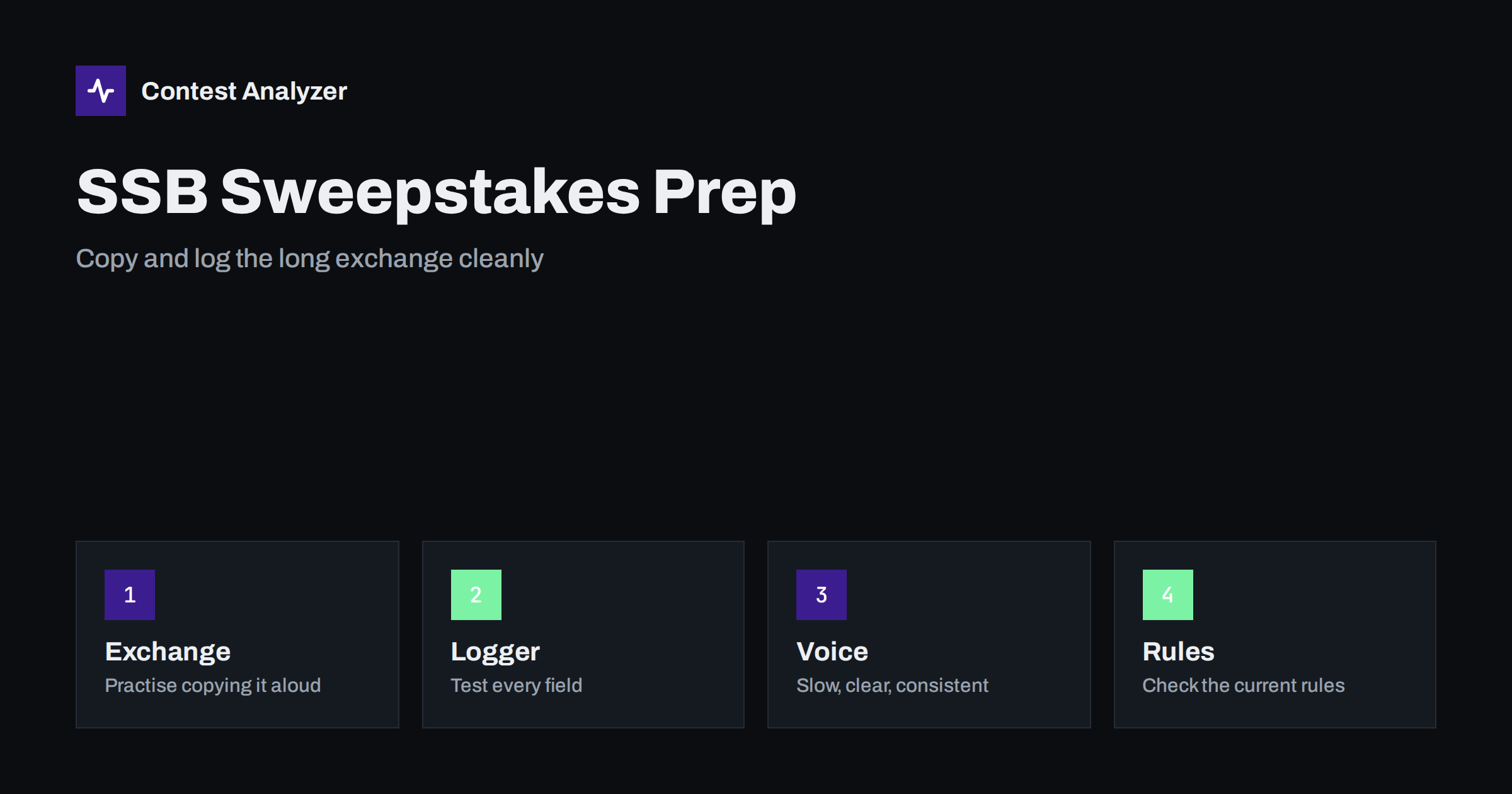
Short answer: An SSB Sweepstakes weekend is won on accuracy as much as on rate, because the exchange is long and every part of it must be copied correctly for the QSO to count in full. Prepare by learning the exchange fields, setting up your logger so that the fields appear in the order you hear them, rehearsing your own transmission until it is slow and consistent, and agreeing with yourself how you will ask for repeats. This article is general; always read the current official rules for the event before you operate.
Why Sweepstakes feels different from other contests
Most of the large international contests use a short exchange: a signal report plus a zone, or a signal report plus a serial number. The Sweepstakes exchange, in general terms, has several elements: a serial number, a precedence letter, your callsign, a two-digit check and your section. That is five items, and the callsign is repeated inside the exchange. When you work a station, you must copy all of it, and the other operator must copy yours.
The result is that each QSO takes longer than in a short-exchange contest, and rates are lower. In return, the contest rewards patience. An operator who copies every element on the first pass and rarely asks for a repeat can keep a steady rate that is hard to beat. An operator who rushes will spend more time on fills than the faster speaker saves. Because the details of the exchange can change in the rules from year to year, treat the description above as orientation only and confirm every element against the current rules.
Learn the exchange before the weekend
The most useful preparation costs nothing: read the rules and write the exchange on a card next to your keyboard. List each element in the order it is normally sent, with a short note on what it means. The serial number counts your contacts. The precedence letter tells the other side your power or operator class. The check is the last two digits of the year you were first licensed. The section is your geographic area. Knowing what each part means helps you copy it, because you know what kind of answer to expect.
For example, the section is one of a limited set of abbreviations, and many of them are two or three letters. If you know the list, you can recognise a half-heard section and fill the gap with confidence. The same is true of the precedence: it is one letter from a short list. Print or display the list of sections near the radio. You will use it dozens of times in the first hours, and it will become second nature by the second day.
Set up the logger to match the exchange
Open your logging program and choose the Sweepstakes contest template. Then do a short test with a few made-up QSOs. Check three things. First, does the cursor move through the fields in the same order that the exchange is spoken? If the order is different, you will have to jump between fields while listening, which causes errors. Second, does the logger accept the section abbreviations you expect and warn you when you enter something invalid? Third, does it save the exchange in the log in a form that will be written correctly to the Cabrillo file?
Many loggers offer a call history or a previous-contest file that prefills the section, check and precedence for stations you have worked before. That can save seconds, but it can also copy an old, wrong or outdated value into your log. If you use such a feature, read the prefilled data against what you actually hear. A related article on call history files explains the habit in more detail. After the test, delete the practice QSOs so that they do not appear in the real log, and make a backup copy of the empty contest file.
Speak the exchange the same way every time
On SSB, the other station has only your voice. Three habits improve copy quality at once. Use the same order every time, so that listeners know what comes next. Say numbers and letters slowly and clearly, with standard phonetics for the precedence letter and for any letters in your section. Pause briefly between elements so that a tired operator can write them down. If you speed up when the band is busy, accuracy drops for both stations.
Record a practice call of your own exchange and play it back. Listen as a stranger would, through a noisy band. Does the check sound like two separate digits, or does it run together? Does the section abbreviation sound unambiguous? You may find that one of your letters is easy to confuse, and you can decide in advance which phonetic word you will use for it. Our article on SSB phonetics and confirming callsigns lists the pairs of letters that cause the most trouble.
Plan how you ask for repeats
Because the exchange is long, you will need repeats. Decide beforehand how to ask for them in a way that is short and clear. Asking for “the whole exchange again” wastes time when only one element was missed. Ask for the specific element: the section, the check, or the precedence. The other operator then repeats only that part, and you can fill it in without disturbing the rest.
It is also a good habit to read back what you have copied when you are not sure. A short confirmation costs two seconds and can save a QSO that would otherwise be lost as a bad copy. The balance is personal: on a very busy band, you may skip it for strong and familiar stations; on a weak or uncertain contact, it is almost always worth it. The key is to decide the rule for yourself before the first hour, so that you do not invent a new one every time you are tired.
Keep the log accurate while you operate
The same discipline that helps your copy also helps your log. Enter the callsign as soon as you are sure of it, and complete the exchange fields before you press the key that logs the QSO. If you need to correct an item, correct it immediately; a note to “fix later” is easy to forget. If your logger lets you add a short comment to a QSO, use it for anything doubtful, such as a callsign you copied partly or a section you were not sure about. The article on writing notes during a contest explains how those notes help later.
Watch the clock too. A drifting computer clock can put QSOs in the wrong minute, which matters when the other station’s log is compared with yours. A simple time-sync check before the contest, and again on the second day, is cheap insurance.
Use rest and breaks sensibly
An exchange this long is tiring to copy for many hours. Fatigue shows up as small mistakes: a transposed pair of digits in the check, a section copied from the previous QSO, a callsign with one wrong letter. Plan short breaks, drink water, and eat real food. If the rules of your category limit operating time or require off periods, check them in the current rules and plan your schedule around them. The main point is that a rested operator with a lower rate can still finish ahead of a tired operator with a higher raw count, once errors are subtracted.
Many operators find that their error rate rises in the same hours every contest. After the weekend, look at your hourly statistics and compare the busiest hours with the hours in which you had to correct the most QSOs. That picture is more honest than memory and tells you when to rest next time.
After the contest: check before you submit
When the weekend ends, export your Cabrillo file and read the header and a sample of the QSO lines. Check that the contest name, category and callsign are correct, and that the exchange columns contain what you intended. Then look for callsigns that look unusual, sections that do not match the station’s location, and QSOs outside the contest period. A routine that you follow every time is more reliable than an ad hoc check. Our 30-minute routine is a practical template.
For the contests it supports, Contest Analyzer checks every callsign and every zone in an uploaded Cabrillo file against official license databases and several independent reference sources, showing only the few QSOs worth a second look. It works with Cabrillo from N1MM Logger+, DXLog and Win-Test. Serial numbers are not checked. Look at the list of supported contests to see whether the event you operated is included; if it is not, the manual routine above is your safety net.
Related reading
- ARRL Sweepstakes: Why the Long Exchange Needs Precision
- Sweepstakes Exchange: Precedence, Check and Copying Errors
- SSB Phonetics and Confirming Callsigns Quickly
- Your First HF Contest: A Practical Guide for Beginners
The bottom line
Preparation for an SSB Sweepstakes weekend is mostly about the exchange: learn its parts, set up the logger to follow the same order, speak clearly and consistently, and decide in advance how to ask for repeats. Keep your log accurate while you operate, rest before errors accumulate, and check the Cabrillo file before you submit. Always confirm the details in the current official rules.
FAQ
Is the Sweepstakes exchange the same every year?
In general the structure stays stable, but rules can change. Read the current official rules before the weekend and do not rely on memory from previous years.
Should I read back every exchange I copy?
Not necessarily. A short read-back is most useful when the signal is weak or when you are unsure of one element. Decide your own rule before the contest starts.
How can I practise before the weekend?
Record your own exchange and listen to it critically, rehearse copying with a friend or from an old audio recording, and test the logger with a few made-up QSOs.
Does Contest Analyzer check the serial numbers?
No. Serial numbers are not checked; callsigns and zones are. You remain responsible for copying and logging the numbered parts of the exchange correctly.
What is the best way to avoid errors on the second day?
Sleep and eat properly, keep the clock synchronised, and correct doubtful items immediately instead of leaving them for later.