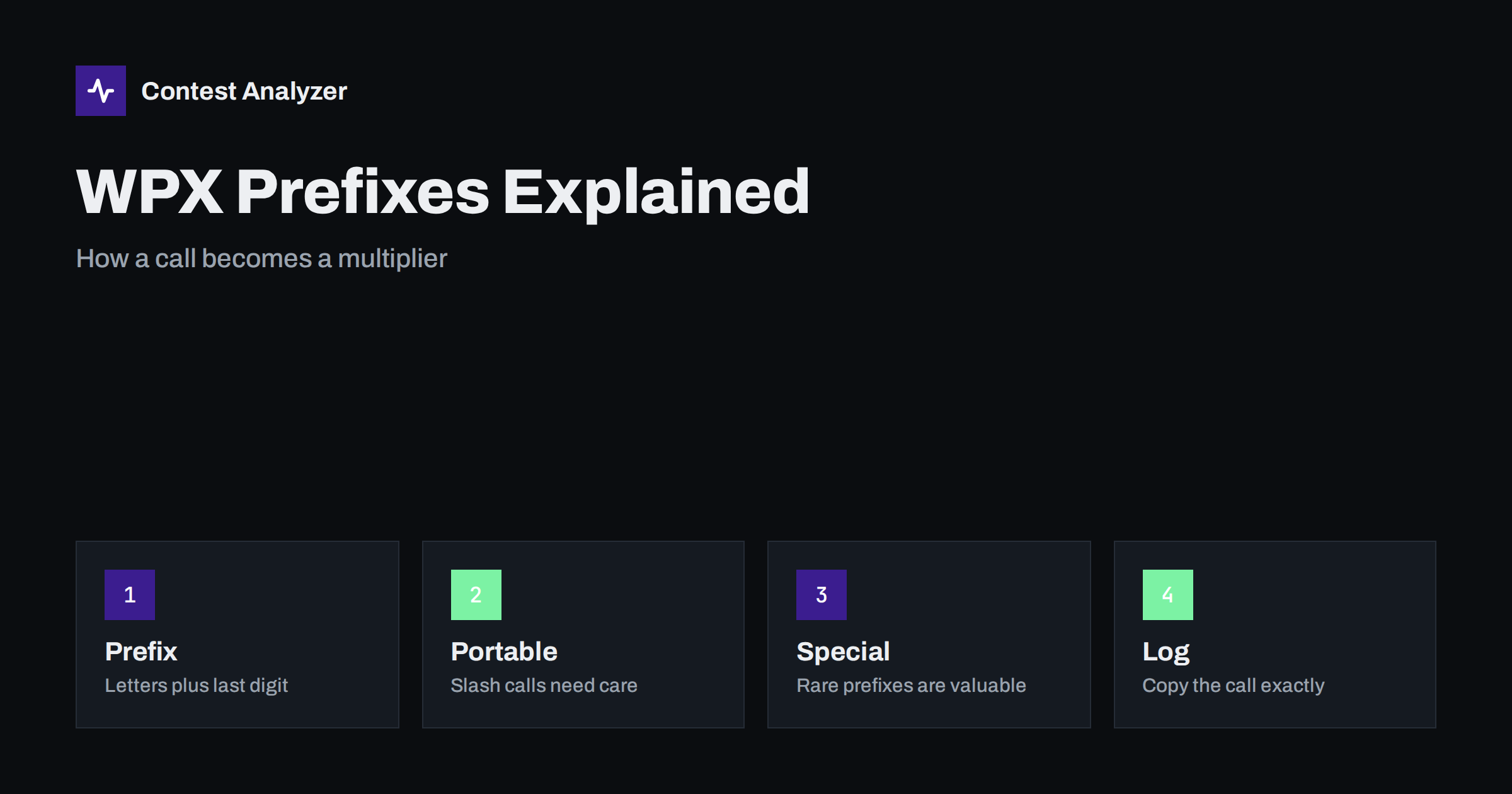
Short answer: In CQ WPX the multiplier is the callsign prefix, not the country or the zone. A prefix is, in general, the letters and digits at the start of a callsign up to and including the last digit, so W1AW gives W1 and DL1ABC gives DL1. Portable and unusual calls follow special rules, so read the current official rules before the contest and always log the callsign exactly as the other station sent it.
Why the prefix is the multiplier
CQ WPX is built around a simple idea: every different callsign prefix you work is worth a multiplier. That makes the contest different from CQ WW DX, where countries and zones count, and it changes how you think about the bands. A single country can contain dozens of prefixes, so a big signal into a country with many call areas, such as the USA, Japan or Brazil, can feed your multiplier count for hours. A rare DX country may give you only one new prefix, but a busy one can give you many.
The exchange is just as simple: a signal report and a serial number. There is no zone or state to copy, so the contest rewards rate and callsign accuracy. Because the prefix is derived directly from the callsign you log, a single wrong character in a call can do more than invalidate one QSO. It can also remove a multiplier, or in some cases create a prefix that does not exist.
How a prefix is formed
The general principle is that the prefix is the combination of letters and numerals at the beginning of the callsign, ending with the last numeral before the suffix. The rest of the call, the suffix, does not matter for the multiplier. Some simple examples show the idea:
| Callsign | Prefix | Comment |
|---|---|---|
| W1AW | W1 | One letter, one numeral |
| DL1ABC | DL1 | Two letters, one numeral |
| 9A1A | 9A1 | Prefix that starts with a numeral |
| LY2XYZ | LY2 | Same country, different call area, different prefix |
| LY3XYZ | LY3 | A new multiplier for the same country |
Notice the last two lines. Two stations from the same country can give you two different multipliers if their numerals differ. This is why operators in a single-band entry often look for the numerals they are missing, and why a big country is a good place to find several multipliers in one pass of the band.
Portable, mobile and unusual calls
The straightforward cases are easy. The difficult ones are calls with a slash. A portable operator may add a prefix or suffix: a station signing a different location prefix before the home call, a station adding /P or /M after it, or a station signing /MM at sea. The WPX rules define how each of these is treated, and in general the answer depends on whether the added part contains a numeral and where it is placed. In broad terms:
- A suffix such as /P, /M or /A usually does not change the prefix that the home call already gives.
- A different prefix before the slash usually replaces the home prefix, and some forms of it need a numeral added by the rules to become a valid prefix.
- Maritime mobile operation is usually treated differently from land operation and may not give a prefix multiplier at all.
- Calls without any numeral, which are rare, have their own handling in the rules.
Because these cases are decided by the text of the current rules, this article does not list them as fixed facts. Open the official page at cqwpx.com/rules and read the section on prefixes before you operate. The details have been refined over the years, and a rule you remember from an earlier contest may no longer apply.
Special event and unusual prefixes
Many countries issue special calls for national anniversaries and events, and some of them carry prefixes that no ordinary station uses. In WPX these are valuable because the prefix is, by definition, rare. They also create two practical problems.
- They look wrong. A callsign you have never seen may be a real special call or a busted copy of a normal one. Do not “fix” it on the basis of what you expect; ask for a repeat.
- Your logger may not know them. Prefix and country files are updated regularly, but a brand-new special prefix may not yet be there. The QSO is still valid, and the multiplier is decided by the contest rules, not by what your program displays.
If your logger shows a country or prefix that seems odd, do not delete the QSO. Make a note, check it after the contest and confirm against the official rules.
Prefix multipliers and the bands
An important planning question is whether a prefix counts once per contest or once per band. The answer depends on the category and on the rules for the year, so check the rule text. If prefixes count once for the whole contest, then working W1 on 20 metres and again on 15 metres adds nothing to the multiplier on the second band, although the QSO still scores points. In that case your task is to collect as many different prefixes as possible, in any order, and the band matters only as a place where you can find them.
This has a practical effect on strategy. Early in the contest almost every call from a populated area is a new prefix. Later the new ones dry up, and the high-rate hours on a good band yield more QSOs than multipliers. At that point the best move is often to search for prefixes you do not yet have, rather than continuing to run. Your hour-by-hour statistics will show when that switch happened in the last contest and whether it came at the right time.
Logging prefixes without errors
Your logging program normally works out the prefix from the callsign automatically. That helps, but it does not remove your responsibility for the call itself. Keep these habits:
- Type the call as received. Do not abbreviate a long call or drop a portable designator because it is awkward to type. The log must show what was sent on the air.
- Enter the slash parts correctly. A prefix before the slash and a suffix after it are different things. Keep the order exactly as heard.
- Watch your own call. If you operate with a visiting or portable call, set it in the contest setup exactly as you will sign it, and check that the header of your Cabrillo file agrees. Our guide to the Cabrillo log header explains the fields.
- Update your country and prefix data before the contest. New prefixes appear every year, and a current data file avoids confusing displays.
- Do not log a guess. A partial call and an expected suffix is a busted call waiting to happen. See our article on busted callsigns for the habits that prevent it.
What a bad copy does to a prefix
Consider what happens when a numeral is copied wrongly. LY2XYZ logged as LY3XYZ is a busted call, so the QSO is at risk. But it also shows a different prefix, LY3, which you may not have worked. If the QSO is removed, the multiplier it brought may go too. Conversely, a correct call whose prefix you simply thought you already had does not cost you anything, so there is no reason to skip a QSO just because the prefix looks familiar.
These errors are small in number but expensive in effect, because each one touches both QSO points and the multiplier. When you review the log, give extra attention to calls whose numeral is unusual for the country, calls with a slash, and calls that gave you a “new” prefix very late in the contest.
Reviewing prefixes after the contest
After the contest, sort your QSOs by prefix and look at the list. Prefixes that appear only once are the most valuable and also the most likely to hide a copying slip, so look at them first. Contest Analyzer reads the Cabrillo from N1MM Logger+, DXLog or Win-Test and gives you WPX prefix statistics together with rates, QSOs by hour and band, countries, continents and zones. It checks every callsign and every zone against official license databases and several independent reference sources and shows only the few QSOs worth a second look. You can then edit a call in the report and download a corrected Cabrillo. The service covers 22 contests, which you can see on the contests page. Serial numbers are not checked, and dupes are not treated as errors.
Related reading
- Busted callsigns in contest logs
- Check your contest log before you submit
- Contest rates: how to read QSOs per hour
The bottom line
In CQ WPX the prefix is the multiplier, so the callsign is the most important thing in the log. Learn the basic rule, read the current official text for portable and special calls, keep your data files up to date and copy every call exactly. A short review of rare prefixes after the contest will show you where the multiplier count was real and where a slip crept in.
FAQ
Is the WPX multiplier the same as the DXCC country?
No. A country can contain many prefixes, and each different prefix is a separate multiplier. The country itself is not the unit that counts.
Does a call with /P give a different prefix?
A plain /P suffix normally does not change the prefix of the home call. A different prefix before the slash may, so read the section on portable operation in the current rules.
Should I skip a station whose prefix I already have?
Not necessarily. The QSO still earns points, and when the rate is good that is often worth more than looking for a new prefix. Search for new prefixes when the run slows down.
My logger shows a strange country for a special call. Is the QSO valid?
The QSO is valid if the call was copied correctly. How it counts for the multiplier is decided by the official rules, not by the display of your program.
Does Contest Analyzer check my serial numbers?
No. Serial numbers are not checked. The service checks callsigns and zones and gives statistics, including WPX prefixes.