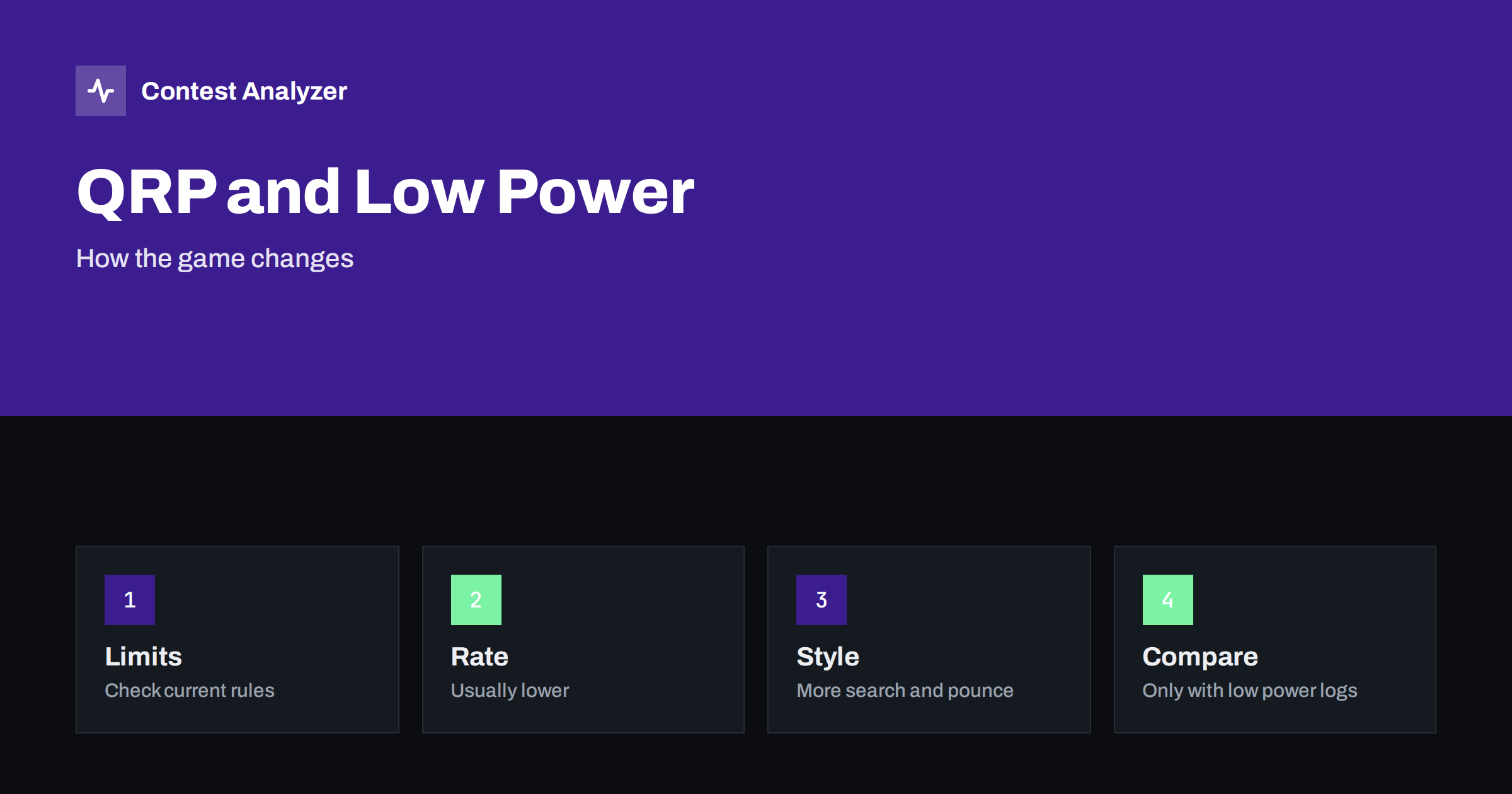
Short answer: QRP and Low Power categories limit the power of your transmitter, and the exact limits are set by the rules of each contest, so always read the current rules. With less power, you will usually work more by search and pounce, your rate will be lower and the multipliers will matter more. The category also changes how you should read your statistics: compare your results with your own earlier low-power logs, not with high-power ones, and look at the numbers that show how well you used the conditions.
What the categories are
Most contests offer several power classes for the same type of entry. The names and the limits are not the same everywhere. A typical set includes a high-power class with the maximum power allowed by the licence, a low-power class with a moderate limit and a QRP class with a very small limit. The exact values, and sometimes even the names, differ from one contest to another, so use the rules of the contest you enter. Do not assume that a limit you remember from another event applies.
The power class is not the only choice in the rules. Operator type (single or multi), the bands (all or one), the mode and any assistance are also part of the category. The article on assisted and unassisted categories describes the question of assistance, and category overlays shows some of the extra classes that are used in some contests.
Why operators choose low power
- The station. Some stations have no amplifier, or have limits on power because of the neighbours, the site or the licence.
- The challenge. Working the world with a small signal is a satisfying task for many people.
- A fair comparison. A class with other low-power stations gives you competitors who have the same limits.
- Simplicity. Without a big amplifier, the station is simpler and the preparation is shorter.
Whatever the reason, remember that the category you enter should reflect how you really operated. If you exceeded the limit for part of the contest, you must enter in the higher category.
How the rate changes
With less power, fewer stations hear your calls. As a result, running is harder. A high-power station that calls CQ on a good frequency may attract callers from across the world. A low-power station will often call CQ for a long time with few answers, especially on the more difficult bands. The rate is therefore typically lower, and the shape of the rate through the contest is different.
The difference is not equal everywhere. On a band that is wide open, and with a good antenna, a low-power station can run well, particularly towards nearby regions. On a weak band or toward a distant place, the difference is greater. Many low-power stations find that the best strategy is to run on the bands with the best propagation for short periods and to use search and pounce otherwise. The article on run versus search and pounce shows how to see the balance in your statistics.
How the multipliers change
When the rate is lower, each multiplier is relatively more valuable, because the share of the score that comes from multipliers is larger. Low-power operators therefore often put more effort into finding multipliers. They search patiently, they follow the openings and they use time on the bands where the multipliers are found. This approach rewards good listening and a good knowledge of propagation more than a strong signal does.
It also means that your list of missing multipliers is a key tool. Check it at regular intervals, and use the times when the rate is low to work through the list. The article on multiplier strategy in CQ WW gives a way to think about zones and countries, and many of the ideas apply to low-power operation in other contests.
Operating tips for low power
- Choose the time and the band carefully. A low-power signal needs the best part of an opening. Use the table of openings from earlier years to be on the right band at the right time.
- Be efficient in the QSO. A short, clean exchange helps you to keep the contact in poor conditions.
- Call at the right moment. When you search and pounce, wait for the end of the QSO, give your call once and listen. Calling over and over can annoy the other operator and does not help.
- Improve the antenna before the amplifier. For a low-power class, the antenna is the biggest change you can make, and a better antenna works for both transmit and receive.
- Keep the logging clean. With fewer QSOs, each one counts for more, and a busted call is more costly.
Reading your statistics in a low-power category
The numbers of a low-power log have their own character. The total number of QSOs is lower, and so is the average rate. It would be a mistake to compare them directly with a high-power log. The right comparison is with your own earlier low-power logs, and with the logs of others in the same class if you can see them. Within your own log, look at the rate on each band, the share of search and pounce, the distance and the continents. They show how well you used the conditions.
Contest Analyzer gives these figures after the review. It checks every callsign and every zone against official license databases and several independent reference sources and shows only the few QSOs worth a second look. In a log with a small number of QSOs, each correction counts, so the review is worth the time. The report also gives full statistics, with rates, QSOs by hour and band, countries, continents, CQ and ITU zones, WPX prefixes, distance, beam heading, breaks and off time and callsign length and structure. You can edit calls or zones in the report and download a corrected Cabrillo. You can compare with your own logs from earlier years, which is the comparison that matters most for a low-power class. It works with Cabrillo from N1MM Logger+, DXLog and Win-Test and supports 22 contests, listed on the contests page. Serial numbers are not checked and dupes are not errors.
Setting expectations
A common mistake in the first low-power contest is to expect the same type of result as with a high-power station and to feel disappointed when the rate is much lower. A better approach is to set expectations from your own history. If you have a log from a contest at higher power with the same station and the same antennas, you can estimate the effect of the change by comparing the QSOs on each band, but be careful, because the change in power is not the only difference. If you have no history, use the first low-power contest as a baseline, and judge the following ones against it.
It also helps to choose a few small goals that are not connected to the total score: to work all the continents on a certain band, to reach a particular number of multipliers, to keep the share of corrected calls in the review below a certain level or to make a number of QSOs in the best hour. Goals of this type keep the contest interesting, even when the rate is slow. The article on setting realistic goals from last year’s statistics explains how to turn numbers into such goals.
Finally, remember that many of the best-known stories in contesting come from low-power and QRP operators who made the most of a good opening. The work is slower, the listening more careful and the satisfaction of a hard-won QSO can be greater than that of an easy one. If you like a challenge, the low-power classes offer exactly that.
The category in the Cabrillo file
The power class is declared in the header of the Cabrillo file. The field must contain one of the values that the contest accepts, and a wrong value can lead to your log being classified in another category. Check the exact words in the instructions of the contest, and see the Cabrillo header guide for the general description of the category fields. If you change your category after the contest, for example because you remember that you used the amplifier for a few hours, correct the header before you submit, and do not leave it to chance.
Choosing the class honestly
It is tempting to use more power for a short time, for example for a rare multiplier, and to stay in the low class. The rules do not allow this, and the committee’s checks, together with the sense of fair play in the hobby, make honesty the only sensible option. If you want to use more power for part of the contest, enter the higher class. If you want a low class, keep to the limit for the entire contest, including the tuning period. The rules of the contest are the final authority.
Related reading
- Assisted versus unassisted categories
- Category overlays: Classic and Rookie
- Run versus search and pounce
The bottom line
A QRP or Low Power category changes the game: the rate is lower, the multipliers are more important and good listening and propagation planning matter more than a strong signal. Read the current rules for the limits, enter the class that matches how you really operated and judge your results by comparison with your own low-power logs.
FAQ
What are the power limits?
They differ by contest and can change. Always read the current rules of the contest you enter.
Is search and pounce better for low power?
Often, but not always. A good band and a good antenna make it possible to run for periods as well.
Can I compare my low-power result with high-power stations?
It is not a fair comparison. Compare with your own low-power logs and with others in the same class.
What if I used more power for a short time?
Then you must enter the higher power class, according to the rules.
Where is the category set in the log?
In the header of the Cabrillo file. Use the exact value that the contest accepts.