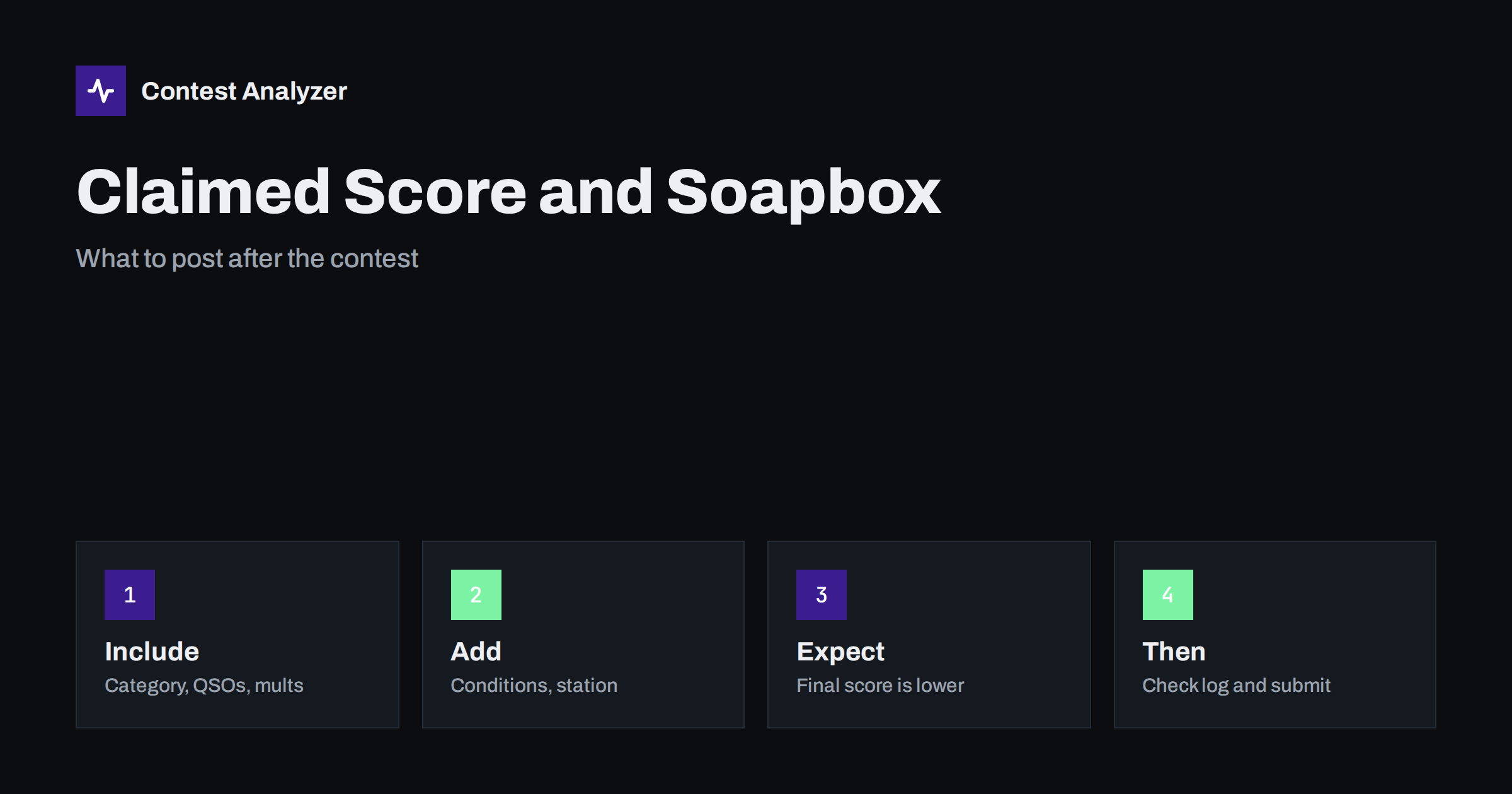
Short answer: A claimed score is the result you calculate from your own log, and a soapbox post is a short story of how the contest went. A good post gives the callsign, the category, the numbers of QSOs and multipliers, the claimed score and a few words about conditions and equipment. It is not a final result: the committee will check the logs, and the final score is usually lower than the claimed one. Post after you have exported and checked the log, and use your own review as the source of the numbers.
What a claimed score is
When you finish a contest, your logging software calculates a score from the QSOs, the points for each of them and the multipliers according to the rules of that contest. This is the claimed score. It is what you believe you have achieved, based on your own log, without any checking by the organisers or by other stations. Many contests also ask you to put the claimed score in the header of the Cabrillo file, and many contesters post it on websites that collect them during the days after the contest.
The claimed score is a useful figure, because it lets you and others see roughly how the contest went. But it is calculated before the log has been checked for busted calls, missing QSOs in the other logs, wrong zones or other problems. For this reason, it is normal for the final score to be lower. The article on claimed versus final score describes why this happens and how to keep the difference small.
What a soapbox is
A soapbox is a short text that goes with a claimed score. It is a place to share impressions: the conditions, the antennas, the operators, a rare station you worked, a technical problem you had to repair or something that surprised you. In some contests, there is an official place for soapbox comments. In others, the comments are posted on a web page that is kept by a volunteer or by the club. The idea is the same everywhere: a friendly way to tell others how the weekend went, and a way to learn how it went for them.
A good soapbox comment makes a contest feel like a shared event. It is also useful in a practical way: when you read the comments from other stations, you can compare their conditions with yours and see whether a bad weekend was a local problem or a general one.
What to include
- Callsign and category. The category tells readers how to compare the result: operator type, power, bands and any assistance.
- QSOs and multipliers. The numbers behind the score. Give only the figures that you know from your own log.
- Claimed score. The figure from your logger or from the report.
- Operating time. If you did not operate for the whole contest, mention it, because it explains the number of QSOs.
- Conditions. A few words about propagation, noise or interference.
- Station. The antennas and the power, in general terms. This is the part that other contesters like most.
- Highlights and problems. The best moment, the biggest problem and what you learned.
Keep it short. Three to six sentences are enough for most posts. Do not give your own opinion of the rules or of other stations, and do not criticise the organisers in the soapbox. Use another channel for that purpose.
Be honest with the numbers
A claimed score is a claim, and it should be a fair one. Use the figure that your log gives, after you have corrected any known errors. Do not round up, do not add QSOs that you are not sure about and do not leave out information that matters, such as a break in the operation or a change of category. If you later find an error and correct it, it is acceptable to post an update. In a friendly hobby, honesty about the numbers also makes the comparison between years useful for yourself.
Remember that some contests have rules about the way a claimed score may be published before the results. If you are not sure, check the current rules. In general, a claimed score is public information after the contest, but the details of how and where it is posted are set by the contest organisers.
Check the log before you post
The best time to post the claimed score is after you have exported the Cabrillo file and checked the log. If you post the number straight from the logger, it may include QSOs with busted calls or wrong zones. A short review lowers the score a little, but it brings the number closer to the real one, and it saves you from seeing a big drop in the final result.
Contest Analyzer checks every callsign and every zone against official license databases and several independent reference sources and shows only the few QSOs worth a second look. After you edit what needs editing, you can download a corrected Cabrillo and use it for your submission. The report also gives full statistics, with rates, QSOs by hour and band, countries, continents, CQ and ITU zones, WPX prefixes, distance, beam heading, breaks and off time and callsign length and structure. These numbers are useful for the soapbox: the best hour, the best band and the farthest QSO make good content for a short post. It works with Cabrillo from N1MM Logger+, DXLog and Win-Test and supports 22 contests, as shown on the contests page, and it lets you compare with your own logs from earlier years. Serial numbers are not checked and dupes are not errors.
The routine described in how to check a contest log before you submit it gives the full order of the steps.
The claimed score in the Cabrillo header
The Cabrillo header has a field for the claimed score. The value should be consistent with the one you post, and it should match the number of QSOs in the file. If you correct calls in the log after the export, the claimed score in the header may no longer fit, so update it or let your software recalculate it. The meaning of the other fields is explained in the Cabrillo header guide. A wrong or missing claimed score does not usually make the log invalid, but it is better to keep the file tidy.
An example of a good post
A useful post does not need to be long or clever. Here is the kind of text that tells readers what they want to know: the category and the operating style, a short statement of the result, a comment on conditions and one thing that you will do differently next time. For instance, a single-operator station might write that it entered the all-band category with low power, that the first night was good on the low bands while the second day was poor because of a geomagnetic disturbance, that it lost an hour to a rotator problem and that it plans to fix the cable before the next contest. Notice what is missing: complaints about other stations, guesses about the final ranking and exaggeration of the numbers.
A multi-operator team might add the number of operators and a line about the shifts. A station that ran a new antenna might say how it behaved, without claiming more than the log can show; the article on comparing contest results between years explains why one weekend rarely proves a change. A beginner can write about the first experience, and other contesters usually read such posts with interest and welcome the newcomer.
Where to post and what to avoid
The place for a claimed score depends on the contest. Some organisers maintain an official page for claimed scores, and some contests are covered by a volunteer site that collects them. If there is an official place, use it, and read the instructions there. Do not post personal information that you would not like to be public, such as a home address or the details of your equipment that might make it easy to find. A callsign is already public, and the rest is your choice.
Avoid a few common mistakes. Do not post a score and then leave the log unsubmitted: the organisers need the log, and the claimed score on a web page is not a submission. Do not copy the claimed score from a previous year by mistake, and do not compare your score with another station without taking the category into account, because a low-power station and a high-power station play different games. Finally, do not take the claimed scores of others as exact. They have the same limitations as yours.
Some people post a preliminary score on the evening after the contest and update it later. This is fine, provided that the first post says that it is preliminary. A better approach is to wait a day or two, review the log and post one number. If you submit the log and then find that you submitted the wrong file, follow the instructions of the organisers; the article on submitting a Cabrillo log describes the steps and the common problems.
Use soapbox posts as a source for your plan
Soapbox comments are interesting after the weekend, but they are also useful one year later. When you plan the next contest, read your own post and those of other stations from the last time. They remind you of the conditions, the problems and the ideas that were new. Combined with your statistics, they make a good basis for the goals described in setting realistic goals from last year’s statistics. A simple habit is to save your own post, together with the final score when it arrives, in a folder with the log and the notes of that year.
Related reading
The bottom line
A claimed score and a soapbox comment are part of the pleasure of contesting. Post them after you have checked the log, include the category and the main numbers, add a few honest words about conditions and the station and remember that the final score will probably be a little lower. Then submit the log, and keep your post for your own planning.
FAQ
Is the claimed score official?
No. It is your own calculation. The final score comes from the organisers after they check the logs.
Why is the final score lower?
Because errors, such as busted calls and wrong exchanges, and some QSOs that are not confirmed, are removed during checking.
What should I write in a soapbox?
The category, the numbers, a few words on conditions and the station, and one highlight or lesson.
When should I post?
After the log is exported and checked. Check the current rules of the contest for any restrictions.
Can I change the claimed score after posting?
Yes, you can post an update. Say clearly that it replaces the earlier figure.