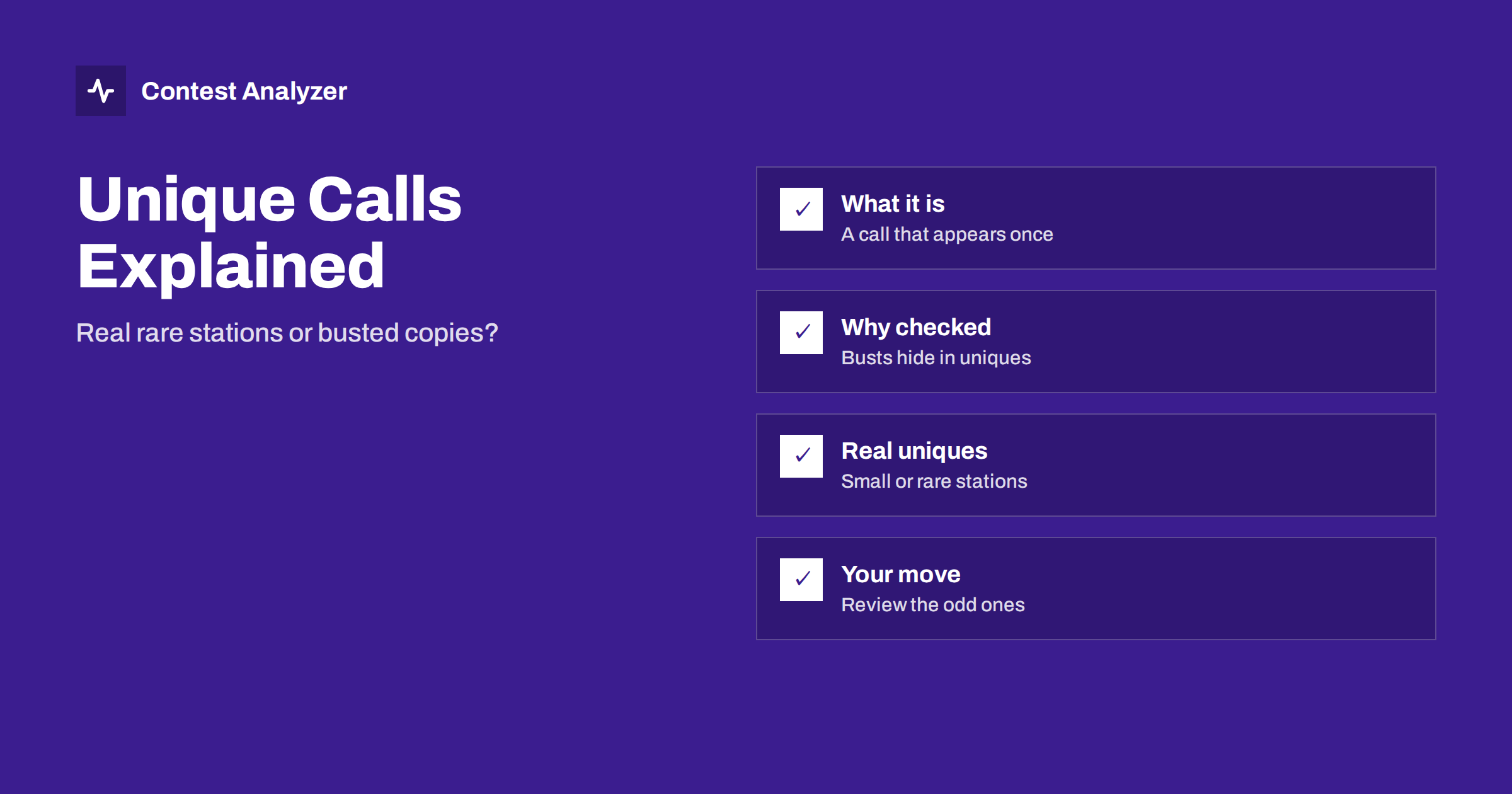
Short answer: A unique call is a callsign that appears in your log but is not found in the entries of other participants. Contest committees look at uniques because many busted callsigns end up among them, but a unique is not automatically an error: small, rare and new stations that did not send a log are often real. The practical task is to separate genuine uniques from badly copied calls, and to do that before you submit.
What a unique call is
In general log checking, a committee takes the logs sent by all participants and compares them. A callsign that you logged, and which does not appear in the other logs of the contest, is called unique. The definition of the word is simply about the callsign, not about its quality. A unique can be a station that was on the air and did not submit a log. It can be a station that was working only a few contacts. It can also be your own mistake: a call that you copied wrongly, which therefore matches no real station at all.
This is why the term sits alongside “busted” and “not in log” in the well-known UBN report: unique, busted and not in log are three categories of QSO that were flagged for different reasons. If you want to read that kind of report, see our article on the UBN report. This article concentrates on the first letter of that abbreviation.
Why committees look at uniques
A committee has to decide which QSOs to credit, and it cannot hear the original signal. What it can do is look for patterns. Experience shows that a call that appears only once is more likely to be wrong than a call that appears in many logs. The reason is simple: when a call is copied incorrectly, the result is a new combination of characters that almost nobody else logged. So uniques are a good place to start a check, and a large share of the QSOs that are removed in some contests come from that list.
Many committees also look further, to see whether the unique call is plausible: does it look like a valid callsign at all, and does it resemble a call that other logs contain. Rules and methods differ between contests, and committees do not always describe them in full, so treat any explanation as general. The practical result for you is clear: a large number of uniques in your log makes the committee spend more attention on your QSOs, and each of them is a potential loss.
Genuine uniques
Real uniques exist, and it would be a mistake to treat them all as errors. Typical examples are:
- Stations that did not send a log. A large part of the participants in any contest, especially casual ones, never submit a log. Their contacts are valid.
- Rare DX and expeditions. A station on a rare island may have a few hours on the air and no resources to submit a log. It often produces a unique that is worth many points.
- Special event and temporary calls. These may be on the air for a short time, with an unusual format.
- New licences and unusual formats. Callsign formats change, and a new call does not always look familiar to the operator who copies it.
- Small stations in a weak spot. A low-power station that only you heard is still a valid contact.
When you work a station like this, you cannot prove it with the log alone. What helps is the way you handle the QSO on the air, which is where the real protection against a busted call lies.
Busted calls that look like uniques
The uncomfortable part is that a busted call also looks unique. Common causes are well known: noise or QRM that hides one character, a partial call completed from memory, a wrong digit, a letter copied with the wrong phonetic, and typing errors in the heat of a pile-up. We describe them in the article on busted callsigns. A busted call has two typical signs:
- it differs from a more common or better-known call by one character;
- it appears only once in your log, often at a time when the rate was high or the band conditions were poor.
These signs are not proof. They are a reason to look closer. A real station can look like a busted version of a common call; an unusual-looking call can be perfectly correct. The point is that the QSOs worth a second look are, in practice, a small share of the log.
How to look at your own uniques
Start with a list of all callsigns that appear only once in your log. In a log of a few thousand QSOs this list can be long, so do not read it line by line from the top. Group the entries and work in this order.
- Calls that differ by one character from calls elsewhere in your log. If you worked LY2XYZ in the first hour and LY2XYV in the thirtieth, one of them is probably a copy error.
- Calls logged during a very high rate. Fast QSOs have less time for confirmation, so they are the first place to look for slips.
- Calls with an unusual structure. A call that does not follow the normal pattern of letters and digits for its country needs a second look.
- Calls with a slash. The prefix or suffix may be wrongly placed or spelled.
- Calls logged on weak bands or at the end of an opening. Marginal conditions mean marginal copy.
If you remember the QSO, a short note may be enough. If you do not, compare the call with what you can check from official sources before the contest closes. If you still have doubt, a QSO you cannot defend is better corrected or removed than left as a likely bust. The log is yours, and the rules of most contests allow you to remove a QSO you are not sure about.
Reducing uniques while you operate
- Ask for the call again when it matters. A repeat costs a few seconds. A bust costs the QSO and perhaps a multiplier.
- Confirm the call back once. Saying the call you have copied is the simplest protection.
- Use partial-call help in your logging software. Many programs offer a check based on a callsign file during operation. It is an operating aid, and it should help you to notice a doubtful call, not to replace listening.
- Do not complete a partial call from habit. If you heard only part of the call, say so.
- Log unusual calls slowly. A rare or special call deserves a clean copy.
An example of a review
Suppose your list of single-entry calls contains DL1ABX, and thirty hours earlier you worked DL1ABC on the same band. The two differ by one letter, and X and C are letters that sound different on CW but can be mixed up on a weak SSB signal. You do not need an outside opinion to see that one of them deserves a second look. Depending on your notes, you may keep both, correct one or remove one. In another case the list contains a call with an unusual prefix that you copied during a quiet hour on 15 metres. You remember the operator spelling it twice, so you keep it. The point is not to remove uniques but to give each doubtful one a short, conscious decision.
Uniques and the statistics of your contest
The number of uniques is not a score, but it is a useful indicator of your accuracy. If you compare your log to your own earlier ones, a rising share of single-entry calls with no sign of rare stations suggests more copy errors, or higher speed under worse conditions. Our article on comparing contest results year on year explains how to set up that comparison fairly.
Contest Analyzer reads the Cabrillo from N1MM Logger+, DXLog or Win-Test and checks every callsign and every zone against official license databases and several independent reference sources. It then shows only the few QSOs worth a second look, so that you do not need to inspect every unique by hand. You can edit calls and zones in the report, download a corrected Cabrillo and keep the full statistics: rates, QSOs by hour and band, countries, continents, CQ and ITU zones, WPX prefixes, distance, beam heading, breaks and off time, callsign length and structure. Dupes are not errors, and serial numbers are not checked. The contests page lists the 22 supported contests.
Related reading
The bottom line
A unique call is a call that only your log contains. It may be a genuine rare or small station, or a badly copied version of a real one. Do not fear uniques, but do not ignore them either: review the ones that differ by one character from other calls, those made at a high rate and those with an unusual structure, and correct what you cannot defend before you send the log.
FAQ
Is a unique call always a mistake?
No. Stations that did not send a log, rare DX and special calls are all valid uniques. A unique only means the call needs a closer look.
Why do committees look at uniques first?
Because a badly copied call usually produces a combination that few or no other participants logged, so busts are over-represented among uniques.
Can I remove a QSO I am unsure about?
In most contests you may leave out a contact you cannot stand behind, but check the current rules of your contest for anything specific.
Does a high number of uniques lower my score?
Not by itself. Genuine uniques count. The risk lies in the busted calls hidden among them.
Are dupes the same as uniques?
No. A dupe is a repeated contact with the same station on the same band and mode. In Contest Analyzer dupes are not treated as errors.