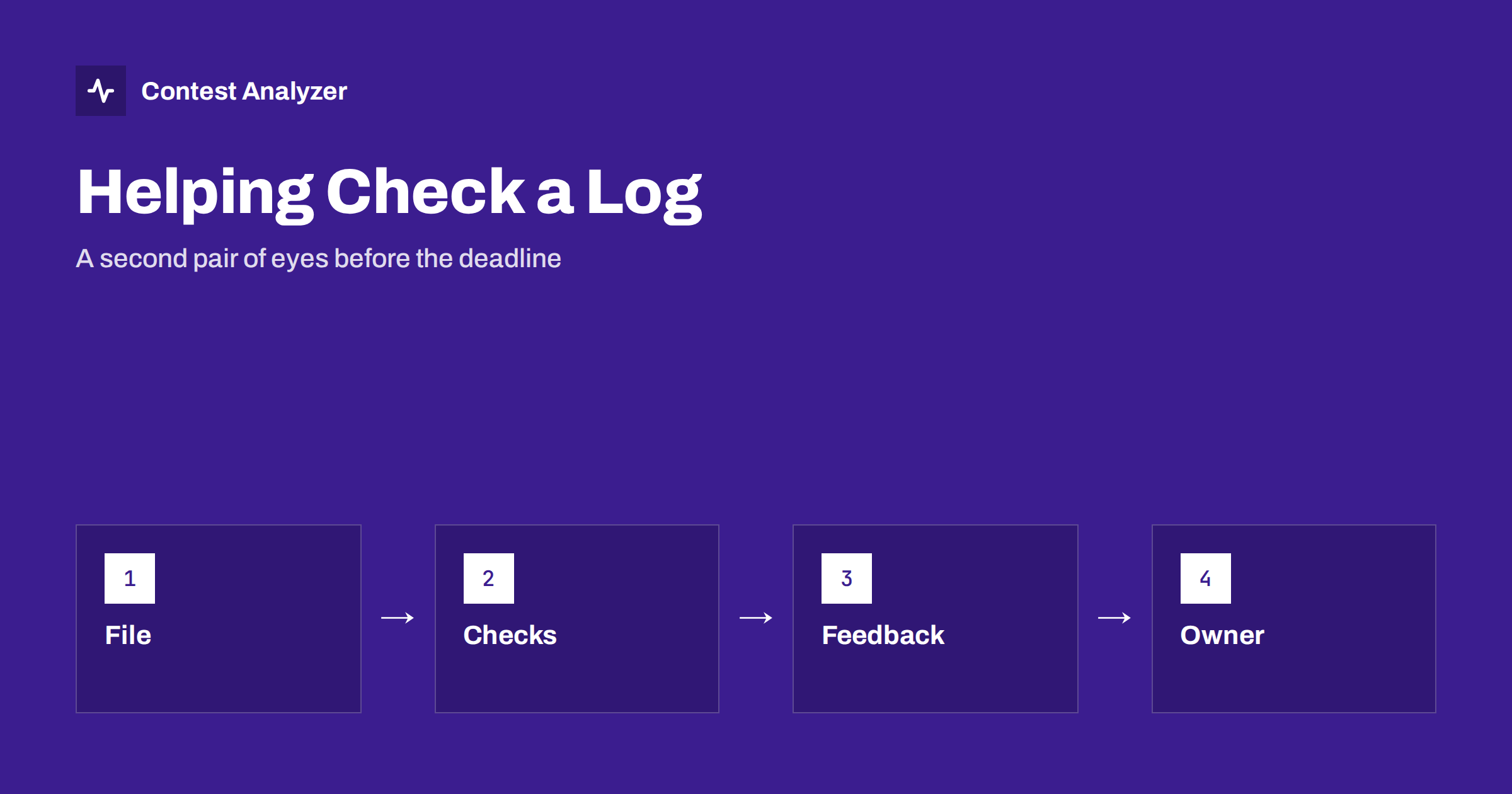
Short answer: A second pair of eyes is one of the best ways to improve a contest log, but the log still belongs to the operator who made it. Ask for the Cabrillo file and the exact category, look at the header, the time range, the bands and the callsigns, write down your findings in a short list and let the owner decide what to change. Leave enough time before the deadline, because corrections take longer than you expect.
Why a second reader helps
When you check your own log, you see what you expect to see. A friend does not know what the log should look like, and that is why he finds things that you miss: a header from the wrong contest, a band that does not belong, a callsign with an obvious typing slip. In a club, checking each other’s logs before submission is a habit that costs little and improves every entry. It also teaches the helper something, because looking at another operator’s log shows other ways of working and other mistakes.
The same principle is behind the checklist in checking a contest log before you submit. The difference is that you have to share the work with someone else, and that needs a few agreements before you start.
Agree on the task before you start
Ask the owner what he wants. Does he want only a check of the header and the format, or also a look at the callsigns and the zones? Does he want you to correct the file, or only to give a list of findings? Many misunderstandings come from the helper who changes the file and the owner who does not know what was changed. A good rule is that the helper never edits the original file, and that every change is made by the owner or in a copy with a clear name.
Also agree on the deadline. The owner should send the file early enough, and you should answer early enough, so that there is time for the changes and for a final look. Rules about deadlines differ between contests, as described in log submission deadlines, and in CQ WW the current rule is 48 hours after the end of the contest. Do not leave the check to the last hour.
What to ask the owner for
Ask for four things: the Cabrillo file, the name of the contest and the category that the owner wants to enter, a short note about how the station was operated and the logger and version that made the file. The note about the operating is important. If the owner used help from spots or a second operator for a short time, this changes the category, and the helper cannot see it from the file.
If the owner has a recording of the contest, ask whether it is available. It will not be needed in every case, but when a QSO looks wrong, a listen is the surest way to decide. The article on recording audio for a log check explains the idea.
A simple order of checks
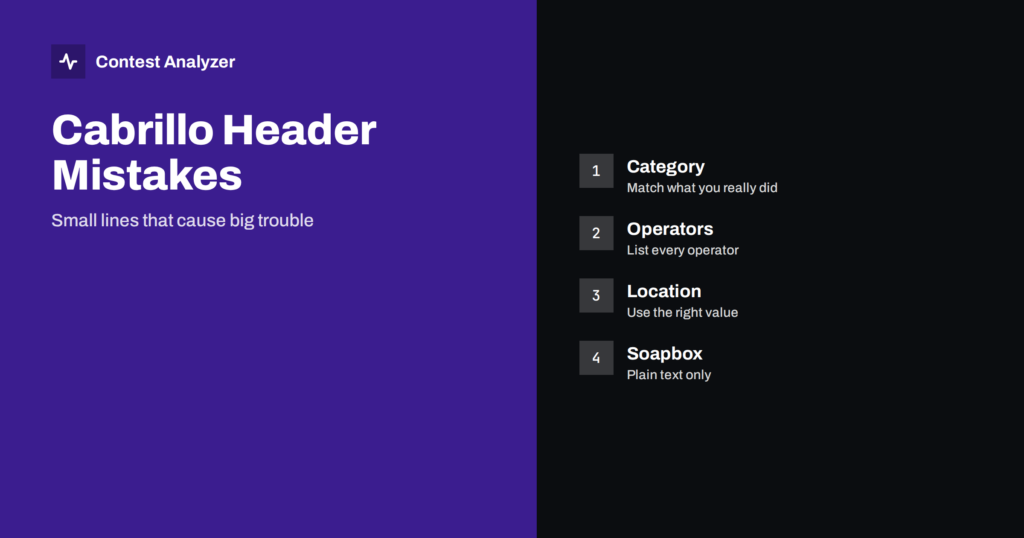
Work from the large to the small. Start with the header: contest name, callsign, category lines, operators, location and soapbox. The details are in the Cabrillo header guide. Continue with the time range: do the first and last QSO lie inside the contest period, and does the time look right? Then check the bands and frequencies against the limits, and the exchange columns against the contest rules.
Only then look at the callsigns and the zones. Check the ones that look unusual: a call with a strange structure, a prefix that does not match the zone, or two calls that look almost the same. Do not try to read every line. A helper who looks at a thousand lines for an hour gets tired, and the second half is checked worse than the first. A short list of the places that deserve a second look is more useful than a long list of doubts.
What not to change
Some changes are not for the helper. Do not change a callsign because you think it is wrong: the owner heard the QSO, and you did not. Do not remove dupes, because they are not errors, and do not change times unless the owner confirms a clock problem. Do not touch the category without a conversation. Mark everything that you think is wrong and let the owner check it against his notes or recording. The articles on dupes and on time correction explain why careless changes do harm.
How to give feedback
Write a short list, with the line number or the time of each QSO, what you see and what you suggest. Divide it into three groups: must fix (a wrong header, a time outside the contest), should look at (a doubtful callsign or zone) and ideas for the future (a habit that costs points). Keep the tone friendly and factual. Nobody likes a long list of faults, and the owner is more likely to act on a list that fits on one screen.
Say what is good as well. If the log is clean, tell him. The statistics may show a strong rate or good multipliers, and a short word about it makes the check a pleasant task. If you find a repeated problem, such as the same zone confused several times, point to the cause and not only to the lines.
Use the tools to save time
A tool saves the helper from reading every line. Contest Analyzer checks every callsign and every zone against official license databases and several independent reference sources and shows only the few QSOs worth a second look. The owner can edit calls, zones, time and frequency in the report, mark QSOs checked in his own audio recording, duplicate a QSO line and download a corrected Cabrillo. It marks QSOs outside the contest period and outside the band limits for the ITU region, with split QSOs shown as a note, and gives full statistics such as rates, QSOs by hour and band, countries, continents, zones, breaks and off time. It works with Cabrillo from N1MM Logger+, DXLog and Win-Test, and the contests page lists the 22 supported contests. A helper and a report together are quicker than either one alone.
Checking your own log as a helper
The same list works when you are the owner and you ask a friend to read your log. Prepare the file and the notes before you send them, so that the helper does not waste time on questions. Write down the category you want, any breaks that were longer than an hour, and the moments in which something went wrong at the station, such as a computer restart or a clock problem. These notes explain odd lines in the log and save the helper from marking them as errors.
When the answer comes back, read the list calmly. Some findings will be wrong, because the helper did not hear the QSO, and some will be right. Check each one against your notes or recording and decide for yourself. Thank the helper, and offer to do the same for him in the next contest. Mutual checks between friends are among the most useful habits in a club, and they cost only an evening.
Before the file is submitted
After the changes, ask the owner to export a new Cabrillo and look at the header and the first and last lines once more. Make sure that the file has the right name, and that the owner uses the upload method that the contest asks for. The steps are described in uploading the Cabrillo log and a corrected Cabrillo before you submit. Keep both the original and the corrected file until the committee confirms receipt.
Keep the work private. A log belongs to the operator, and the mistakes in it are his business. Do not post the findings in a public group, and do not compare the scores of friends without their agreement. A quiet and helpful check builds trust, and trust is what makes people send their logs for a check the next time. If the owner disagrees with a finding, accept it: it is his log, and his answer after listening to the recording is the one that counts. The goal is a clean file and a good habit, not a win in a discussion.
Helping a club in a larger way
If you do this for a club, set a day a few days before the deadline as a log evening. Each member brings the file, and one or two experienced members look at the headers and the main statistics. Keep a short list of the common mistakes of the year and discuss it at the next meeting. Over time, the mistakes become fewer, and the club score, which often depends on many small logs, gets better.
Related reading
The bottom line
A friendly check improves a log, if the helper asks first, looks from the large to the small and leaves the decisions to the owner. Start early, keep a short list and finish with a new export that has been read once more.
FAQ
Should the helper edit the log?
Better not. Give a list of findings and let the owner decide, or work in a copy with a clear name.
What is the first thing to check?
The header: contest, callsign, category lines, operators and location. Then the time range and the bands.
Can I judge a callsign without hearing the QSO?
You can mark it as doubtful, but only the owner, with his notes or recording, can decide.
How early should the check start?
As early as possible, and well before the deadline of the contest. Check the current rules for the date.
Is it a problem if the log has dupes?
No. A dupe is not an error, and it usually should stay in the file.