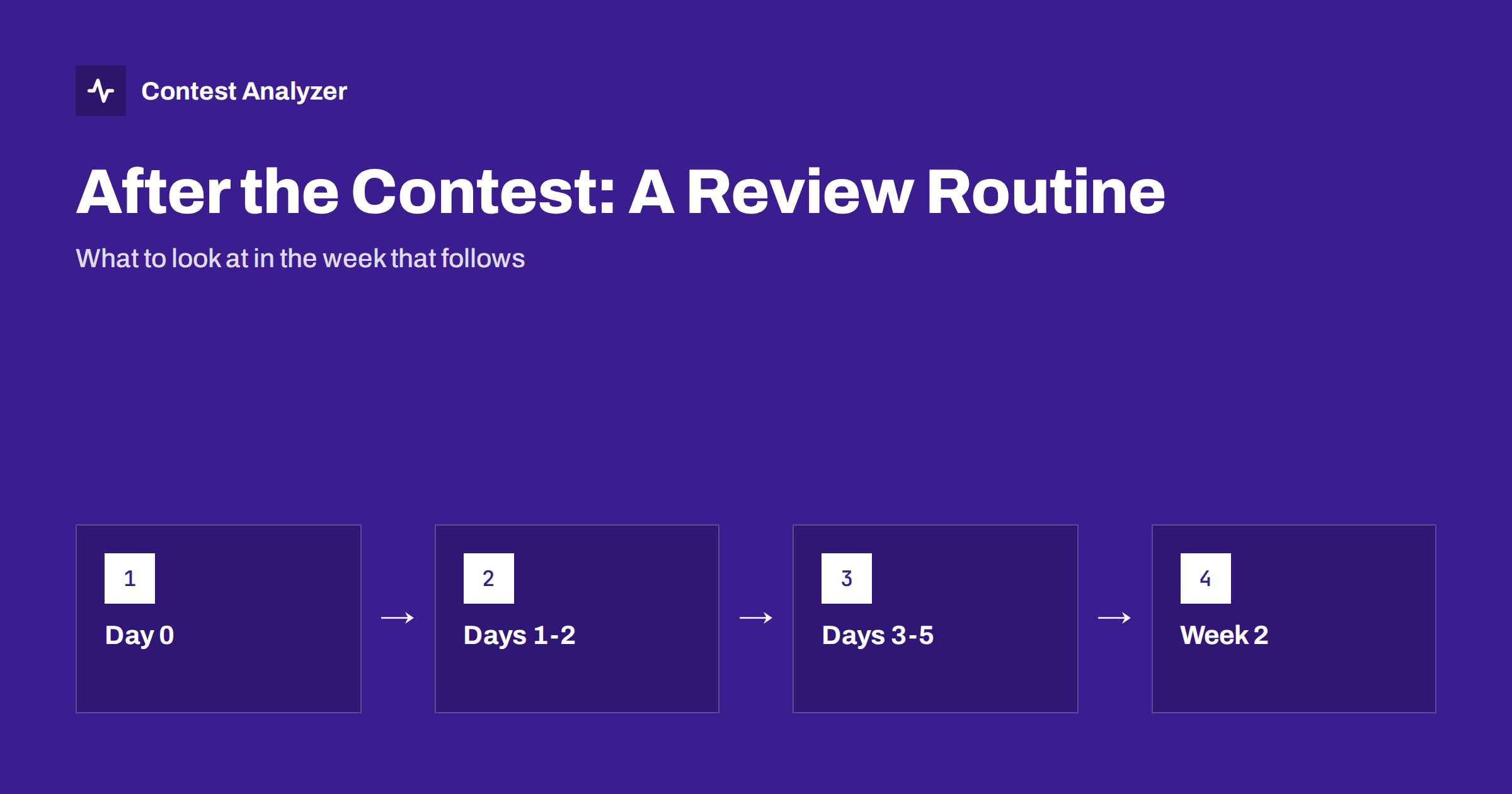
Short answer: A post-contest review is a short, repeatable routine that you follow in the days after every contest: secure the log, correct errors and submit it, study the statistics, write down what you learned and keep that note where you will find it before next year’s contest. Done in a fixed order it takes a few hours spread over a week, and it is the part of contesting that turns experience into improvement.
Why a routine, and why now
Most operators finish a contest tired and slightly relieved, and a few days later their memory has blurred. The details that you really want for next time, such as why the rate fell on Sunday morning, which band you should have tried at which hour and which equipment problem cost you an hour, are the first to go. A review done soon after the contest captures them. A review done weeks later mostly captures what you can read in the log.
A routine also removes the guesswork. If you know what you do on day one, on day two and in the following week, you do not have to decide each time, and you do not forget the tedious steps that matter, such as saving a backup and keeping the confirmation of the submission. The steps below are only a suggestion; adjust them to the contest, the deadline in the current rules and your own habits.
Day zero: secure what you have
Right after the last QSO, before any sleep that you really need, do two small things.
- Save a copy of the log. Close the contest in the logger, make a backup of the logger’s database and copy it to a second place, such as a USB drive or another computer. A log that exists in only one place is a risk.
- Write down impressions while they are fresh. Five minutes is enough. What went well, what annoyed you, which band surprised you, what equipment did not behave. These notes are not meant to be elegant. They are triggers for the later review.
Then rest. Looking at a log with tired eyes is exactly how errors survive. If the contest has a short deadline, such as the 48 hours of CQ WW, schedule the next step for the same day or the next one, and check the exact time limit in the current rules.
Days one and two: errors first, then submit
The first real task is a correct log. Export a Cabrillo file, open it in a text editor and read the header, the first and last QSO lines and a sample from the middle. Our checklist before you submit covers the sequence.
- Check the header and the period. Category, callsign, operators and times must be right.
- Check the clock. The first QSO should be after the start and the last before the end.
- Deal with doubtful QSOs. If you marked uncertain contacts while operating, now is the time to settle them. If you recorded audio, listen to the relevant parts.
- Check callsigns and zones. This is the most laborious part and the most valuable. Use Contest Analyzer here: it checks every callsign and every zone against official license databases and several independent reference sources and lists only the few QSOs worth a second look. You can edit calls or zones in the report and download a corrected Cabrillo.
- Submit and keep the confirmation. Follow the sponsor’s instructions, then file the confirmation message together with the file you sent.
Submitting early has a practical benefit: the log is no longer hanging over you, and the review that follows is free of deadline pressure. The best moment for it is when you have decided that the log is final.
Days three to five: read the statistics
Once the log is clean, look at what it shows. The goal is not to admire a total but to find patterns that you can use. A useful order is:
- Rate and hours. QSOs per hour across the whole contest and by band. Where were the peaks and the dead spells? Our article on the hour-by-hour analysis describes the grid.
- Breaks and off time. Did the breaks fall where you planned them? Do they agree with the rule of your category? See off time and breaks.
- Bands. When did each band work, and when did you stay too long on a band that was fading?
- Multipliers. Countries and zones per band, and what was missed. The article on multiplier strategy helps with this.
- Geography. Continents, distance and beam heading. Do they match your antennas and your plan?
- Run and search and pounce. How much of the log came from each style, and at what rate?
Contest Analyzer gives all of these in one report from your Cabrillo file: rates, QSOs by hour and band, countries, continents, CQ and ITU zones, WPX prefixes, distance, beam heading, breaks and off time, and callsign length and structure. It works with files from N1MM Logger+, DXLog and Win-Test for 22 contests; see the list. Plans start at €7 per month plus VAT, as shown on the pricing page.
Compare, but compare fairly
A single result tells little. The more useful question is how this year differs from your previous logs of the same contest. Compare like with like: the same contest, the same category, and if possible similar conditions. Our guide to comparing results between years lists what to look at, and the report supports year-on-year comparison with your own logs.
Remember that propagation, solar activity and the number of active stations change from year to year. If your rate is lower, ask first whether the conditions were weaker, and only then whether your operating changed. The article on solar flux and results explains the effect. Also note changes on your side: a new antenna, a different logger, a change of category. Without these notes the numbers are hard to interpret later.
Write the notes that you will actually read
A review that exists only in your head is lost. Keep a short file for each contest, with the same headings every time. A set that works for many operators:
- Result: category, claimed score, QSOs, multipliers, the date.
- What worked: two or three things to repeat.
- What cost points: two or three things to fix, with a reason. Errors, gaps, equipment, fatigue.
- One change for next time: a single, concrete item, such as a different time for the main break or a test of the keyer macros a week earlier.
- Technical to-do: a short list for the station, with a due date before the next contest.
Choose only one or two changes. A long list is rarely done, and a small change that you really make beats five good intentions. The idea of setting a target from earlier numbers is developed in the article on realistic contest goals.
When the committee’s results arrive
Some weeks or months later the sponsor publishes the results, and often a report on your log. Take half an hour for this too. Compare the final score with your claimed score, and look at which QSOs were removed and why. If the committee provides a detailed report, read it carefully, and add what you find to your notes. The article on log checking reports shows how to learn from them, and the one on claimed versus final score explains the gap in general terms.
Compare it with your own review. If the committee found errors that your check did not, your process has a gap, and the gap is the thing to fix before the next contest.
Mistakes that spoil a review
- Reviewing only the score. A total hides everything useful. The causes are in the hours, the bands and the errors, not in the final number.
- Blaming conditions for everything. Propagation matters, but if every weak result is explained by the bands, nothing is learned. Look for the part that you control.
- Collecting too many lessons. Ten resolutions turn into none. Pick the one or two with the largest expected effect.
- Waiting for the official results. They can arrive months later. Your own review is more useful when it is done while you still remember the weekend.
- Not looking at the notes later. Put a reminder in your calendar a month before the next contest to open the file and read the last entry.
Related reading
- Checking your contest log before you submit
- Comparing contest results between years
- Setting realistic contest goals from statistics
The bottom line
The contest ends when the log has been checked, sent and understood, not when the last QSO is made. Secure the log, correct the errors, submit it, read the statistics, compare fairly with earlier years and write down one or two changes that you will really make. A review of a few hours, repeated after every contest, is one of the cheapest ways to improve.
FAQ
How soon after the contest should I start the review?
Secure the log at once and write short notes the same day. Do the full review in the following days, after you have rested and submitted the log.
How long should the review take?
A few hours spread over the week is usually enough: checking and submitting the log, reading the statistics and writing the notes.
What is the most important thing to look at?
Errors first, because they cost points directly, then rate and band use by hour, which show where your plan can be improved.
Should I compare with other stations?
Mainly compare with your own earlier logs of the same contest and category. Comparisons with others are useful once the results are published, but conditions and stations differ.
Where should I keep my notes?
In one place that you will open before the next contest, such as a text file or a folder with the same name for every contest.