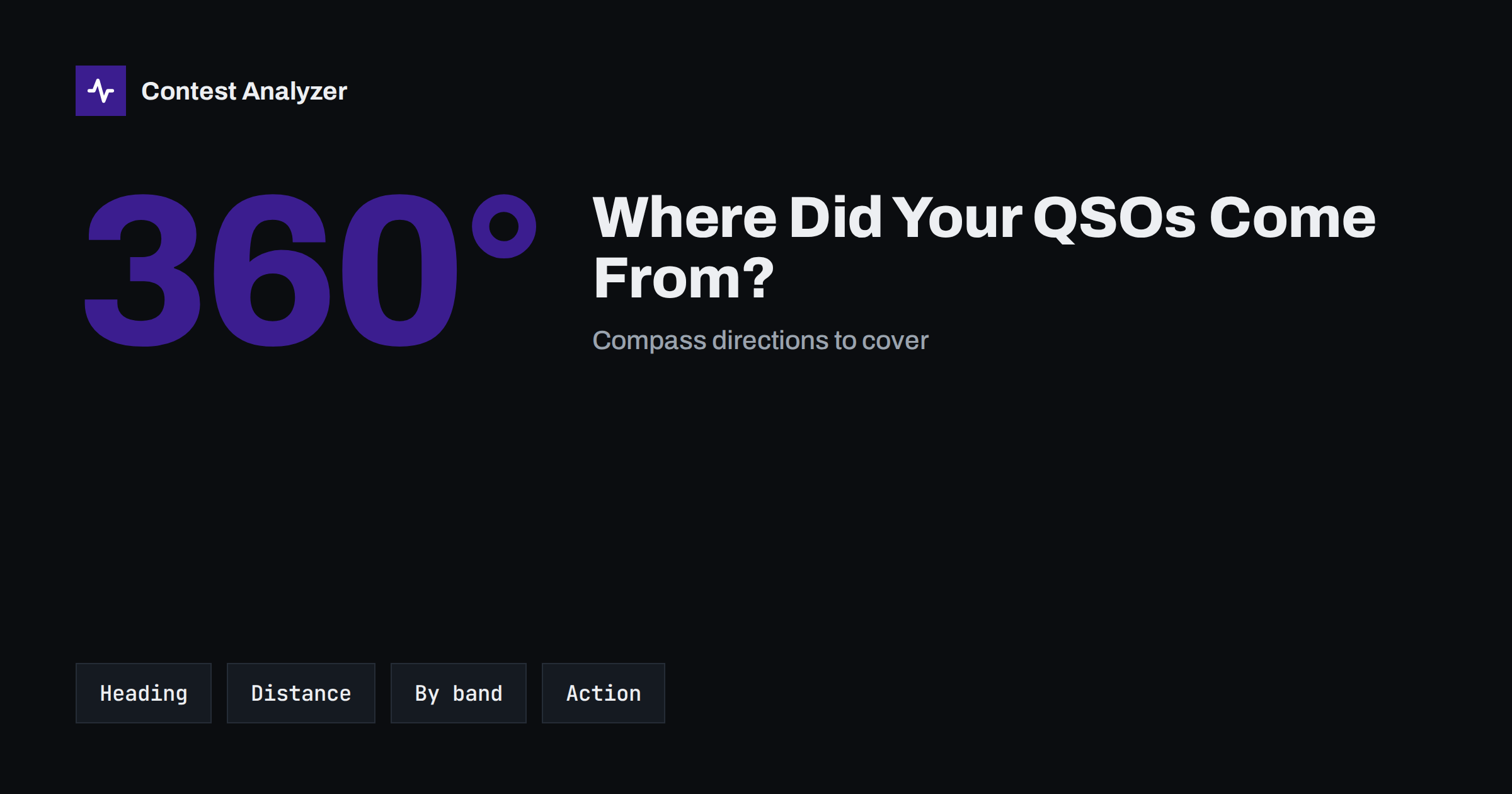
Short answer: The beam heading of a QSO is the compass direction from your station to the other station, and the distance is how far away it is. If you group your QSOs by heading and by distance, you can see which directions and ranges produced your result, which ones you neglected and whether your antennas and rotator habits match your real traffic. Read the picture band by band, compare it with earlier years and let it decide where to point the beam, where to add an antenna and when to stop calling into a quiet direction.
Two simple numbers per QSO
For each contact in your log, two geometric facts exist. The first is the heading (also called bearing or azimuth): the direction in degrees, clockwise from north, in which you would point an antenna to reach the other station along the shortest path. The second is the distance along that path. Together they describe where the contact was in terms that matter for antennas: in which direction and how far.
Neither number is typed into the logger. They come from the positions of the two stations, so they are derived and carry the accuracy of the positions used. For a country-level view that is plenty to judge directions and ranges, but small differences between neighboring QSOs should not be over-interpreted. The statistics are about the big picture of hundreds or thousands of contacts, and not about a single bearing.
One more detail to remember: radio waves do not always travel along the short path. On some bands and at some hours the long path, which points 180 degrees away from the short path, can be stronger. A heading statistic based on the short path is still a sensible summary, but if you remember using long-path openings, keep that in mind when you read the figures.
Reading the heading distribution
The usual way to display headings is to divide the compass into sectors, for example eight sectors of 45 degrees or twelve sectors of 30 degrees, and count the QSOs in each sector. A chart of the counts is often drawn like a compass rose. When you look at it, ask these questions:
- Where is the bulk? Most operators see one or two broad sectors with most of the QSOs. For a European station that is often east and west, towards the large population areas.
- Is it symmetrical? If you expected traffic in several directions but got a lopsided chart, check whether the missing directions were open, or whether your antenna was pointed elsewhere.
- What is in the empty sectors? A sector with almost no QSOs may be a direction with few stations or few openings, or it may be a direction you never turned to.
- Does the shape follow your antenna? A fixed antenna or a beam with a narrow lobe will favor some sectors. If the chart has a notch exactly where the antenna is weak, that is expected, and it tells you the antenna is doing what it was designed to do.
The interesting findings are surprises: a sector with far more QSOs than you expected, or one with fewer. Both deserve a note, and often a check of the band and the hour in which they happened.
Reading the distance distribution
Distance tells you the range of your contest. A histogram in steps of a few thousand kilometers, or a division into short, medium and long distances, gives a clear picture.
- Short distances are your regional QSOs. They bring a high rate, particularly on the lower bands, and in many contests they bring few points per QSO.
- Medium distances often cover the neighboring continents and are the core of many results.
- Long distances are the DX. They are rare and slow to work, but they carry the multipliers and the higher point values in contests that reward distance or other continents.
Compare the shape with your goals. If you want a higher score and the chart is dominated by short distances, you are probably running well but missing the long-range multipliers. If the chart is weighted to long distances with a low rate, you may be too selective. Neither is wrong in itself, but it should be your choice and not an accident.
Combine heading and distance by band
The most useful reading appears when you put the two numbers together and split them by band. A high band might show long distances in a few directions, which tells you where the path was open. A low band may show many short QSOs in all directions, plus a few long-range contacts at night. You will see, band by band, which sectors were reachable and which not.
Do this with a small table for yourself, with the bands as rows and the compass sectors as columns, and mark the cells that were strong. After one contest it is a record; after three it is a map of your station’s real coverage. It connects naturally with the continent view of your log, which gives the same information in coarser units, and with your rates by band and hour.
What to improve from the numbers
Statistics must end in decisions. Here are the most common conclusions, each with the observation behind it.
- Point the beam more often. A sector with moderate traffic in which the antenna was rarely turned may produce more with attention. Try a deliberate pass in that direction at the right hour.
- Stop rotating so often. If the chart is spread evenly and your rate is low, you may spend too much time turning the antenna. A fixed direction for longer periods can raise the rate.
- Add an antenna for the weak sector. If a direction is workable but your pattern is poor there, a second antenna or a different design might be worth the effort. Check this against several contests, because one weekend can mislead.
- Review the low-band performance. A low band with only short distances may point to a station that hears more than it transmits, or to a limited antenna. Compare with your receive conditions before you decide.
- Use the long path on purpose. If your chart has unexplained QSOs in the opposite direction at certain hours, long-path openings may be real for your location.
Always consider the effort. A larger antenna is a project of weeks or months. A change in operating habit costs nothing. Start with the habits, and invest in hardware only when the numbers show a lasting gap.
Cautions when reading the figures
- Different years, different conditions. A sector that was strong in one year may be weaker in another because of propagation, not because of your station. Our article on comparing results year on year covers this point.
- Where the stations are. The chart reflects where the stations are as much as your antenna. A direction with an ocean has few QSOs for obvious reasons.
- Busted calls shift the picture. A wrong callsign can put a QSO in a different country and thus at a wrong heading and distance. Clean the calls first.
- Small samples. In a short or low-activity contest, a few QSOs can change a sector. Do not base a major decision on a sector with five contacts.
- Location matters. If you operate from different places, from home and from a field site, keep the statistics separate.
Getting heading and distance statistics from your log
You can compute headings and distances yourself, but it takes some work with positions and formulas. Contest Analyzer includes them in the full statistics for your Cabrillo file, next to rates, QSOs by hour and band, countries, continents, CQ and ITU zones, WPX prefixes, breaks and callsign length and structure. Cabrillo files from N1MM Logger+, DXLog and Win-Test are supported, and the year-on-year comparison with your own earlier logs lets you see whether a direction has gained or lost over the seasons.
The same report checks every callsign and every zone against official license databases and several independent reference sources, and it shows only the few QSOs worth a second look. You can correct calls and zones in the report and download a corrected Cabrillo, which also keeps the distance statistics honest. Serial numbers are not checked, and dupes are not errors. The service covers 22 contests (see the contests page) and works in 25 languages.
Related reading
The bottom line
Heading and distance turn a list of calls into a map. Read the compass sectors and the distance ranges together, split them by band, treat surprises as questions and change habits before hardware. Keep the log clean, and compare year after year, so that the map becomes more accurate with each contest.
FAQ
What is beam heading in a contest log?
It is the compass direction, in degrees from north, from your station to the station you worked. It is derived from the positions of the two stations.
Does the statistic consider long-path propagation?
A heading statistic normally shows the short-path direction. If you used long-path openings, remember that the real path pointed the opposite way.
How many sectors should I use to read headings?
Eight or twelve sectors are usually enough. Narrower sectors need many QSOs to give a stable picture.
Can heading statistics tell me to buy a new antenna?
They can show a persistent gap in a direction, but one contest is a weak basis. Check several contests and your habits before spending on hardware.
Does a wrong callsign affect the distance statistics?
Yes. A busted call can put the QSO in another country, so correct the calls before you read the figures.