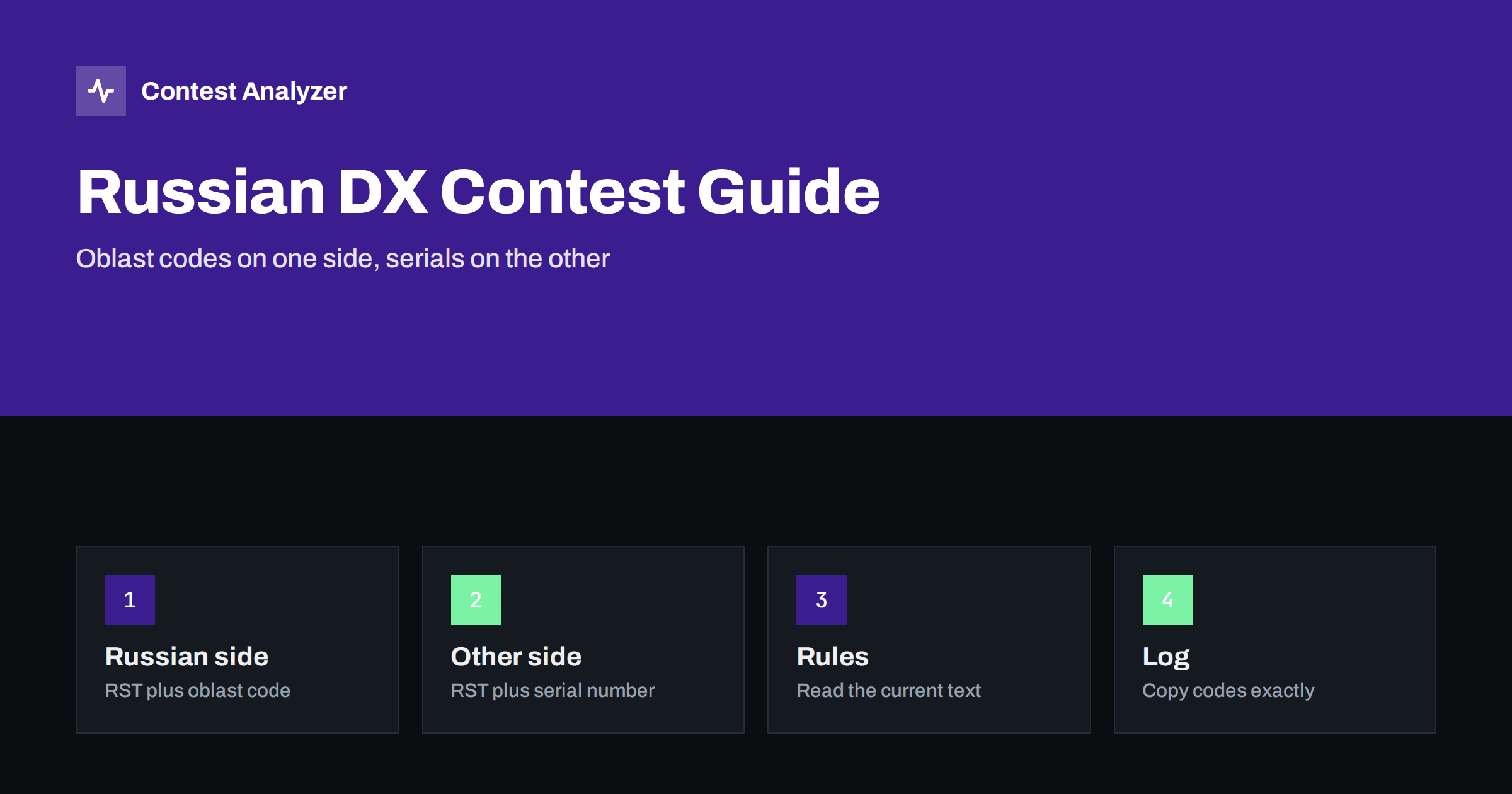
Short answer: The Russian DX Contest (RDXC) uses two kinds of exchange. As a rule, Russian stations send a signal report plus a code for their oblast (region), while stations elsewhere send a signal report plus a serial number. The details of who may work whom, the exact list of codes and the multipliers belong in the current official rules, so read them before the contest and set up your logger accordingly.
What RDXC is
The Russian DX Contest is an annual HF contest in which stations from outside Russia contact Russian stations, and the Russian stations work the rest of the world. It is held on CW and SSB in a single event, and it has its own club of regular participants from many countries. Dates, categories, scoring and the list of regions can change, and the organisers publish them on the contest website. This article describes the shape of the exchange in general terms, so use the rules as the final authority on every detail, including who is allowed to enter and in which category.
The reason the contest deserves its own guide is the mix of exchange types. Many operators are used to either a zone, a serial number or a state. RDXC puts a regional code and a serial number into the same event, and that makes logging errors easy to make.
Two sides, two exchanges
In outline, the exchange is as follows:
| Station | Sends | Logger field |
|---|---|---|
| Russian station | RS(T) report plus an oblast code | Letters in the received field |
| Station outside Russia | RS(T) report plus a serial number | Number in the received field |
The consequence for the operator is that you must expect a different item depending on who you call. If you operate outside Russia, you copy an oblast code from every Russian station and send your serial number. If you operate in Russia, you send your oblast code and copy serial numbers. A contest-specific logger handles this automatically, but only if the contest is selected and your own location is set up correctly.
Oblast codes
An oblast code is a short code, normally two letters, that identifies the region of Russia in which the station operates. The set of codes and the exact way they are written are published in the rules or in the contest’s supporting documents. Some points to keep in mind:
- They are regional codes, not prefixes. A callsign does not always say which oblast a station is in. Stations move, and some call areas contain several oblasts.
- They are multipliers. In this kind of event the regions are among the things the scoring rewards, so a wrong code can cost a multiplier as well as the QSO. The rules say how they count, per band or overall.
- They can sound alike. Two-letter codes are short, and on SSB some letter pairs are hard to separate under noise. Use phonetics and confirm when you are unsure.
- Your logger should have the list. Most contest programs include a table of valid codes and warn you if you type something that does not exist. Make sure this table is up to date.
Do not try to memorise the entire list from an article like this one. Download the current list from the organisers, load it into your logger and use it as a reference during the contest.
Serial numbers
For stations outside Russia the second item is a serial number, which increases by one with every QSO. A serial number is simple, but it has its own failure modes: numbers that jump because the logger was restarted, numbers that repeat after a crash and numbers that were edited by hand. If you work with several computers or operators, make sure only one program issues the numbers or that your network setup does so safely.
It is worth remembering that serial numbers are not checked by Contest Analyzer. They are checked by the organisers, who compare them across their data and may remove contacts if they do not agree. For your own purposes this means that a serial number you copy wrongly is a cost you will only learn about from the official results. Take the number seriously when you copy it, especially at high speed.
Setting up the logger
- Select the Russian DX Contest in the contest list of your program. Do not use a similar contest as a workaround.
- Enter your own exchange: your oblast code if you are in Russia, otherwise leave the serial number to be generated by the program.
- Check the received exchange field: does it accept both letters and numbers? Does it warn if a code is not in the list?
- Update the country and callsign data files so that the callsign display is accurate.
- Export a test Cabrillo file and check how the exchange columns look. Compare them with the sample in the rules, if the organisers provide one. For a reminder of the general layout, see our guide to exporting Cabrillo from the major loggers.
Running and search-and-pounce
RDXC has a natural rhythm: a station outside Russia gets a lot of calls from the region on the right bands, and a station inside Russia gets calls from all over the world. For the outside operator, the typical work pattern is a mix of running on the best band and searching for new oblasts. Each new oblast is a reason to listen closely rather than call at once, because hearing the exchange of the station before you call gives you the code in advance and shows how fast the operator sends.
A good way to protect accuracy is to follow a fixed pattern for every QSO: copy the call, confirm it once, then copy the code. If you have to ask for a repeat, ask for the item that is unclear and not the whole exchange. This saves time and reduces the chance of a second misunderstanding.
Common mistakes
- Logging a serial number where a code belongs, or the reverse. This usually happens when the logger is set to a different contest.
- Using a code that does not exist. If your program does not warn you, you may only learn of the mistake after the contest. A review of rare codes is worth doing.
- Busted callsigns. They are as expensive here as in any contest. See our article on busted callsigns for habits that reduce them.
- Mixing up the sending side. A station outside Russia that sends an oblast code, or a Russian station that sends a serial number, creates a log full of exchange mismatches.
- Wrong category in the header. Check the list of categories in the current rules, and make sure the header of your Cabrillo file matches your real operation.
Planning your operation
The structure of the contest suggests a simple plan. If you operate outside Russia, find out which bands give you the best path to the regions you need and when. Make a note of the bands where you expect the most Russian stations at different hours, and schedule your search-and-pounce periods when a band is full of them. If you operate in Russia, plan your runs on the bands with the best DX conditions and keep your oblast code fixed in the macros of your logger, so that you never type it by hand. Last year’s statistics are the best help: they show at which hours the QSOs came, which bands gave the best rate and where the quiet spells were. Our article on comparing results year on year explains how to read them.
Reviewing the log
When the contest is over, review the log with fresh eyes before you send it. Read the header, scan the received exchange column for items that do not fit the pattern and look at the callsigns that appear only once. Contest Analyzer reads Cabrillo files from N1MM Logger+, DXLog and Win-Test and checks every callsign and every zone against official license databases and several independent reference sources, showing only the few QSOs worth a second look. The report includes full statistics, such as rates, QSOs by hour and band, countries, continents, CQ and ITU zones, WPX prefixes, distance, beam heading, breaks and off time, and callsign length and structure. You can fix calls in the report and download a corrected Cabrillo. Dupes are not errors. Check the contests page to see which of the 22 supported contests are available.
Related reading
- Busted callsigns in contest logs
- Export Cabrillo from N1MM Logger+, DXLog and Win-Test
- Check your contest log before you submit
The bottom line
RDXC combines oblast codes and serial numbers in one contest. Select the right contest in your logger, load the current code list, set your own exchange before you start and keep a fixed routine for every QSO. For anything that matters to your entry, such as categories, who works whom and how multipliers count, use the current official rules.
FAQ
What do Russian stations send in RDXC?
In general terms a signal report plus an oblast code. Check the current rules for the exact format.
What do stations outside Russia send?
A signal report plus a serial number, as a rule.
Where can I find the list of oblast codes?
On the official contest pages and in the supporting files of your logging program. Always use the version for the current year.
Can I guess the oblast from the callsign?
No. A callsign does not reliably show the region, so log the code the station sends.
Does Contest Analyzer check oblast codes or serial numbers?
Serial numbers are not checked. The service checks callsigns and zones and shows the few QSOs worth a second look.