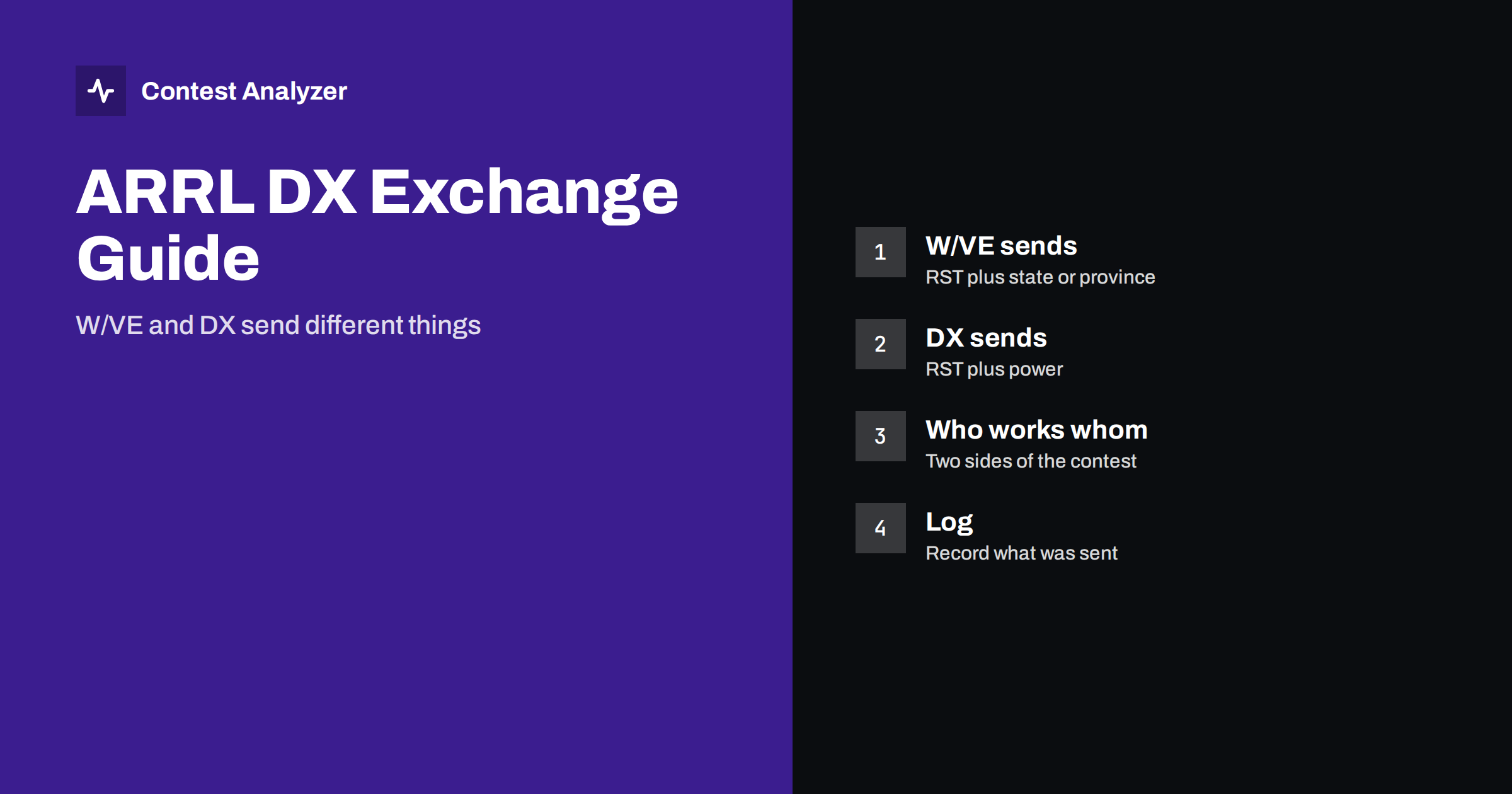
Short answer: The ARRL International DX Contest is a two-sided contest. Stations in the United States and Canada (W/VE) work stations outside that area (DX), and the two sides send different exchanges. W/VE stations send a signal report plus their state or province; DX stations send a signal report plus their transmitter power. Log what you receive exactly, and check the current rules for categories, power classes and dates.
A contest with two sides
Most worldwide contests let everyone work everyone. The ARRL International DX Contest, organised by the ARRL, is different. It is built around contacts between W/VE stations and the rest of the world. In general terms, a W/VE station works DX stations, and a DX station works W/VE stations. Contacts between two W/VE stations, or between two DX stations, are not what the contest is about, so they do not give the points a W/VE-to-DX contact does. The exact definition of who counts as W/VE and who as DX, including how territories and special areas are treated, is in the official rules.
This structure shapes everything: the way you call CQ, the exchange you send, the multipliers you chase and the way your log is read. If you operate from Europe, your whole contest is about calling and answering W and VE stations. If you operate from the United States or Canada, you spend the weekend working DX.
The exchange on each side
The exchange has two parts on both sides, and the second part is the one that differs.
| You are | You send | You receive |
|---|---|---|
| W/VE station | RS(T) report plus your state or province | RS(T) report plus the DX station’s power |
| DX station | RS(T) report plus your power | RS(T) report plus the W/VE station’s state or province |
On CW the report is RST and on SSB it is RS. W/VE stations use the abbreviation of their state or province. The DX side sends a number that represents the transmitter power in use. How the power value must be given, and what is allowed for reduced-power classes, is set by the rules, so read the current text on the ARRL DX contest page rather than relying on memory.
A practical point: many W/VE operators have a quick habit of sending the state in a short form, and a DX operator hears it hundreds of times. Over a weekend the state abbreviations become familiar. The power value is trickier for beginners, because it is a number that is not a serial and does not change from one QSO to the next for the same station. If you hear it change, that may be a power change by the operator, or it may be an error in your copy.
Multipliers on each side
The multipliers also differ, in line with the two-sided design. In general, W/VE stations are interested in the countries they can work from the DX side, while DX stations look for the states and provinces they still need. In both cases multipliers are usually counted per band, which makes it worth moving across the bands whenever the rate allows. The exact list of what counts, and any special handling for particular areas, comes from the rules of the year.
For a DX station this means that an additional band is not just an additional place to make QSOs. It is also a fresh set of states and provinces to work. A station with a good signal on all bands tends to build a large multiplier total through persistence rather than through any single big opening.
Logging the exchange
The exchange is short, but a few details cause a large share of the errors.
- Log the state or province as it was sent. If a station uses an unusual abbreviation, do not replace it with the one you expect. Ask for a repeat if it is not clear.
- Distinguish similar abbreviations. Several U.S. state and Canadian province abbreviations sound alike on a weak SSB signal. A short confirmation back to the other station is cheaper than a lost multiplier.
- Do not guess the state from the call. The call area gives a hint, but operators move, use club or portable calls and keep calls from older addresses. Log what you hear.
- Copy the power as a number. On the DX side, set up your logger so that the power field accepts exactly what the other station sends, and watch for fields that are formatted for a different contest.
- Set up your own exchange first. If you are on the DX side, enter your power in the contest setup, and if you are W/VE, enter your state or province, before the first QSO. A wrong default is repeated in every line of the log.
Our article about the Cabrillo header shows where the category and power class you choose appear in your file. A mismatch between the header and what you did on the air is one of the simplest things for the organisers to notice.
Running and answering
With a one-sided structure, your behaviour on the air should be adapted to it. A DX station running a frequency answers W/VE callers and does not need to listen for other DX stations. A W/VE station running can almost ignore calls from nearby W/VE stations. In busy hours this keeps the exchange fast, because you only need to copy a call and the one item that differs.
When you search and pounce, listen first. Hearing the exchange of the station you want to work, as it is given to someone else, gives you a good idea of the format before you call. It also tells you whether your callsign is on the right side of the contest for that particular QSO. If you are not sure whether a station is W/VE or DX, for example because of a territory or an unusual call, the rules decide, not the prefix on the display of your program.
Common mistakes in ARRL DX logs
- Wrong power class in the header. The class you enter must match what you used. If the transmitted power value is part of the exchange, your claimed class and the numbers you sent should agree.
- Exchange from another contest. Loggers remember settings from the previous contest. A zone or a serial number left from another event is a mistake that repeats in every QSO.
- A busted callsign. As in every contest, a call with a wrong letter removes the QSO and may remove the multiplier. See our guide to busted callsigns.
- Wrong state or province. This is a typical cause of lost multipliers on the DX side.
- Unclear category choice. If you are not sure which category fits your station, read the current rules before the contest, not after it.
Planning a weekend
The contest is held on two separate weekends, one for CW and one for SSB, so the same plan has to be adapted to the mode. Check the dates and the duration in the current rules. Good preparation is mostly simple: update the software, test your Cabrillo export with a few dummy QSOs, choose your category honestly and decide in advance where your breaks will be. If you are on the DX side, think about which bands give you the best path to North America at which hours. If you are W/VE, think about which direction your antennas can cover best at each time.
The statistics from your last ARRL DX entry are the best planning tool. They show when you made your best hours and on which bands, how your QSOs split by continent, and where the long gaps were. Comparing two or more years makes patterns visible; our article on comparing contest results year on year explains what to look at.
Checking the log before you send it
Because the exchange is short, a log can look clean at first glance. Take a few minutes for a final review: read the header, check the band and time range, look at the odd callsigns, and scan the state and province column for anything that is not a valid abbreviation. Contest Analyzer reads the Cabrillo from N1MM Logger+, DXLog or Win-Test, checks every callsign and every zone against official license databases and several independent reference sources, and shows only the few QSOs worth a second look. It also gives full statistics: rates, QSOs by hour and band, countries, continents, CQ and ITU zones, WPX prefixes, distance, beam heading, breaks and off time, and callsign length and structure. You can edit calls in the report and download a corrected Cabrillo. Dupes are not treated as errors. See the contests page for the list of 22 supported contests.
Related reading
- Cabrillo log header explained
- Check your contest log before you submit
- Compare contest results year on year
The bottom line
The ARRL DX contest is about W/VE stations and DX stations working each other, with a state or province on one side and power on the other. Set your own exchange first, copy the other side’s part exactly, choose your category honestly and review the log before you send it. Anything that depends on a date, a class or a definition should be confirmed in the current official rules.
FAQ
What does a DX station send in the ARRL DX Contest?
A signal report plus its transmitter power. The exact way the power must be expressed is in the current rules.
What does a W/VE station send?
A signal report plus its state or province.
Can two W/VE stations work each other?
The contest is built around W/VE-to-DX contacts. Check the rules for how other contacts are treated before you count on them.
Should I guess the state from the callsign?
No. Operators move and use portable or club calls. Log what the other station sends, and ask for a repeat when needed.
Does Contest Analyzer support the ARRL DX Contest?
Check the list of supported contests on the contests page. It covers 22 contests and works with Cabrillo from N1MM Logger+, DXLog and Win-Test.