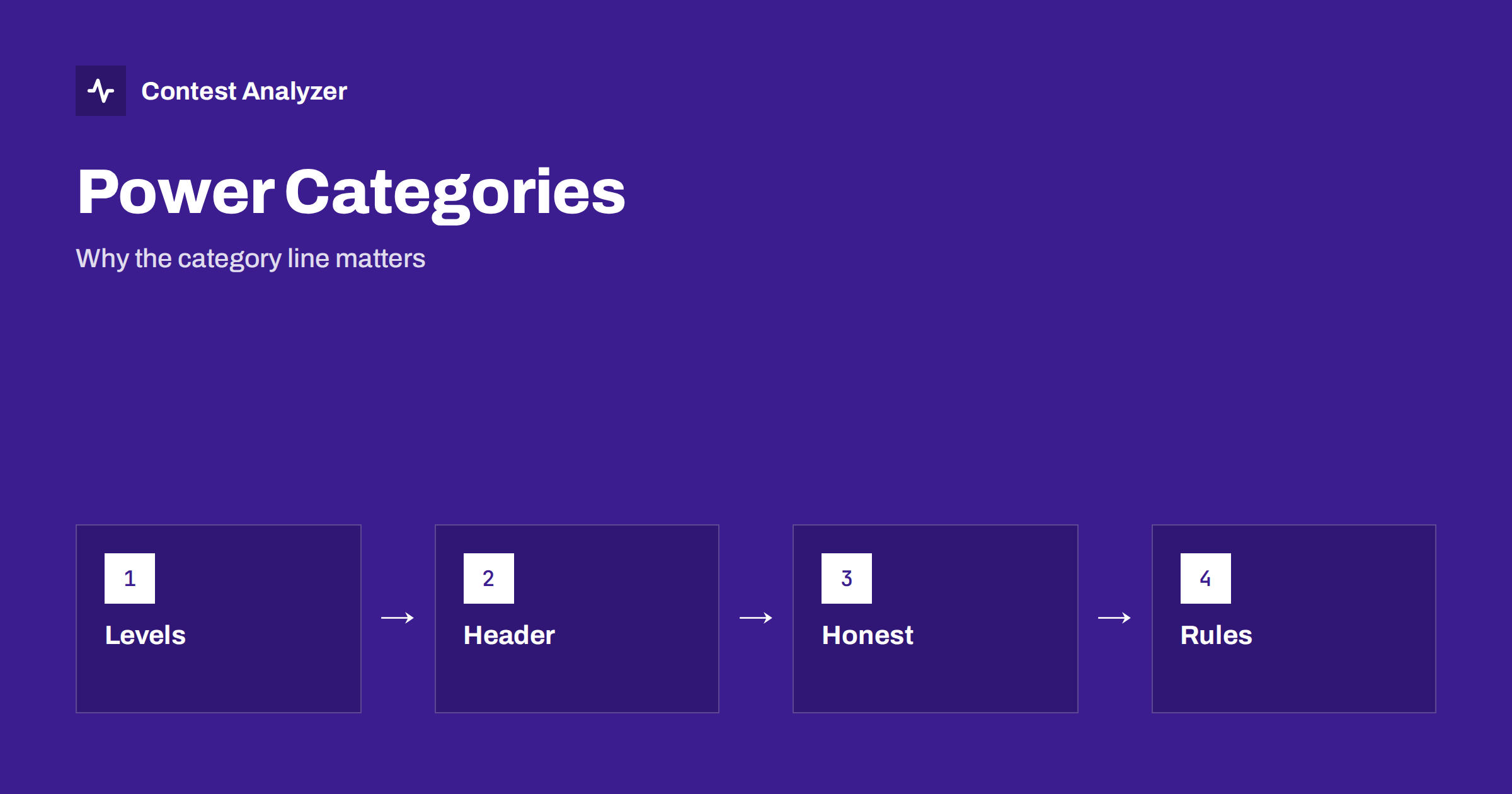
Short answer: Most HF contests offer power categories, such as high power, low power and QRP, and each one has a limit that is defined in the current rules. The category line in your Cabrillo header declares which one you entered, and your result is compared with others in that group. The right choice is the one that matches how you really operated for the whole contest, and the limits and the way of measuring power must be read from the official rules.
What power categories are for
Power categories exist to make a fair comparison. A station with a large amplifier has an advantage over a station with a small one, and the contest puts them in separate groups so that each can be compared with similar stations. The most common groups are high power, low power and QRP, although the names and the limits depend on the contest. Some contests have only two, and some add a third level or a separate category for very low power. Always check the current rules, since the numbers can change.
The idea is simple, but the details are not. The rules say how power is measured, for example at the output of the transmitter or at the antenna connector, and whether the limit applies to the whole contest or to each band. Many contesters know the main numbers, but not the details, and details are where mistakes happen. The article on QRP and low power categories gives a first overview of the lower groups.
The category line in the Cabrillo header
In the Cabrillo header, the category of power is a line of its own, usually with a few allowed values such as HIGH, LOW or QRP. The value that you write there places your log in the corresponding group in the results. It is one line in a file with many, and it has a big effect: a wrong value can place your log in a group in which it should not be, or can lead to a reclassification by the organisers. See the Cabrillo header guide and common Cabrillo header mistakes.
The logger usually writes the category from the settings you made at the start of the contest. If you changed the power during the contest, check whether the setting reflects the whole contest or only the last period. If you are not sure that the logger wrote the right value, open the file and read the line before you submit.
Why honesty matters
A category is a declaration. When you choose it, you tell the organisers and the other participants how you operated. The contest community depends on trust in these declarations, because the organisers cannot measure the power of every station. A station that declares low power and runs high power gains an unfair advantage over everyone else in the group, and it harms the contest for all.
The principle is simple: declare what you really did. If you are not sure whether your station fits a category, choose the one that is clearly correct, or ask the organisers. Do not rely on the hope that no one will notice. Reputation in the contest community lasts for years, and a clean record is worth more than a place in a smaller group.
Common doubts
- Power changed during the contest: if you ran low power for part of the time and high power for the rest, the whole entry normally belongs in the higher category. Read the rules for how they treat this.
- Power measured at which point: the transmitter output, the amplifier output or after feed line losses. The rules define it.
- Remote stations: the limit applies to the remote transmitter in the usual interpretation, but check the current rules for remote operation.
- Multi-operator entries: the power category is part of the entry for the whole station, and the rules say how it combines with the other category lines.
- Mixed power by band: some contests allow a single level for the whole contest only, and some have separate rules for each band.
When in doubt, read the official rules, and if they are not clear, write to the organisers before the contest. A short email costs nothing and can save your entry.
Power and the other category lines
The power line is only one of several that define your category. The others describe the operator type, the band set, the mode and the assistance. Together they form the full entry, and the results are produced for each combination. A mismatch between lines is a typical mistake: for example, a single-band entry with a list of several bands, or an assisted category that does not fit the equipment that was used. The articles on assisted versus unassisted categories and category overlays such as classic and rookie explain how these lines interact.
If you operate with low power, check also whether an overlay category offers a separate comparison. Some contests have separate lists for new operators, for classic equipment or for specific regions. These are described in the rules, and many of them depend on a line in the header.
How the category affects your statistics
The category you choose affects what you should expect of your result and of your statistics. A low-power station has a lower rate and fewer long-distance QSOs than a high-power one, and the statistics show this in the distribution of QSOs by band, by continent and by distance. If you compare yourself with a higher group, you may draw wrong conclusions. The article on choosing your contest category from your own statistics describes how to use the numbers to decide which category fits you next year.
Contest Analyzer gives full statistics, including rates, QSOs by hour and band, countries, continents, CQ and ITU zones, distance and beam heading, and year-on-year comparison with your own logs. This allows you to compare yourself with your own earlier results in the same category, which is the fairest comparison. It also checks every callsign and every zone against official license databases and several independent reference sources and shows only the few QSOs worth a second look. It works with Cabrillo from N1MM Logger+, DXLog and Win-Test, and the contests page lists the supported contests. The tool does not decide your category, and it is your own declaration.
Checking the category before you submit
Before submitting, open the Cabrillo file and read all the category lines. Ask yourself: is each line true for the whole contest? Does the power line match the equipment that I used at every hour? Does the list of bands match the QSOs in the log? If the answer to any of these is no, correct the line or the log. The article on checking your contest log before you submit gives a full list.
If you find a mistake after the log has been submitted, contact the organisers, explain what happened and ask what to do. Most committees prefer an honest correction to an entry that is wrong, and they have processes for it.
Documenting your station
If you are close to a limit, keep evidence. Note the power setting on the transmitter and the amplifier at the start of the contest and whenever you change them, together with the time. If a question arises later, a short log of settings is much more convincing than a memory of what you did. Some contesters take a photo of the front panel of the equipment at the start, which takes a few seconds and can be very useful.
It also helps to think about the test of your own system. Many stations have a power meter that is not very accurate at low levels, and a reading that looks like the limit may be off by some margin. If you are near the limit and want to be sure, check the meter against another instrument or keep a safe margin below the limit. Contest categories are meant to be clear, and it is not worth operating on the edge of one for a small gain.
When you plan the next contest, decide on the category in advance and write it in your plan together with the equipment that fits. Changing the category at the last minute because the conditions look good is a typical source of mistakes in the header, and it is better to decide calmly a week before than in a hurry on the evening of the start.
Talking to other contesters
If you are new to contesting, ask more experienced operators how they decide on a category. Most are glad to explain, and many have faced the same doubts about power, equipment and assistance. Clubs and online groups are a good place for such questions. Ask before the contest and not after, and bring the exact text of the rule that you are unsure about, because a precise question gets a precise answer.
Remember, too, that the final word belongs to the organisers. Advice from friends is useful, but the rules and the contest committee decide, and the committee will answer a clear question sent in good time.
Related reading
The bottom line
Pick the power category that matches how you really operated, write it correctly in the header and check the limits and the way of measuring in the current official rules.
FAQ
Are the power limits the same in every contest?
No. The names and the limits depend on the contest, so read the current rules.
What if I changed power during the contest?
Check the rules. Often the whole entry belongs in the higher category.
Can I change the category after submitting?
Contact the organisers. Many accept an honest correction.
Does the logger set the category automatically?
It writes what you set at the start. Read the header line before you submit.
Is the power category checked by the organisers?
They rely mainly on the declaration, which is why honesty matters.