Short answer: Many contests limit how many hours a single operator may operate, and they count only longer pauses as off time. In CQ WW DX, single-operator off time counts only for breaks of at least 60 minutes, so a 45-minute nap is still operating time. Check the current rules for your category, plan breaks that are clearly long enough, and look at the gaps in your own log afterwards.
Why contests count off time at all
A 48-hour contest invites an obvious question: how do you compare a station that operated all night with one that slept? Rules answer this by dividing the contest into operating time and off time, and some categories limit the total operating time. A single operator who is allowed a fixed number of operating hours has to decide when to rest, and this makes the contest as much about strategy as about stamina. Multi-operator stations usually have no such limits, because the team can keep going in shifts, but they have their own rules on categories and on who may operate.
The details are rule-specific. They change between contests, between categories, and sometimes from year to year. In this article we use the CQ WW DX rule as a worked example, because it is the one most contesters know, and keep everything else general. For the exact text, read the official CQ WW rules.
The CQ WW rule: only breaks of 60 minutes or more
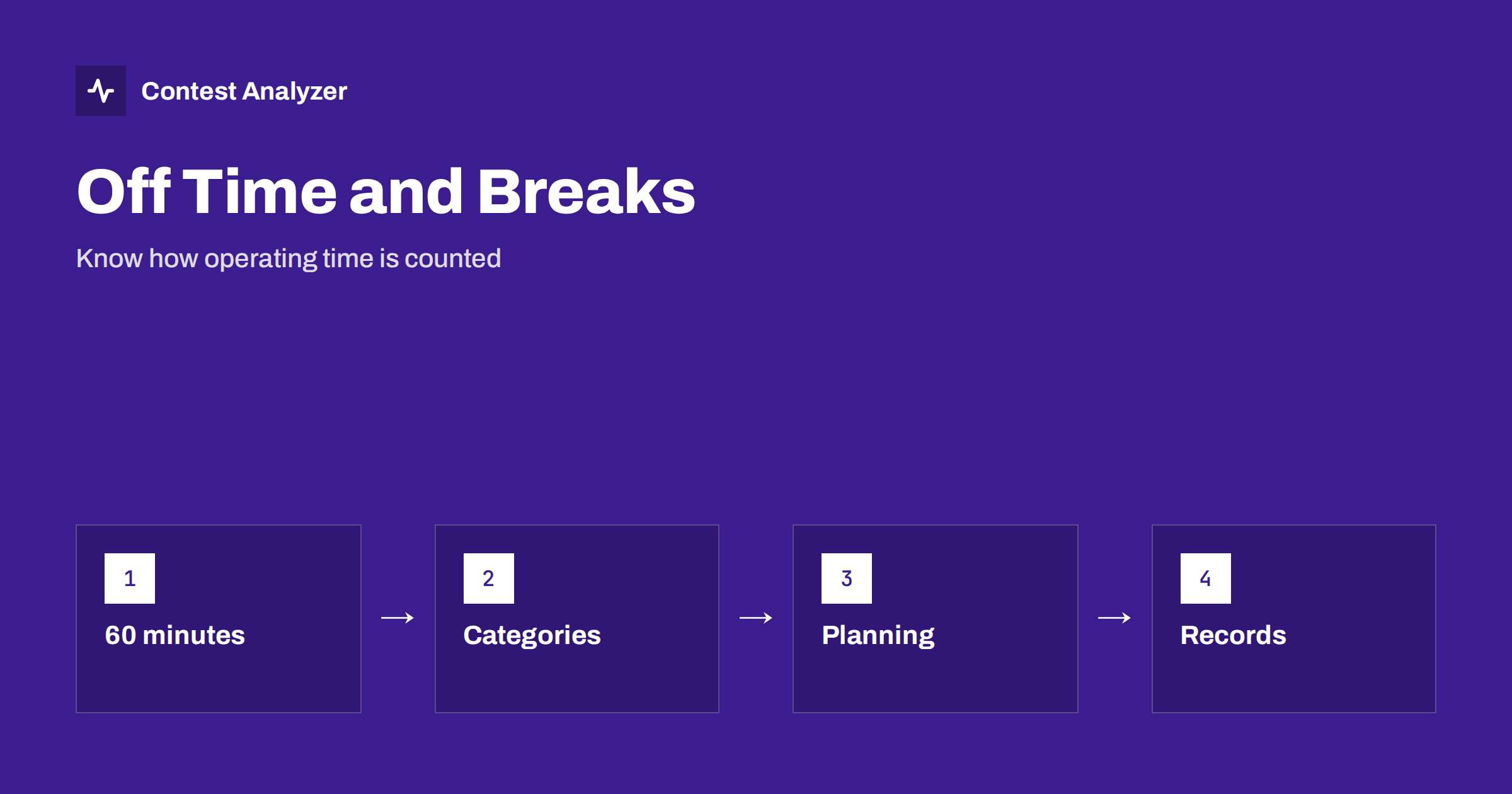
In CQ WW, single-operator categories have a limit on the hours you may operate. The key point for planning is how off time is counted: a break counts as off time only if it lasts at least 60 minutes. A pause shorter than that is treated as operating time. In practice this means:
- a 90-minute rest is off time;
- a 60-minute rest is off time, but with no safety margin;
- a 50-minute rest, however sensible, counts as operating time and does not reduce your total.
Several short breaks therefore do not add up to off time, no matter how many you take. If you plan to rest, plan a few proper breaks rather than many small ones, and make each clearly longer than the minimum. Confirm the numbers, including the total hours allowed in your category, in the current rules.
How the time is worked out
The rules refer to time in the contest. When your log is checked, operating and off periods are generally worked out from the times of your QSOs: the gaps between consecutive contacts show when you were not operating. A long gap in the log is therefore treated as a break. This has two consequences you should keep in mind.
- The log is the evidence. You cannot claim a break the log does not show, and you cannot hide one that it does. If you left the radio for an hour and then logged a quick contact, the clock restarts at that contact.
- Time accuracy matters. If the PC clock was off by several minutes, your gaps shift. A break that was 62 minutes by your watch could appear shorter in the log. Keep the computer synchronized and on UTC.
This is also why it is wise to avoid a “last QSO” just before you stop, and a “first QSO” immediately when you return, if they sit awkwardly close to the 60-minute boundary. Give yourself a margin of five to ten minutes on each side.
What it means for your category
Off time is not just a counter. It ties into the category you enter. If a category limits operating time and your log shows more than the limit, the entry may be reclassified or treated differently from what you intended, depending on the contest rules. That is a poor reward for a weekend of work. When you decide on a category, make sure your plan fits its limits, not only your intention.
Two practical points follow:
- if you are unsure, read the category definition in the rules, not a forum summary;
- keep your own record of your break times during the contest, so that you can compare it with the log afterwards.
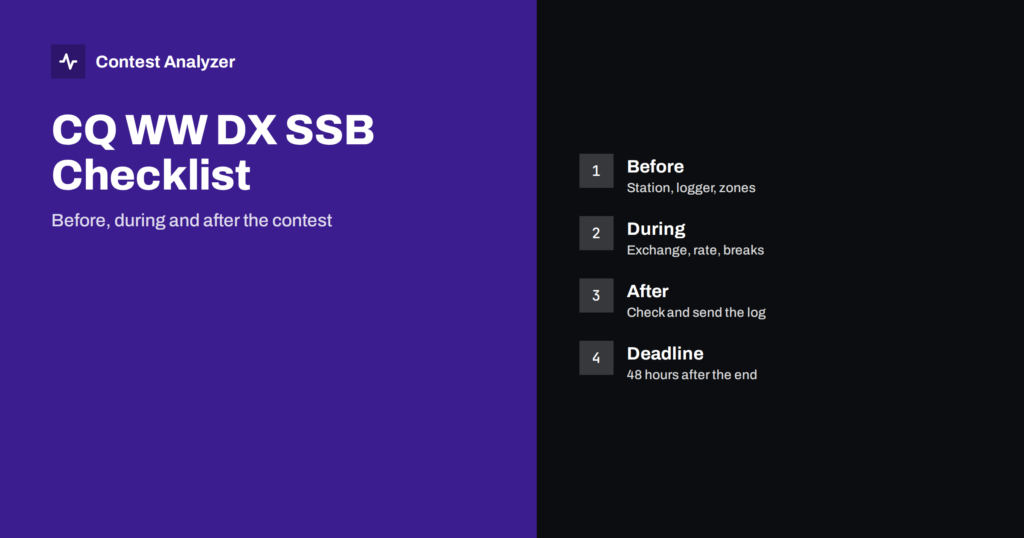
Our CQ WW DX SSB checklist includes the break planning in its before-the-contest steps.
Planning your breaks
The aim is to give up as few QSOs and multipliers as possible for each hour of rest. Some principles that work for many operators:
- Rest when your rate is naturally low. Look at an earlier log from the same contest: which hours were weakest? Those are the candidates for off time. Our article on contest rates explains how to read that picture.
- Do not rest in the prime openings. If your best band opens to the right area at a known hour, be at the radio.
- Make the break long enough. Aim for 75 to 90 minutes if you can, not 60. You gain the full benefit and have a margin.
- Take the longest rest when you are most tired, not when you feel strong. Rest earlier than you think you need to, because errors rise as fatigue builds.
- Write the plan down. A simple table of time, band and planned rest is enough.
- Keep the schedule flexible. If the band is unexpectedly good, you can delay a break, but do not drop it altogether.
Notice that a break also affects what happens when you return: the first few minutes after a pause tend to be slow. You need to find a clear frequency, and the stations you want may have moved. Take that into account when you plan, and use the first minutes back for a quick search for multipliers rather than a run.
An example break plan
The following is only an illustration of the thinking, not a recommendation for any particular contest or category. Suppose that, from your location, your earlier logs show weak rates in the early hours of the first night and in the middle of the second day. A plan might be:
- One long rest of around 90 minutes in the early hours of the first night, when the high bands are closed and the low bands are crowded and noisy.
- One shorter, but still clearly longer than the minimum, rest of 70 to 75 minutes in the middle of the second day, between the morning and evening openings.
- A reserve rest, to be used only if you notice that fatigue is causing copying errors.
Write the planned times next to the openings you expect. During the contest, compare reality with the plan every few hours. If the band is better than expected, delay the rest; if the rate has collapsed, bring it forward. The plan is a tool, and its value is that you made the decision calmly, before you were tired.
Finally, remember that rules are written for fairness among stations that all face the same limits. Respecting them, and keeping an honest log, is part of the sport.
Off time in your statistics
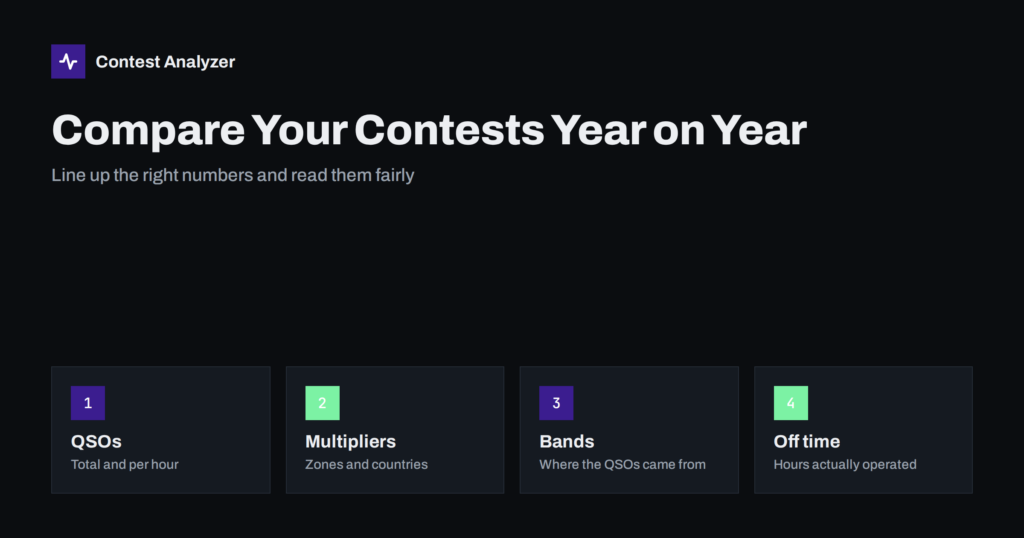
After the contest, your breaks and off time are among the most informative numbers. They tell you how many hours you really operated, which is the basis for any fair comparison of your rates. A rate of 70 QSOs per operating hour means something different when the operating time was 26 hours than when it was 36. When you compare years, use the same way of measuring off time in both. The article on comparing results year on year covers this.
Contest Analyzer includes breaks and off time in its statistics, along with rates, QSOs by hour and band, countries, continents, CQ and ITU zones, WPX prefixes, distance, beam heading and callsign length and structure, and it lets you compare with your own earlier logs. You can see how the pauses in your log line up with the dips in your rate.
Common mistakes with breaks
- Counting short naps as off time. Sleep of 40 minutes is a good idea for your health, but not for your off-time total under a 60-minute rule.
- Taking the whole rest in one block at the wrong time. A single long break during a prime opening is expensive.
- Forgetting to log properly after a break. If you restart without checking the clock or the logger’s band and mode, errors follow.
- Assuming every contest works like CQ WW. Some contests use different minimum lengths and different limits. Always read the rules of the contest you enter.
- Ignoring the evidence in the log. If you planned an 8-hour rest but the log shows only 6 hours of gaps of 60 minutes or more, the difference counts as operating time.
Related reading
- CQ WW DX SSB checklist
- Contest rates: reading and improving QSOs per hour
- How to compare your contest results year on year
The bottom line
Off time is a rule, a plan and a statistic at the same time. Learn how your contest counts it, schedule a few real breaks with a safe margin, rest in your weakest hours, and then check the gaps in your log. Doing that protects your category and also makes your year-on-year comparisons honest.
FAQ
Does a 30-minute break count as off time in CQ WW?
No. For single operators only breaks of at least 60 minutes count as off time, so a 30-minute pause is operating time.
Can I add several short breaks to reach the required off time?
No. Each break is judged on its own, so short ones do not add up. Check the current rules for your category and contest.
How is off time calculated from my log?
Generally from the gaps between QSO times in your log. This is why a correct clock and an accurate log matter.
Do the same limits apply to multi-operator stations?
Usually the operating-time limits are aimed at single-operator categories, but check the rules for your multi-operator class, as they differ.
Where can I see my breaks after the contest?
In Contest Analyzer, the statistics for your Cabrillo include breaks and off time, so you can compare your plan with what the log shows.