Short answer: The Contest Analyzer FAQ answers “Is my log private?” with: Yes. Your log and your callsign are never shown to other users. That is the whole statement on the live pages, and this article does not add to it. What it does is to explain what a contest log contains, why privacy matters to contesters, what you can still decide for yourself when you share results, and which habits keep your data tidy, whatever service you use.
What the FAQ says
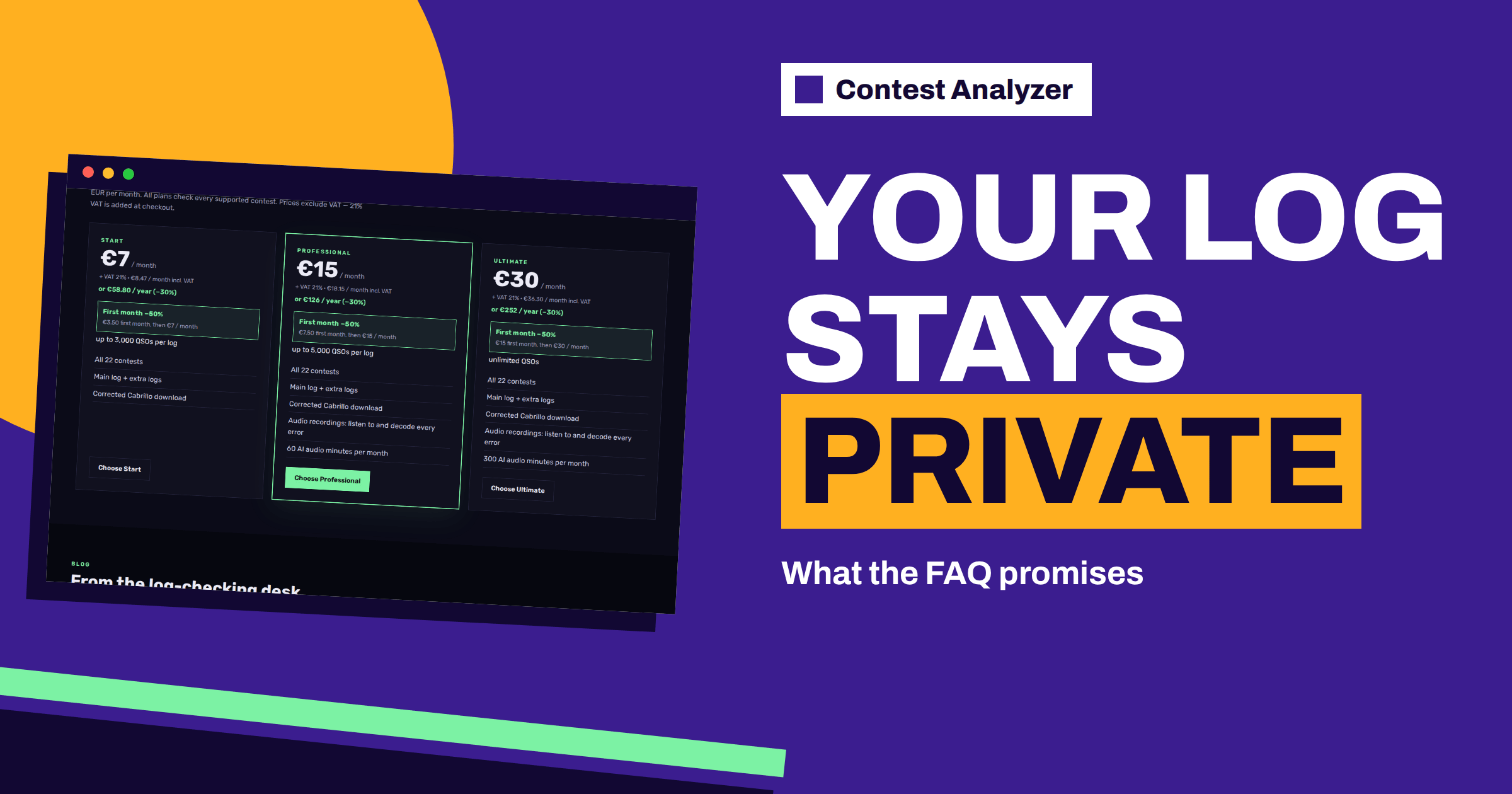
The FAQ lists a handful of questions that operators ask, and one of them is “Is my log private?” The answer is short and clear: yes, and your log and your callsign are never shown to other users. A related answer, to the question “Why must my callsign be verified?”, says that a log can be checked only for a callsign in your account that is verified, so accounts are not shared. Taken together they describe a personal workspace: your account, your verified callsign, your logs and your reports.
The site footer lists a Privacy Policy and Terms of Service for readers who want the legal detail, and the contacts page gives an address for questions. This article is not a legal text and makes no promise beyond what the site says. If a question concerns the handling of your data in a particular case, ask there.
What a contest log contains
To see why privacy matters, look at the file. A Cabrillo log contains your callsign, the contest, your category and station details, and often your name, address, email and the names or callsigns of the operators in the header. Each QSO line shows the frequency or band, the mode, the date and time in UTC, your callsign, the other station’s callsign and the exchange. Taken together, the lines show when you operated, on which bands, how fast and with whom. That is a detailed picture of your contest.
Many contesters do not mind sharing it, and some contests publish logs as part of the results. But sharing should be a decision, not an accident. The article on the Cabrillo header shows what the header fields hold, and it is worth knowing before you send a file anywhere.
Why privacy matters to contesters
There are several reasons. First, competition: your hourly pattern and your multipliers show your strategy, and some contesters prefer not to show it before the results are out. Second, personal information: the header may contain a home address, and the QSO lines show when you were at the radio. Third, errors: a log that contains mistakes is something most people want to fix before anybody else sees it. A private check allows you to clean the log first.
The last point is important. A service that checks logs is useful partly because it is a safe place to find and correct your mistakes. If the report were visible to others, you might hesitate to upload a rough log. Knowing that it is private encourages you to use the check before submission, when fixing is still possible. The article on checking your log before you submit explains the routine.
Teams and clubs: private does not mean isolated
The home page says that team and club members can add their logs to the same contest. The FAQ says that your log and your callsign are never shown to other users. These two statements do not contradict each other: members of a team can each work on the same contest, and nobody’s log is displayed to the others by the service. If a club wants to compare results, each member decides what to share, for example a few numbers or a screenshot of a chart.
The article on club and team logs describes a routine for a club check that respects this. A good rule is to ask the owner before showing anybody’s full report, and to share numbers freely. A club that respects privacy builds trust, and trust makes members more willing to share their lessons.
What you control
Even in a private service, you remain in control of what you share outside it. A screenshot of a report can show your callsign, times and QSOs. Think before you post it in a forum or a social network: crop out what you do not want to show, or share only the statistics. The corrected Cabrillo file that you download is yours; when you send it to the contest organiser you follow the rules of the contest, and you decide whether to share it with others.
Keep your account details to yourself, as for any online service. The fact that accounts are not shared is part of the design, and the verification of the callsign is meant to keep it so. See why your callsign is verified for more.
A practical example is a forum question. When you ask for help with a strange row in your log, a short text is usually enough: “A call logged as such-and-such at 02:15 UTC on 40 metres, suffix doubtful, how would you handle it?” You do not need to post the whole report. Others can give advice without seeing your callsign or the whole log, and you keep the context to yourself. The same applies to a question to a club mate: describe the problem, not the entire file.
It is also worth remembering that audio recordings are part of the private material. A recording of your contest contains the voices and signals of many stations, and, in phone contests, your own voice. Keep it in your own folder, and share short clips only when you have a reason and the other person agrees.
Good habits for any log
- Check the header before you send a file anywhere: do you want your address and email in it?
- Keep the original Cabrillo file and the corrected file in a folder only you can open.
- Back up your logs to a place you control, and not only to a shared drive.
- Share numbers and lessons freely, and screenshots with care.
- When helping a friend, work on his or her screen and let the friend decide what to share.
The last point is covered in helping a friend check a contest log. In short, the log belongs to the operator, and so does the decision to show it.
Public logs and the contest organiser
Some contest organisers publish submitted logs after the contest. When you submit a log to an organiser, you follow the rules of that organiser, and these rules may include the publication of the log. This is separate from a private check before submission. Read the current rules of your contest to see what happens to your log after you submit it, and decide accordingly. The article on log checking reports describes what some organisers send back to entrants.
Since the submission is the point at which your log becomes part of the contest, the private check before it is the best time to fix everything: callsigns, zones, time and frequency. Contest Analyzer checks every callsign and every zone against official license databases and several independent reference sources and shows only the few QSOs worth a second look. You can then download a corrected Cabrillo file ready to submit, and the contests page lists the deadline of each supported contest.
Privacy and learning from your own mistakes
A private report has another benefit that is easy to overlook. It is a safe place to look at your own weaknesses. Most operators have a few habits that cause errors: a tendency to confuse certain letters, a habit of accepting prefilled calls or a slowdown at night. Seeing these patterns in a report that nobody else sees makes it easier to admit them and to work on them. If the report were public, the temptation to hide the problem would be stronger.
Use the privacy to be honest. Mark the QSOs that you are unsure about, write notes about the causes and keep a list of the lessons. After a few contests, the list becomes a personal training plan, as in the article on CW copying accuracy, and you can measure your progress with the year-on-year comparison of your own logs. Nobody needs to see the first drafts of your improvement. When you are ready, you can share the results.
Questions to ask any service
Privacy is worth asking about wherever you upload a log. Who can see it? Is it public, or limited to my account? Can I remove it? How is my callsign handled? For Contest Analyzer, the FAQ answers the first question, and the footer links to the policy for the rest. If you are not sure, write to the contacts page before you upload. A short, clear answer is better than an assumption.
Related reading
- Keeping Your Analysed Logs in One Place
- Submitting Your Cabrillo Log: Upload and Email
- Your Post-Contest Review Routine: What to Check
The bottom line
The FAQ is clear: your log and your callsign are never shown to other users. Use that to check and fix your log in peace before you submit it, share lessons and numbers freely with friends and clubs, and think before you publish screenshots. For anything beyond the FAQ, ask through the contacts page.
FAQ
O meu log é privado?
Yes. The FAQ says that your log and your callsign are never shown to other users.
Can team members see each other’s logs?
The service does not show your log to other users. Team and club members can add their logs to the same contest, and each decides what to share.
Does a private check mean the organiser will not see my log?
No. When you submit the log to an organiser, its rules apply. The check is a separate, earlier step.
Where can I ask about data handling?
Use the contacts page, and see the Privacy Policy linked in the site footer.